A legal brief citing fake court cases cost a law firm ,000 in sanctions when their AI confidently invented three non-existent judicial decisions that seemed perfectly legitimate. AI hallucination isn’t a bug—it’s how these systems are designed to work, filling knowledge gaps with plausible-sounding fiction that can destroy credibility and careers. Every professional using AI tools faces this invisible threat that strikes even the most sophisticated models.
AI hallucination is one of the most important concepts to understand before trusting any AI tool with important work. Whether you’re using ChatGPT
we’ll explain what AI hallucinations are, why they happen, real-world examples, and most importantly—how to detect and prevent them.
Quick Summary
| Aspect | Details |
|---|---|
| Definition | AI-generated content that is false, fabricated, or not supported by training data |
| Also Called | Confabulation, AI fabrication, AI errors |
| Frequency | 0.7% to 30% depending on the model |
| Most Reliable Model (2026) | Google Gemini-2.0-Flash-001 (0.7% rate) |
| Highest Risk Areas | Legal citations, medical advice, statistics |
| Best Prevention | RAG (Retrieval-Augmented Generation), fact-checking |
Table of Contents
- What is AI Hallucination?
- Why Do AI Models Hallucinate?
- Real-World Examples
- Which AI Models Hallucinate Most?
- Types of AI Hallucinations
- High-Risk Use Cases
- How to Detect AI Hallucinations
- How to Prevent AI Hallucinations
- FAQs
- Final Thoughts
What is AI Hallucination?
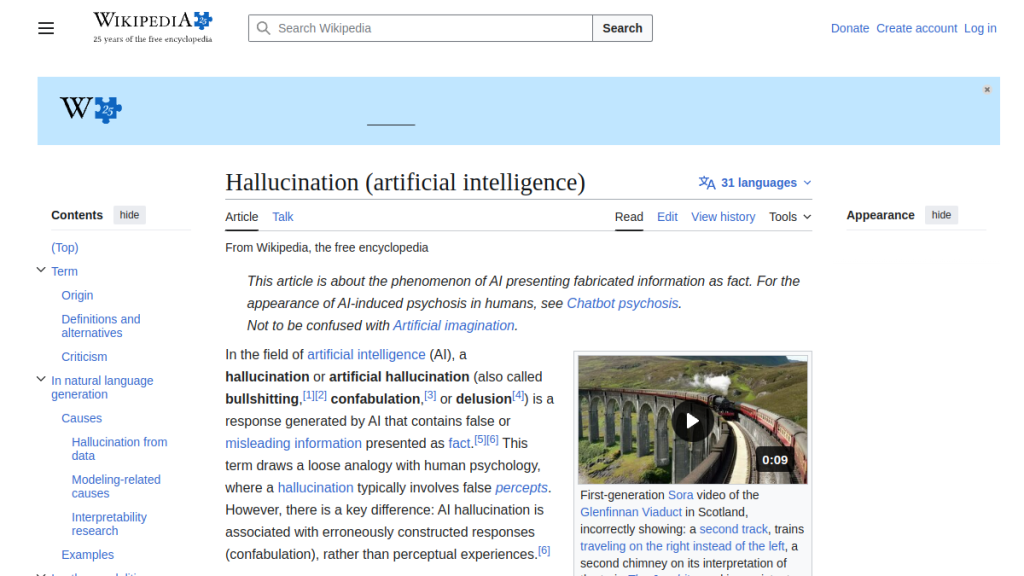
AI hallucination occurs when a generative AI model produces content that is incorrect, misleading, fabricated, or not grounded in its training data—while presenting it with complete confidence.
The term “hallucination” comes from the way these AI systems generate plausible-sounding but fictional information, similar to how a person experiencing hallucinations sees things that aren’t there.
Key Characteristics of AI Hallucinations:
- Confident delivery: The AI presents false information as if it’s certain
- Plausible appearance: The fabricated content sounds reasonable and well-structured
- Not intentional: The AI isn’t “lying”—it’s a limitation of how these models work
- Hard to detect: Without fact-checking, hallucinations can slip through unnoticed
Simple Example:
You ask: “Who wrote the book ‘The Silicon Mind’ published in 2019?”
AI responds: “The Silicon Mind was written by Dr. Sarah Chen, a professor at Stanford University, and explores the intersection of neuroscience and artificial intelligence.”
Reality: This book, author, and details may be completely fabricated. The AI generated a plausible-sounding answer rather than admitting it doesn’t know.
Why Do AI Models Hallucinate?
Understanding why AI hallucinations happen helps you better anticipate and prevent them. There are several root causes:
1. Training Data Limitations
Large Language Models (LLMs) are trained on massive datasets from the internet. But this data has gaps, contradictions, and inaccuracies. When asked about topics with sparse or conflicting training data, the model may “fill in the blanks” incorrectly.
2. Pattern Completion vs. Understanding
LLMs don’t truly “understand” information—they predict the most likely next words based on patterns. This means they’re optimized to sound coherent, not to be factually accurate. A grammatically perfect sentence can be completely false.
3. Lack of Real-Time Knowledge
Most AI models have a knowledge cutoff date. When asked about recent events or changes (new product pricing, recent news, etc.), they may generate outdated or fabricated information rather than admitting ignorance.
4. Overconfidence by Design
AI assistants are designed to be helpful. This creates a bias toward providing some answer rather than saying “I don’t know.” The model would rather confidently guess than appear unhelpful.
5. Compounding Errors in Long Outputs
In longer content generation, small errors early in the response can compound. The AI builds subsequent content on top of earlier statements, even if those statements were hallucinated.
6. Model Size Matters
Research shows a clear correlation between model size and hallucination rates:
| Model Size | Average Hallucination Rate |
|---|---|
| Under 7B parameters | 15-30% |
| 7B to 70B parameters | 5-15% |
| Over 70B parameters | 1-5% |
Larger models generally have more “knowledge” to draw from and better reasoning capabilities.
Real-World Examples of AI Hallucination
AI hallucinations aren’t just theoretical—they’ve caused real problems across industries.
Legal Citations: The Fake Cases Problem
In 2025 alone, judges worldwide issued hundreds of decisions addressing AI hallucinations in legal filings. Lawyers using AI to research case law discovered their briefs contained citations to cases that simply don’t exist—complete with fabricated case names, dates, and rulings.
One high-profile 2023 case involved a New York attorney who submitted a brief with six fake cases generated by ChatGPT. The AI created convincing-sounding case names, complete with made-up judicial opinions. The attorney was sanctioned when opposing counsel couldn’t find any of the cited cases.
By 2025, approximately 90% of all judicial decisions addressing AI in legal filings related to hallucination issues.
The Geography Test Failure
In March 2025, researchers at the University of Toronto tested 12 leading LLMs with a simple geography question: “Name all countries bordering Mongolia.”
Nine out of twelve models confidently listed Kazakhstan as a bordering country—despite Kazakhstan sharing no border with Mongolia. (Mongolia borders only Russia and China.)
The models didn’t just fail—they failed confidently, often adding fabricated details about the “Kazakhstan-Mongolia border region.”
Medical Misinformation
Healthcare represents one of the highest-risk domains for AI hallucination. AI chatbots have been documented:
- Inventing drug interactions that don’t exist
- Fabricating medical study results
- Creating fictional treatment protocols
- Generating non-existent medication dosages
This is why major health organizations explicitly warn against using AI for medical advice without professional verification.
Fabricated Statistics and Studies
AI models frequently hallucinate statistics, creating convincing-but-fake data points like:
- “According to a 2024 Harvard study…” (study doesn’t exist)
- “Research shows that 73% of users…” (statistic is fabricated)
- “The WHO reports that…” (report is fictional)
These fabricated citations are particularly dangerous because they look authoritative.
Which AI Models Hallucinate Most?
Based on Vectara’s hallucination leaderboard (December 2025), here are the current hallucination rates for leading AI models:
Most Reliable (Under 1% Hallucination Rate)
| Model | Hallucination Rate | Trust Level |
|---|---|---|
| Google Gemini-2.0-Flash-001 | 0.7% | ★★★★★ |
| Google Gemini-2.0-Pro-Exp | 0.8% | ★★★★★ |
| OpenAI o3-mini-high | 0.8% | ★★★★★ |
| Vectara Mockingbird-2-Echo | 0.9% | ★★★★★ |
Very Reliable (1-2% Hallucination Rate)
| Model | Hallucination Rate |
|---|---|
| Google Gemini-2.5-Pro | 1.1% |
| OpenAI GPT-4.5-Preview | 1.2% |
| OpenAI GPT-4o | 1.5% |
| OpenAI GPT-4-Turbo | 1.7% |
| OpenAI GPT-4 | 1.8% |
Moderate Risk (2-5% Hallucination Rate)
| Model | Hallucination Rate |
|---|---|
| OpenAI GPT-4.1 | 2.0% |
| XAI Grok-3-Beta | 2.1% |
| Claude-3.7-Sonnet | 4.4% |
| Meta Llama-4-Maverick | 4.6% |
Higher Risk (5-10% Hallucination Rate)
| Model | Hallucination Rate |
|---|---|
| Llama-3.1-8B-Instruct | 5.4% |
| Llama-2-70B-Chat | 5.9% |
| Google Gemma-2-2B-it | 7.0% |
Very High Risk (Over 10%)
| Model | Hallucination Rate |
|---|---|
| Claude-3-Opus | 10.1% |
| Llama-2-13B-Chat | 10.5% |
| Google Gemma-7B-it | 14.8% |
| Claude-3-sonnet (older) | 16.3% |
| TII Falcon-7B-Instruct | 29.9% |
Key takeaway: Model selection significantly impacts reliability. The best models in 2026 hallucinate less than 1% of the time, while some smaller or older models hallucinate in nearly 1 out of 3 responses.
Types of AI Hallucinations
Not all hallucinations are the same. Understanding the different types helps you spot them:
1. Factual Hallucinations
The AI states something as fact that is demonstrably false:
- Wrong dates, numbers, or statistics
- Misattributed quotes
- Incorrect historical events
Example: “The Eiffel Tower was completed in 1901.” (It was actually 1889)
2. Fabrication Hallucinations
The AI creates entirely fictional entities:
- Non-existent books, papers, or studies
- Fake people or organizations
- Invented products or companies
Example: Citing a study by “Dr. James Wilson at the Institute of Advanced Computing” when neither exists.
3. Logical Hallucinations
The AI makes logically inconsistent statements:
- Contradicting itself within the same response
- Drawing conclusions that don’t follow from premises
- Circular reasoning presented as fact
4. Contextual Hallucinations
The AI misunderstands context and provides irrelevant information:
- Answering a different question than asked
- Confusing similar-sounding concepts
- Mixing up entities with similar names
5. Temporal Hallucinations
The AI confuses timelines or presents outdated information as current:
- Citing a company’s pricing from years ago as current
- Mixing events from different time periods
- Presenting historical information as present-day fact
High-Risk Use Cases
Some applications are especially vulnerable to AI hallucination damage:
⚠️ Very High Risk
| Use Case | Hallucination Risk | Why It’s Dangerous |
|---|---|---|
| Legal research | 6.4% average | Fake citations lead to sanctions, lost cases |
| Medical information | High | Wrong information can cause physical harm |
| Financial advice | High | Fabricated data leads to poor decisions |
| Academic citations | High | Can constitute plagiarism/fraud |
⚠️ Medium Risk
| Use Case | Notes |
|---|---|
| Technical documentation | Incorrect procedures can cause problems |
| Customer support | Wrong answers frustrate customers |
| Coding/debugging | Fabricated functions or APIs |
✅ Lower Risk
| Use Case | Notes |
|---|---|
| Creative writing | Fiction doesn’t require factual accuracy |
| Brainstorming | Ideas don’t need to be verified facts |
| Marketing copy | Can be reviewed before publishing |
How to Detect AI Hallucinations
Develop these habits to catch hallucinations before they cause problems:
1. Verify Specific Claims
Any time the AI provides:
- Names of people, books, or studies
- Statistics or percentages
- Quotes or citations
- Historical facts or dates
Action: Search for these specific claims independently. If you can’t find them elsewhere, they may be fabricated.
2. Check for Overly Specific Details
Hallucinations often include suspiciously specific details that “sound” authoritative:
- “According to a 2024 study by researchers at MIT…”
- “The report found that exactly 73.4% of users…”
Real sources are usually easy to find. Fake ones aren’t.
3. Look for Internal Inconsistencies
Read the full response and check:
- Does the AI contradict itself?
- Do numbers add up correctly?
- Is the logic consistent throughout?
4. Test with Known Facts
If you’re using AI for research in an unfamiliar area, first ask questions you already know the answers to. If the AI gets those wrong, be extra skeptical of answers you can’t verify.
5. Request Sources
Ask the AI: “Can you provide sources for this information?”
If it can’t provide verifiable sources, or the sources it provides don’t exist when you check them, the information is likely hallucinated.
6. Use Multiple AI Models
Cross-check important information across different AI systems. If multiple models give the same answer, it’s more likely correct (though not guaranteed).
How to Prevent AI Hallucinations
For Users: Best Practices
1. Use Retrieval-Augmented Generation (RAG)
RAG is the most effective technique for reducing hallucinations, cutting them by up to 71% when implemented properly. RAG works by:
- Connecting the AI to verified knowledge sources
- Grounding responses in actual documents
- Limiting the AI to information in the retrieved context
Many enterprise AI tools now offer RAG capabilities.
2. Be Specific in Prompts
Vague prompts invite hallucinations. Compare:
❌ “Tell me about marketing strategies”
✅ “List 5 specific B2B email marketing tactics with examples from HubSpot’s published case studies”
The more specific your request, the less room for fabrication.
3. Ask the AI to Acknowledge Uncertainty
Explicitly instruct the AI:
- “If you’re not certain, say so”
- “Only include information you can verify”
- “Say ‘I don’t know’ rather than guessing”
Research shows that simply asking “Are you hallucinating right now?” can reduce hallucination rates by 17% in subsequent responses.
4. Request Step-by-Step Reasoning
Ask the AI to show its work:
- “Explain your reasoning step by step”
- “How did you arrive at this conclusion?”
This makes it easier to spot where logic breaks down.
5. Use the Most Reliable Models
When accuracy matters, use top-tier models:
- For critical work: Gemini-2.0-Pro, GPT-4.5, or GPT-4o
- Avoid older/smaller models for factual tasks
The difference between a 0.7% and 30% hallucination rate is enormous.
For Organizations: Implementation Strategies
- Human-in-the-loop: 76% of enterprises now include human review processes for AI outputs
- Fact-checking workflows: Implement verification steps before publishing AI content
- Model selection policies: Define which models can be used for which tasks
- Training and awareness: Educate team members on hallucination risks
- Monitoring and logging: Track AI outputs to identify patterns and problems
The Future of AI Hallucinations
The good news: hallucination rates are dropping rapidly.
Progress in 2025-2026
- Multiple models now achieve sub-1% hallucination rates—a milestone that seemed impossible just two years ago
- Some models reported up to 64% improvement in hallucination rates year-over-year
- New architectures with built-in verification are emerging
What’s Coming
- Self-verification systems: Models that check their own work before responding
- Better knowledge grounding: Tighter integration with verified knowledge bases
- Uncertainty quantification: Models that express confidence levels with their answers
- Specialized models: Domain-specific AI trained for accuracy in particular fields
However, experts believe hallucinations will never be completely eliminated—they’re a fundamental characteristic of how generative AI works. The goal is to minimize them to acceptable levels for each use case.
FAQs
Is AI hallucination the same as AI lying?
No. Lying implies intentional deception. AI hallucination is an unintentional error—the model isn’t trying to deceive; it’s generating plausible-sounding content based on patterns without understanding truth or falsity.
Can AI hallucinations be completely eliminated?
Likely not entirely. Hallucinations are somewhat inherent to how generative AI models work. However, rates can be reduced dramatically—from 30%+ to under 1%—with better models, techniques like RAG, and proper prompt engineering.
Which AI model hallucinates the least?
As of early 2026, Google’s Gemini-2.0-Flash-001 leads with just a 0.7% hallucination rate, followed closely by Gemini-2.0-Pro-Exp and OpenAI’s o3-mini-high at 0.8%.
How can I tell if AI output is hallucinated?
Verify specific claims (names, dates, statistics, citations) independently. Be especially skeptical of very specific details. Check that sources actually exist. Ask the AI to provide references, then verify them.
Are AI hallucinations dangerous?
They can be, depending on the context. In legal, medical, or financial applications, hallucinated information can cause real harm—from legal sanctions to health risks to financial losses. For creative writing or brainstorming, the risk is minimal.
Does ChatGPT hallucinate?
Yes, all large language models hallucinate to some degree. However, OpenAI’s GPT-4 and newer models have relatively low hallucination rates (1.5-2% for GPT-4o). Older models like GPT-3.5 hallucinate somewhat more frequently.
How do I report AI hallucinations?
Most AI platforms have feedback mechanisms. In ChatGPT, use the thumbs down button. For other tools, look for feedback options or contact support. Reporting helps providers improve their models.
Final Thoughts
🏆 Our Verdict
AI hallucination is not a reason to avoid AI tools—it’s a reason to use them intelligently.
The most reliable AI models in 2026 hallucinate less than 1% of the time. That’s remarkably accurate, but it means errors will still occur. The key is understanding when to trust AI outputs and when to verify them.
Best practices summary:
- Choose reliable models for factual work
- Always verify citations, statistics, and specific claims
- Use RAG when available for knowledge-intensive tasks
- Be specific in your prompts to reduce fabrication room
- Implement human review for high-stakes content
As AI continues improving, hallucination rates will keep dropping. But the habit of healthy skepticism and verification will always be valuable.