Scammers stole million last year using AI voice clones of CEOs to authorize fake wire transfers, fooling employees who recognized their boss’s exact speech patterns and mannerisms. This same technology lets podcasters create multilingual versions of episodes without recording new audio, saving content creators 40+ hours weekly while expanding global reach. Voice cloning has evolved beyond party tricks—it’s reshaping authentication, content creation, and unfortunately, fraud.
AI voice cloning is the technology that creates a digital replica of a human voice using artificial intelligence. With just seconds to minutes of audio, modern AI can generate synthetic speech that sounds nearly identical to the original speaker—capturing their unique tone, accent, pacing, and emotional nuances.
This guide covers everything you need to know about AI voice cloning: how it works, real-world applications, the best tools available, ethical considerations, and where this technology is heading.
Quick Summary
| Aspect | Details |
|---|---|
| Definition | AI technology that creates a digital copy of a human voice |
| Key Technologies | Deep learning, neural networks, text-to-speech (TTS), WaveNet |
| Data Required | 10 seconds to several hours, depending on quality |
| Common Uses | Content creation, accessibility, dubbing, voice preservation |
| Related Terms | Text-to-speech, speech synthesis, voice generation, deepfake audio |
| Leading Tools | ElevenLabs, Resemble AI, Descript, Murf AI, PlayHT |
Table of Contents
- What is AI Voice Cloning?
- How Does AI Voice Cloning Work?
- Types of Voice Cloning
- Real-World Applications
- Best AI Voice Cloning Tools
- Voice Cloning vs. Text-to-Speech
- Benefits of AI Voice Cloning
- Risks and Ethical Concerns
- Legal Considerations
- The Future of Voice Cloning
- FAQs
- Related Topics
What is AI Voice Cloning?
AI voice cloning is the process of using artificial intelligence to create a synthetic version of a specific person’s voice. Unlike generic text-to-speech systems that use preset voices, voice cloning captures the unique characteristics that make each person’s voice distinct:
- Pitch and tone: The highness or lowness of the voice
- Timbre: The unique quality that distinguishes one voice from another
- Accent and dialect: Regional speech patterns
- Pacing and rhythm: Speaking speed and natural pauses
- Emotional inflection: How emotions affect speech
Once a voice is cloned, the AI can generate new speech in that voice—saying things the original person never actually said. The synthetic voice can read any text input while maintaining the speaker’s characteristic sound.
A Brief History
Voice synthesis has existed for decades, but traditional text-to-speech sounded robotic and unnatural. The breakthrough came in 2016 when DeepMind released WaveNet, a deep learning model that could generate remarkably realistic audio waveforms.
Since then, voice cloning technology has advanced rapidly:
- 2016: WaveNet demonstrates near-human speech quality
- 2017-2018: Companies like Lyrebird (now Descript) and Resemble AI launch
- 2019: ElevenLabs founded; voice cloning becomes accessible
- 2022-2023: AI voice tools go mainstream; quality rivals human recordings
- 2024-2026: Real-time voice cloning, zero-shot cloning, emotional control
By 2025, surveys show that 67% of companies consider voice AI central to their products and business strategies.
Why Voice Cloning Matters
Voice is deeply personal. It carries identity, emotion, and connection in ways that text cannot replicate. AI voice cloning matters because it:
- Democratizes content creation: Solo creators can produce professional audio
- Enables accessibility: People who lose their voice to illness can speak again
- Reduces production costs: Eliminates expensive studio recording sessions
- Enables localization at scale: Content can be adapted for global audiences
- Preserves voices: Historical figures and loved ones can “speak” again
How Does AI Voice Cloning Work?
Voice cloning uses deep learning to analyze and replicate the unique acoustic features of a human voice. Here’s how the process works:
Step 1: Data Collection
The system requires voice samples from the target speaker. The amount needed varies:
| Clone Quality | Audio Required | Use Case |
|---|---|---|
| Basic | 10-30 seconds | Quick prototyping |
| Standard | 1-5 minutes | General content |
| Professional | 30-60 minutes | Commercial production |
| Premium | 1-3+ hours | Indistinguishable from original |
The samples should be:
- Clear audio (minimal background noise)
- Natural speech (not overly formal or scripted)
- Varied content (different sentences and emotions)
- Consistent recording quality
Step 2: Feature Extraction
The AI analyzes the audio samples to extract voice characteristics:
- Mel spectrograms: Visual representations of the audio frequency spectrum
- Pitch contours: How the voice rises and falls
- Formants: Resonance frequencies that define vowel sounds
- Phoneme patterns: How specific sounds are pronounced
Step 3: Model Training
Deep neural networks learn to map these features to a voice embedding—a mathematical representation of the speaker’s vocal identity. Common architectures include:
- WaveNet: Generates raw audio waveforms sample by sample
- Tacotron: Converts text to mel spectrograms
- VITS (Variational Inference with adversarial learning for TTS): End-to-end synthesis
- Transformers: Handle long-range dependencies in speech
Step 4: Speech Synthesis
When given new text, the system:
- Converts text to phonemes (speech sounds)
- Applies the voice embedding to determine how those sounds should be spoken
- Generates audio that sounds like the target speaker
Real-Time vs. Offline Cloning
Offline cloning: Processes text and generates audio in batches. Takes seconds to minutes. Best for content production.
Real-time cloning: Processes speech as it happens, enabling live voice conversion. Used for video calls, gaming, and accessibility tools.
Types of Voice Cloning
Not all voice cloning is the same. The technology falls into several categories:
1. Text-to-Speech (TTS) Voice Cloning
The most common type. You input text, and the AI speaks it in the cloned voice.
Use cases:
- Audiobooks and podcasts
- Video narration
- E-learning content
- Automated customer service
Examples: ElevenLabs, Murf AI, PlayHT
2. Speech-to-Speech (STS) Voice Cloning
Also called “voice conversion.” You speak, and the AI transforms your voice into someone else’s in real-time.
Use cases:
- Live dubbing
- Voice chat anonymization
- Accessibility for voice disorders
- Gaming and entertainment
Examples: Resemble AI, Voice.ai
3. Zero-Shot Voice Cloning
Creates a voice clone from just a few seconds of audio—without training a custom model. Uses pre-trained models that can generalize to new voices instantly.
Advantages: Fast, no training required
Limitations: Lower quality than trained clones
Examples: OpenAI’s voice engine, VALL-E
4. Emotional Voice Cloning
Advanced systems that can clone not just the voice but also emotional expressions. You can specify “speak this angrily” or “say this with excitement.”
Examples: ElevenLabs (voice design), Resemble AI
Real-World Applications
AI voice cloning has found applications across numerous industries:
Content Creation
Podcasts and YouTube: Creators clone their own voices to produce content faster—no need to record every word. Some generate entire episodes from scripts.
Audiobooks: Authors can narrate their own books by recording a few hours of samples, then letting AI generate 10+ hours of narration.
Marketing: Brands create personalized video messages at scale using cloned spokesperson voices.
Entertainment and Media
Film Dubbing: Studios dub movies into multiple languages while preserving actors’ voices. Production time has dropped 40%+ for some companies.
Video Games: Games feature hundreds of unique character voices generated from a smaller pool of voice actors.
Posthumous Performances: AI recreates voices of deceased actors for new productions (with estate permission).
Accessibility
Voice Restoration: People with ALS, throat cancer, or other conditions can preserve their voice before losing it. Devices then speak using their personal synthetic voice.
Research confirms: Patients feel more emotionally connected when using a personalized digital voice versus generic TTS.
Customer Service
AI Assistants: Companies deploy voice bots that sound more natural and trustworthy than traditional robotic voices.
Personalization: Some services use cloned voices of specific staff members for consistency across interactions.
Education
Language Learning: Platforms simulate native accents to help learners practice pronunciation.
Training Simulations: Medical and professional training uses AI voices representing diverse demographics.
Localization
Global Content: A single piece of content gets localized into dozens of languages, maintaining the original speaker’s voice characteristics.
Best AI Voice Cloning Tools
The voice cloning market has exploded with options. Here are the leading tools in 2026:
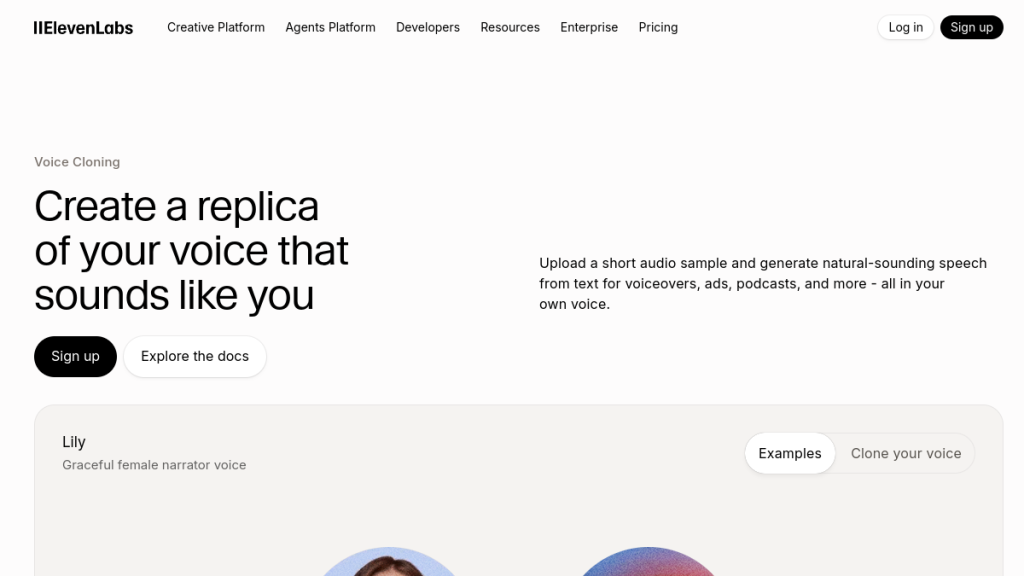
ElevenLabs
Best for: Overall quality and versatility
| Feature | Details |
|---|---|
| Voice Clone Quality | Industry-leading; often indistinguishable from real |
| Data Required | 1+ minutes (Instant Voice Cloning) |
| Languages | 29+ languages |
| Real-Time | Yes (Speech-to-Speech) |
| Pricing | Free tier; $5-330/month |
Pros: Exceptional quality, emotional range, multilingual
Cons: Premium features are expensive
Resemble AI
Best for: Enterprise and real-time applications
| Feature | Details |
|---|---|
| Voice Clone Quality | Excellent; focus on customization |
| Data Required | 3+ minutes |
| Languages | 24+ languages |
| Real-Time | Yes |
| Pricing | Pay-per-use; enterprise plans |
Pros: Real-time API, voice editing, strong privacy controls
Cons: Steeper learning curve
Murf AI
Best for: Business and marketing content
| Feature | Details |
|---|---|
| Voice Clone Quality | Good; emphasis on professional tones |
| Data Required | 10+ minutes recommended |
| Languages | 20+ languages |
| Real-Time | No |
| Pricing | $23-100/month |
Pros: Clean interface, team features, voice changer
Cons: Fewer customization options than competitors
PlayHT
Best for: Long-form content and developers
| Feature | Details |
|---|---|
| Voice Clone Quality | Very good |
| Data Required | 30 seconds minimum |
| Languages | 142 languages |
| Real-Time | Yes (PlayHT 2.0) |
| Pricing | Free tier; $31-99/month |
Pros: Massive language support, strong API
Cons: Quality varies by voice
Descript
Best for: Podcasters and video editors
| Feature | Details |
|---|---|
| Voice Clone Quality | Good; integrated with editing |
| Data Required | 30+ minutes for best results |
| Languages | English primarily |
| Real-Time | No (Overdub feature) |
| Pricing | $12-24/month |
Pros: Full audio/video editor, Overdub feature, Studio Sound
Cons: Voice cloning (Overdub) requires more training data
Comparison Table
| Tool | Quality | Min. Data | Languages | Real-Time | Starting Price |
|---|---|---|---|---|---|
| ElevenLabs | ★★★★★ | 1 min | 29+ | Yes | Free |
| Resemble AI | ★★★★☆ | 3 min | 24+ | Yes | Pay-per-use |
| Murf AI | ★★★★☆ | 10 min | 20+ | No | $23/mo |
| PlayHT | ★★★★☆ | 30 sec | 142 | Yes | Free |
| Descript | ★★★☆☆ | 30 min | 1 | No | $12/mo |
Voice Cloning vs. Text-to-Speech
People often confuse voice cloning with standard text-to-speech. Here’s the difference:
Traditional Text-to-Speech (TTS)
- Uses pre-built voices (generic male/female options)
- Sounds relatively robotic or “computer-like”
- No customization to sound like a specific person
- Available since the 1990s
Examples: Google TTS, Amazon Polly (standard voices), Microsoft SAPI
AI Voice Cloning
- Creates a custom voice modeled on a specific person
- Sounds nearly indistinguishable from the real person
- Captures unique vocal characteristics
- Requires AI training on voice samples
Examples: ElevenLabs, Resemble AI, Descript Overdub
Modern TTS with Neural Networks
The lines are blurring. Modern neural TTS (like Amazon Polly Neural, Google Cloud TTS Neural) produces much more natural speech than legacy systems—but still uses preset voices rather than clones.
Benefits of AI Voice Cloning
Voice cloning offers compelling advantages for various use cases:
For Content Creators
- Faster production: Generate hours of narration from scripts without recording
- Consistency: Same voice quality across all content
- Scale: Produce more content without more studio time
- Corrections: Fix mistakes without re-recording entire segments
For Businesses
- Cost reduction: Eliminate expensive voice actor fees and studio costs
- Personalization: Create thousands of personalized messages efficiently
- Localization: Expand to new markets without recording new voiceovers
- Availability: 24/7 voice content without human scheduling constraints
For Accessibility
- Voice preservation: People facing voice loss can save and reuse their voice
- Communication tools: Individuals with speech disorders maintain personal identity
- Emotional connection: Personalized voices reduce feelings of alienation
For Preservation
- Historical voices: Recreate speeches by historical figures
- Endangered languages: Preserve voices of native speakers
- Family memories: Keep loved ones’ voices for future generations
Risks and Ethical Concerns
The power of voice cloning comes with significant risks:
Fraud and Scams
Voice cloning enables sophisticated fraud. Criminals use cloned voices to:
- Impersonate family members requesting money
- Mimic executives to authorize fraudulent transfers
- Bypass voice-based authentication systems
Real example: In 2023, a UK company lost over $200,000 to a scam where criminals cloned an executive’s voice.
Deepfakes and Misinformation
Fake audio can spread false information:
- Fabricated statements by politicians
- Fake celebrity endorsements
- Manufactured evidence in legal proceedings
Deepfake audio is often harder to detect than fake video.
Privacy Violations
Voice is biometric data. Unauthorized cloning violates privacy because:
- Voices can be cloned without consent from public recordings
- Stolen voice data could bypass security systems
- Individuals may not know their voice has been cloned
Consent and Rights
Key questions remain unresolved:
- Who owns a person’s voice?
- Can someone’s voice be used after death?
- What consent is required for cloning?
- How should voice actors be compensated?
Trust Erosion
As voice cloning improves, we may stop trusting audio evidence entirely. “Is this really them?” becomes a constant question.
Legal Considerations
The legal landscape around voice cloning is evolving:
Current Regulations
United States:
- No federal law specifically addressing voice cloning
- Some states (CA, NY) have right of publicity laws that may apply
- FTC monitors deceptive uses under consumer protection laws
European Union:
- GDPR treats voice as biometric data requiring explicit consent
- AI Act may impose transparency requirements
China:
- Requires consent for synthetic voice generation
- Deep synthesis regulations took effect in 2023
Emerging Legislation
Many jurisdictions are drafting voice cloning regulations:
- Requirements for consent before cloning
- Mandatory disclosure of synthetic audio
- Protections for voice actors and performers
- Criminal penalties for malicious deepfakes
Best Practices
Responsible use of voice cloning means:
- Get explicit consent before cloning anyone’s voice
- Disclose when audio is AI-generated
- Don’t impersonate others without permission
- Secure voice data to prevent misuse
- Monitor for unauthorized use of cloned voices
The Future of Voice Cloning
Voice cloning technology continues advancing rapidly:
Trends to Watch
Improved Quality: Clones become indistinguishable from originals with minimal data.
Real-Time Performance: Live voice conversion with zero latency.
Emotional Control: Precise manipulation of emotions, emphasis, and style.
Cross-Language Cloning: Speak in any language while maintaining your voice.
Voice Design: Create entirely new voices with specific characteristics.
Detection Technology
As cloning improves, so do detection tools:
- AI models trained to identify synthetic speech
- Audio forensics for watermarking and provenance
- Voice authentication with liveness detection
Market Growth
The AI voice market is projected to reach $9.7 billion by 2028, with voice cloning as a key driver. Industries adopting the technology include:
- Media and entertainment
- Education and e-learning
- Healthcare and accessibility
- Customer service automation
- Gaming and virtual worlds
FAQs
How long does it take to clone a voice?
With modern AI, basic voice clones can be created in minutes from just 10-30 seconds of audio. Higher-quality clones requiring training may take 30-60 minutes of setup time plus processing.
Is AI voice cloning legal?
Voice cloning itself is legal, but how you use it matters. Cloning someone’s voice without consent or using clones for fraud, impersonation, or defamation is illegal in most jurisdictions.
Can I clone my own voice?
Yes. Most voice cloning platforms let you create a clone of your own voice. This is legitimate and useful for content creation, voice preservation, and accessibility.
How accurate is AI voice cloning?
Top-tier tools like ElevenLabs can produce clones that are nearly indistinguishable from the original in blind tests. Quality depends on: audio sample quality, amount of training data, and the tool used.
Can voice cloning be detected?
Yes, but it’s getting harder. Detection tools analyze artifacts, patterns, and inconsistencies in synthetic audio. However, as cloning improves, detection becomes an ongoing arms race.
Is voice cloning the same as deepfakes?
Voice cloning is a type of deepfake—specifically, “deepfake audio.” The term “deepfake” broadly refers to AI-generated synthetic media designed to appear authentic.
What data is needed to clone a voice?
Clean audio recordings of the target speaker. More data = better quality. Advanced zero-shot systems need as little as 3 seconds; professional clones may use 1-3 hours of recordings.
Can I use voice cloning for commercial purposes?
Yes, if you have the rights to use the voice. This typically means either: (1) it’s your own voice, (2) you have explicit written consent, or (3) you’re using platform-provided stock voices.
Related Topics
- What is NLP (Natural Language Processing)?
- What is Generative AI?
- Best AI Voice Generators 2026
- ElevenLabs Review 2026
- Murf AI Review 2026
Bottom Line
AI voice cloning has become remarkably accessible and realistic. Whether you need it for content creation, accessibility, or business applications, today’s tools can produce natural-sounding voice clones with minimal input. Just be mindful of the ethical implications.
Learn More
Ready to explore AI voice cloning? Here are your next steps:
- Try a free tool: ElevenLabs offers free voice cloning to test
- Clone your own voice: Start with your voice to understand the technology
- Explore use cases: Consider how voice cloning could help your content or business
- Stay informed: Follow developments in AI voice ethics and regulation
Voice cloning represents one of AI’s most personal applications—the ability to replicate human identity through sound. Used responsibly, it unlocks incredible creative and accessibility possibilities. Understanding both its power and its risks is essential as this technology becomes mainstream.
This article is part of our AI Glossary series explaining key AI concepts for beginners and professionals alike.
For a detailed look at one of the top AI voice platforms, read our Lovo.ai review.