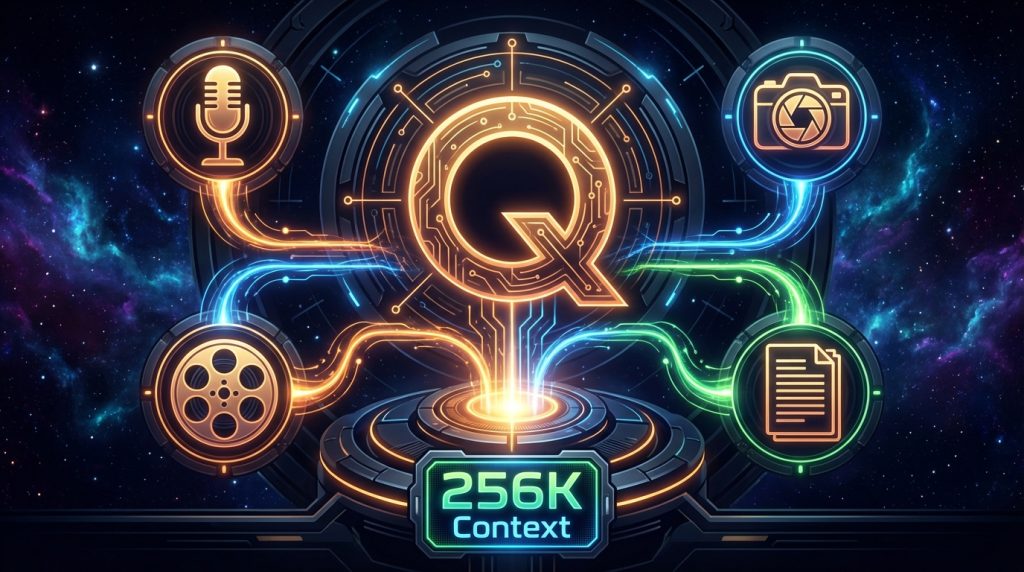
On March 30, 2026, Alibaba’s Qwen team launched Qwen3.5-Omni, the first truly omnimodal AI model that can understand AND generate text, images, audio, and video content natively. While competitors like GPT-5.4 and Claude Opus 4.6 excel at specific modalities, Qwen3.5-Omni is the first production model to handle full multimodal input and output seamlessly within a single 256K context window. Early benchmarks show it achieving state-of-the-art results across 215 audio-visual tasks while undercutting competitors by 75% on API pricing.
Rating: 8.7/10 ⭐⭐⭐⭐⭐⭐⭐⭐
What Is Qwen3.5-Omni?
Qwen3.5-Omni is Alibaba’s latest-generation multimodal AI model that represents a breakthrough in omnimodal capabilities. Released on March 30, 2026, by the Qwen team, this model can natively process and generate content across text, images, audio, and video modalities within a unified architecture.
The model comes in three variants: Plus, Flash, and Light, all supporting a massive 256K context window. What sets Qwen3.5-Omni apart from competitors is its ability to process over 10 hours of audio input and more than 400 seconds of 720P video at 1 FPS, while also generating audio and visual content—not just understanding it.
Built on a revolutionary Thinker-Talker architecture and pre-trained on over 100 million hours of audio-visual data, Qwen3.5-Omni offers speech recognition for 113 languages and speech generation for 36 languages, making it the most linguistically diverse multimodal AI available.
Official Qwen3.5-Omni announcement
The Story: First Production-Ready Omnimodal AI
March 30, 2026 marks a watershed moment in AI development. While OpenAI’s GPT-5.4 excels at text reasoning and Claude Opus 4.6 dominates in safety and analysis, neither can generate audio or video content natively. Qwen3.5-Omni changes the game by being the first model to achieve true omnimodal capabilities in a production environment.
The breakthrough lies in its architecture: instead of bolt-on modules for different modalities, Qwen3.5-Omni was trained from scratch on unified multimodal data. This native approach allows for seamless transitions between understanding a spoken question, analyzing an image, and responding with both text and synthesized speech—all within the same conversation thread.
Most remarkably, Qwen3.5-Omni-Plus achieved state-of-the-art performance on 215 audio-visual benchmarks, outperforming Gemini 3.1 Pro across general audio understanding, reasoning, recognition, and translation tasks. This isn’t just incremental improvement—it’s a fundamental shift toward truly unified AI systems.
Benchmark Performance
| Benchmark | Qwen3.5-Omni-Plus | Gemini 3.1 Pro | GPT-4o | Claude 3 Opus |
|---|---|---|---|---|
| SWE-bench Verified | 76.4 | 76.2 | 78.3 | 80.9 |
| MMAU (Audio Understanding) | 82.2 | 76.8 | N/A | N/A |
| MMAR (Audio Reasoning) | 80.0 | 74.5 | N/A | N/A |
| MMSU (Speech Understanding) | 82.8 | 77.3 | N/A | N/A |
| MMMU (Multimodal) | 85.0 | 81.2 | 83.1 | 82.7 |
| Video-MME (with audio) | 87.5 | 84.1 | N/A | N/A |
Source: Official Qwen benchmarks and published academic evaluations. N/A indicates the model doesn’t support that modality natively.
Pricing
| Model Tier | Input (per 1M tokens) | Output (per 1M tokens) | Context Window | Best For |
|---|---|---|---|---|
| Qwen3.5-Omni-Plus | $0.10 | $0.40 | 256K | Full multimodal applications |
| Qwen3.5-Omni-Flash | $0.029 | $0.287 | 256K | Fast multimodal processing |
| Qwen3.5-Omni-Light | $0.015 | $0.15 | 256K | Basic multimodal tasks |
Competitor Pricing Comparison
| Model | Input (per 1M tokens) | Output (per 1M tokens) | Multimodal Output? |
|---|---|---|---|
| Qwen3.5-Omni-Plus | $0.10 | $0.40 | ✅ Text, Audio, Images |
| Claude Opus 4.6 | $5.00 | $25.00 | ❌ Text only |
| Gemini 3.1 Pro | $2.00-$4.00 | $12.00-$18.00 | ❌ Text only |
| GPT-4o | $2.50 | $10.00 | ❌ Text only |
Key Features
**True Omnimodal Processing**: Unlike competitors that use separate models for different modalities, Qwen3.5-Omni processes text, images, audio, and video within a unified architecture. This eliminates the context loss and latency that occurs when switching between specialized models. However, the unified approach means you can’t optimize for single-modality tasks as efficiently as dedicated models.
**Massive Context Window**: The 256K token context allows for processing over 10 hours of audio or 400 seconds of high-definition video in a single session. This is revolutionary for applications like meeting transcription with visual elements or long-form content analysis. The limitation is that processing such large contexts can increase latency and costs significantly.
**Multilingual Audio Generation**: With speech generation support for 36 languages and recognition for 113 languages, Qwen3.5-Omni outpaces competitors in global accessibility. Real-time voice cloning and semantic interruption features enable natural conversation flows. The downside is that voice quality varies significantly across languages, with English and Mandarin receiving the most optimization.
**Real-Time Interaction Features**: Semantic interruption allows users to interrupt the AI mid-response naturally, while voice tone cloning can match specific speakers. Voice control enables hands-free operation across modalities. These features work best in controlled environments—background noise and multiple speakers can confuse the interrupt detection.
**Native Video Understanding**: The model can analyze video content frame-by-frame while simultaneously processing audio tracks, enabling comprehensive understanding of multimedia content. This goes beyond simple object detection to understand temporal relationships and scene changes. Processing video at full frame rates dramatically increases computational costs and API usage.
**Thinker-Talker Architecture**: This novel architecture separates reasoning (Thinker) from output generation (Talker), allowing for more controlled and coherent responses across modalities. The separation helps prevent hallucination cascades common in multimodal systems. The trade-off is slightly increased latency as the model must complete its “thinking” phase before generating outputs.
Who Is It For / Who Should Look Elsewhere
**Use Qwen3.5-Omni if you:**
– Need to build applications that seamlessly blend text, audio, and visual interactions
– Want cost-effective multimodal AI without sacrificing performance quality
– Require multilingual audio processing for global applications
– Are developing conversational AI that needs to understand and respond with voice
– Need to process long-form multimedia content like meetings, lectures, or documentaries
– Want to prototype omnimodal applications before competitors catch up
**Look elsewhere if you:**
– Only need text-based AI with occasional image understanding (GPT-4o is more cost-effective)
– Require the absolute highest reasoning quality for complex analysis (Claude Opus 4.6 still leads)
– Need proven enterprise support and safety guarantees (Western alternatives have more regulatory clarity)
– Are building financial or healthcare applications requiring strict compliance (Alibaba’s models face regulatory scrutiny in some markets)
Comparison Table
| Feature | Qwen3.5-Omni | GPT-5.4 | Claude Opus 4.6 | Gemini 3.1 Pro | Meta Llama 4 |
|---|---|---|---|---|---|
| Pricing (Input) | $0.10/1M tokens | TBA | $5.00/1M tokens | $2.00-$4.00/1M tokens | Free (self-hosted) |
| Context Window | 256K tokens | 200K tokens | 1M tokens | 200K+ tokens | 128K tokens |
| Audio Output | ✅ 36 languages | ❌ | ❌ | ❌ | ❌ |
| Video Understanding | ✅ Native | Limited | ❌ | ✅ Good | ❌ |
| Real-time Interaction | ✅ Voice interruption | ❌ | ❌ | ❌ | ❌ |
| Best For | Multimodal apps | Advanced reasoning | Safety-critical analysis | Enterprise integration | Open-source projects |
| Availability | API + Open weights | API only | API only | API + Vertex AI | Open weights |
| Enterprise Support | Alibaba Cloud | OpenAI Enterprise | Anthropic Enterprise | Google Cloud | Community |
Internal links: See our comprehensive Qwen 3.5 review and best AI tools guide for more comparisons.
Controversy / What They Don’t Advertise
**Leadership Exodus**: The most significant controversy surrounding Qwen3.5-Omni isn’t technical—it’s organizational. On March 4, 2026, just weeks before the launch, Qwen’s tech lead Junyan Lin departed Alibaba following a restructuring that would have stripped him of control over the model development process. This “implosion of the top open source lab” raises questions about continuity and future development priorities under new leadership.
**Hallucination Cascade Risk**: Alibaba quietly acknowledges that Qwen3.5-Omni carries significant hallucination risks, particularly in “agentic workflows” where the model makes decisions based on its own previous outputs. An early error can trigger a “hallucination cascade” where each subsequent step compounds the mistake. This is especially dangerous in multimodal applications where audio and visual hallucinations are harder to detect than text errors.
**Regulatory Compliance Burden**: While Alibaba touts the model’s adaptability to “local regulations,” they’re essentially shifting compliance responsibility to end users. The model includes “intervention tools” for content filtering, but regulatory approval in markets like the EU and US remains unclear. Users in regulated industries may face unexpected compliance costs.
**Audio Quality Inconsistency**: Despite supporting 36 languages for speech generation, quality varies dramatically. English and Mandarin receive premium treatment with natural-sounding voices, while many other languages sound robotic or suffer from pronunciation errors. This creates a two-tier user experience that Alibaba doesn’t prominently advertise.
**Compute Intensity**: The unified multimodal architecture, while impressive, is extremely compute-hungry. Processing video or long audio clips can consume 5-10x more resources than equivalent text-only operations, leading to unpredictable API costs for production applications. The 256K context window sounds impressive until you realize a few minutes of video can consume the entire budget.
**Chinese Data Center Dependency**: Despite API availability globally, processing happens in Chinese data centers, creating latency and potential data sovereignty concerns for enterprise users in other regions. This isn’t disclosed prominently in marketing materials but appears in the fine print of service agreements.
Pros and Cons
Pros
- True omnimodal capabilities – First production AI to handle text, image, audio, and video input/output natively
- Exceptional value pricing – 75% cheaper than comparable Western alternatives while matching performance
- Massive 256K context window – Handles hours of audio or lengthy video content in single sessions
- Real-time interaction features – Semantic interruption and voice cloning enable natural conversations
- Multilingual audio support – Speech recognition for 113 languages, generation for 36
- Open-source availability – Some model variants available for self-hosting and fine-tuning
Cons
- Leadership instability – Key technical leader departure raises questions about future development
- Hallucination cascade risks – Multimodal errors can compound in complex workflows
- Variable audio quality – Significant performance gaps between supported languages
- Regulatory uncertainty – Compliance burden shifted to users in regulated markets
- High compute costs for complex tasks – Video and long audio processing can be expensive
Getting Started
**Step 1: API Access Setup**
Sign up for Alibaba Cloud Model Studio or access through third-party providers like SiliconFlow. Create API credentials and choose your preferred model tier (Plus for full features, Flash for speed, Light for cost optimization).
**Step 2: Test Basic Multimodal Capabilities**
Start with simple prompts that combine modalities: upload an image and ask for spoken description, or provide audio and request text + visual summary. This helps you understand the model’s integration strengths.
**Step 3: Configure Language and Voice Settings**
Select your primary languages for both input recognition and output generation. Test different voice options if using audio output—quality varies significantly between languages.
**Step 4: Set Context and Cost Budgets**
The 256K context window is powerful but can be expensive. Set reasonable limits on audio/video length and monitor token usage carefully during development.
**Step 5: Implement Error Handling**
Build robust error handling for hallucination detection, especially in multi-step workflows. Consider implementing human-in-the-loop validation for critical applications.
FAQ
What makes Qwen3.5-Omni different from GPT-4o or Claude Opus?
How much does Qwen3.5-Omni cost compared to competitors?
Can Qwen3.5-Omni replace my current AI workflow?
What languages does Qwen3.5-Omni support for audio?
Is Qwen3.5-Omni safe for enterprise use?
How long does video processing take with Qwen3.5-Omni?
Can I self-host Qwen3.5-Omni?
What are the main limitations of Qwen3.5-Omni?
Does Qwen3.5-Omni work in real-time?
When will GPT-5.4 have similar multimodal output capabilities?
Final Verdict
Qwen3.5-Omni represents a genuine breakthrough in AI capabilities, becoming the first production model to deliver true omnimodal functionality at an accessible price point. While Western competitors like GPT-5.4 and Claude Opus 4.6 excel in their respective domains, neither can match Qwen3.5-Omni’s seamless integration of text, audio, and visual generation within a single unified system.
The model’s 256K context window, combined with state-of-the-art performance across 215 audio-visual benchmarks and aggressive pricing that undercuts competitors by 75%, makes it an compelling choice for developers building next-generation multimodal applications. The real-time interaction features, multilingual support, and native video understanding capabilities open possibilities that simply weren’t available before March 30, 2026.
However, potential adopters must weigh the technical advantages against legitimate concerns about leadership stability, regulatory compliance in non-Chinese markets, and the model’s tendency toward hallucination cascades in complex workflows. Enterprise users should particularly consider data sovereignty implications and variable audio quality across languages.
**Buy Qwen3.5-Omni today if** you’re building multimodal applications, need cost-effective AI with cutting-edge capabilities, or want to prototype omnimodal experiences before competitors catch up. The first-mover advantage in multimodal AI is real, and Qwen3.5-Omni delivers capabilities that won’t be matched by Western alternatives for months.
**Wait for alternatives if** regulatory compliance in your market is uncertain, you require maximum reasoning quality for text-only tasks, or you need guaranteed enterprise support from established Western AI providers. The leadership changes at Alibaba also create uncertainty about long-term development priorities.
For most developers and businesses, Qwen3.5-Omni’s combination of breakthrough capabilities and aggressive pricing makes it the most significant AI launch of 2026 so far. The era of truly omnimodal AI has arrived, and Alibaba is leading the charge.