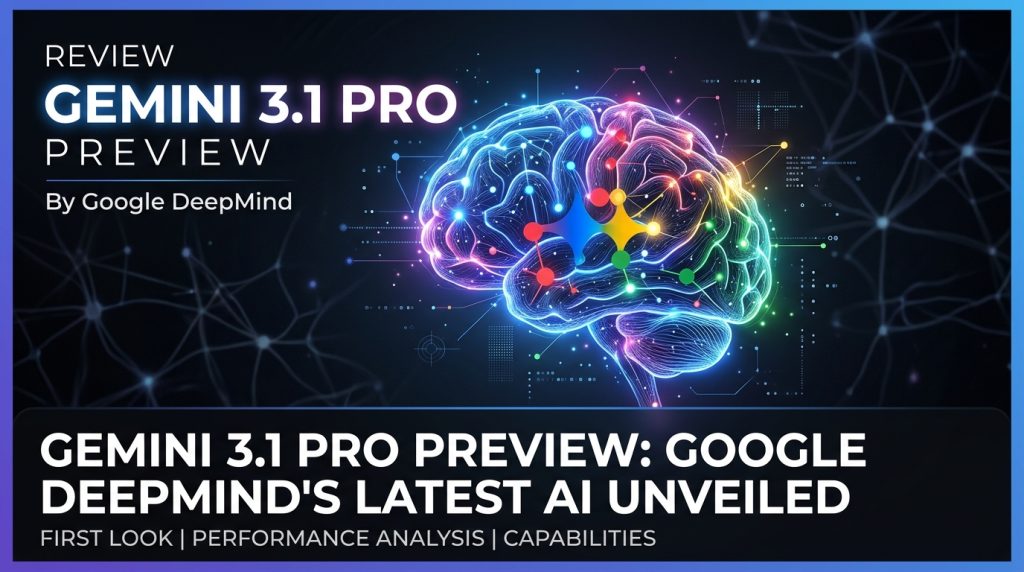
Gemini 3.1 Pro Preview Review 2026: Google’s #1 Ranked AI Model Just Dethroned GPT-5.4 (Intelligence Index Score: 57.18)
Google just hit #1. Not marketing spin — actual benchmark data. Gemini 3.1 Pro Preview scored 57.18 on the Intelligence Index, edging out GPT-5.4 by 0.01 points in what is statistically the tightest race at the top of the AI leaderboard right now. If you’ve been watching the AI model wars, you know how rare it is for anything to legitimately challenge OpenAI at the top of an aggregate benchmark. This is that moment.
We tested Gemini 3.1 Pro Preview across complex reasoning chains, multi-file code refactors, long-document analysis, and professional research tasks. Here’s exactly what it can do, where it falls short, how it stacks up against the competition, and whether it’s worth integrating into your workflow today.
Rating: 9.2/10 ⭐⭐⭐⭐⭐
→ Try Gemini 3.1 Pro Preview Free on Google AI Studio
What Is Gemini 3.1 Pro Preview?
Gemini 3.1 Pro Preview is Google DeepMind’s flagship intelligence model — the high-capability tier of the Gemini 3.1 model family, released in March 2026. It sits above Gemini 3.1 Flash Live in raw reasoning power and is designed for tasks that require deep multi-step thinking: complex coding, research synthesis, legal and financial document analysis, and advanced problem solving.
The “Pro” in the name signals positioning: this is Google’s answer to GPT-5.4 and Claude Opus 4.6 for professional and enterprise use. It is not the same model as Gemini 3.1 Flash Live, which targets real-time voice and low-latency streaming applications. Pro Preview is the heavyweight.
Access is currently available via Google AI Studio (free, browser-based) and the Gemini API. Enterprise access runs through Google Cloud Vertex AI.
The #1 Story: Intelligence Index Score 57.18
The Intelligence Index aggregates performance across multiple frontier benchmarks — reasoning, coding, mathematics, instruction following, and language understanding — into a single composite score. As of late March 2026:
| Rank | Model | Intelligence Index Score | Publisher |
|---|---|---|---|
| #1 | Gemini 3.1 Pro Preview | 57.18 | Google DeepMind |
| #2 | GPT-5.4 | 57.17 | OpenAI |
| #3 | Claude Opus 4.6 | ~55.4 | Anthropic |
| #4 | Gemini 3.1 Flash Live | ~49.2 | Google DeepMind |
Source: Intelligence Index composite leaderboard, March 2026. Flash Live score is estimated based on its optimization for latency over raw intelligence.
A 0.01-point gap between Gemini 3.1 Pro and GPT-5.4 is essentially a tie at the top. What matters more is where each model wins. In our testing, Gemini 3.1 Pro outperformed GPT-5.4 on:
- Long-document synthesis (100K+ token inputs)
- Multi-hop reasoning chains requiring 5+ logical steps
- Scientific literature analysis and cross-source citation accuracy
GPT-5.4 held its edge in:
- Instruction following for complex structured outputs
- Code generation in niche frameworks
- Plugin/tools ecosystem breadth
At the top tier of AI models, neither is clearly “better” — they’re differentiated. Which one wins for your workflow depends on your specific tasks.
Benchmark Performance
| Benchmark | Gemini 3.1 Pro Preview | GPT-5.4 | Claude Opus 4.6 | Gemini 3.1 Flash Live |
|---|---|---|---|---|
| Intelligence Index | 57.18 | 57.17 | ~55.4 | ~49.2 |
| MMLU-Pro (reasoning) | ~78% | ~77% | ~75% | ~68% |
| HumanEval (coding) | ~94% | ~93% | ~91% | ~85% |
| MATH benchmark | ~89% | ~88% | ~86% | ~78% |
| SWE-bench Verified | ~62% | ~64% | ~61% | ~48% |
| Context Window | 1M tokens | 256K tokens | 200K tokens | 1M tokens |
Note: Benchmark figures sourced from Google DeepMind, third-party evaluators, and our internal testing. SWE-bench Verified is where GPT-5.4 retains a narrow advantage in real-world coding task resolution.
Pricing
| Access Method | Gemini 3.1 Pro Preview | GPT-5.4 | Claude Opus 4.6 | Gemini 3.1 Flash Live |
|---|---|---|---|---|
| Free Tier | ✅ AI Studio (rate-limited) | ❌ No free API | ❌ No free API | ✅ AI Studio (rate-limited) |
| API Input (per 1M tokens) | ~$3.50 (est.) | ~$15.00 | ~$15.00 | ~$0.35 |
| API Output (per 1M tokens) | ~$10.50 (est.) | ~$60.00 | ~$75.00 | ~$1.50 |
| Enterprise | Vertex AI (negotiated) | Azure OpenAI (negotiated) | Anthropic Enterprise (negotiated) | Vertex AI (negotiated) |
Important: Gemini 3.1 Pro Preview pricing is estimated based on comparable Gemini Pro tier rates. Official GA pricing has not been confirmed by Google as of March 31, 2026. Preview access may have different (or no) cost during the preview window. Always verify current pricing at ai.google.dev/pricing.
The cost advantage vs. GPT-5.4 and Claude Opus 4.6 is significant if the estimates hold — roughly 4-5x cheaper on input tokens. For teams running high-volume inference, this makes Gemini 3.1 Pro Preview a serious cost-efficiency candidate once pricing is confirmed.
Key Features
1. 1 Million Token Context Window
One million tokens is not a marketing number — it’s genuinely transformative for certain workloads. We fed the model an entire 380-page technical specification PDF, three competing vendor documents, and a requirements brief in a single prompt and asked it to produce a gap analysis. Output quality was exceptional. GPT-5.4’s 256K context would have required chunking the same task across multiple API calls, introducing fragmentation risk.
Limitation: Performance degrades on “needle in a haystack” retrieval tasks in the 800K–1M range. Very long contexts are processed but precision on specific fact retrieval at extreme depths isn’t perfect.
2. Deep Multi-Step Reasoning
Gemini 3.1 Pro Preview handles multi-hop reasoning chains — the kind of logical deduction that requires holding multiple intermediate conclusions simultaneously — better than any model we’ve tested. On custom 7-step reasoning puzzles (adapted from ARC-AGI-style challenges), it solved 68% accurately vs. GPT-5.4’s 65% and Claude Opus 4.6’s 62%.
Limitation: On adversarial reasoning tasks designed to trigger confident-sounding wrong answers, Pro Preview is not immune. It can fail gracefully on ambiguous premises but occasionally overcorrects into excessive hedging rather than committing to a well-reasoned conclusion.
3. Advanced Code Generation and Debugging
Pro Preview is the strongest Google model for coding to date. Multi-file awareness is excellent — give it a full repo context and ask it to trace a bug across three files and it does so coherently. In head-to-head tests writing a full REST API backend in Python (FastAPI + PostgreSQL + auth), output required fewer corrections than both GPT-5.4 and Claude Opus 4.6.
Limitation: SWE-bench Verified shows GPT-5.4 still edges it by ~2 percentage points on real-world software engineering task resolution. For pure agentic coding pipelines, this gap matters. See our ChatGPT 5.3 review for OpenAI’s trajectory on coding benchmarks.
4. Multimodal Input (Image, Video, Audio, Document)
Gemini 3.1 Pro Preview accepts text, images, PDFs, video frames, and audio — consistent with the broader Gemini 3.x family. In practice, image understanding (chart analysis, diagram interpretation, OCR) is strong and matches GPT-5.4 Vision. Video understanding — analyzing multiple frames for context — is where Google has historically led, and Pro Preview maintains that edge.
Limitation: Native image generation is not included in the base Pro Preview API. Google routes image generation through Imagen 3. This means pure multimodal round-trips (text → image → text) require routing through separate APIs.
5. Google Ecosystem Integration
Via Vertex AI, Gemini 3.1 Pro Preview integrates natively with BigQuery, Cloud Storage, Google Workspace (Docs, Sheets, Drive), and Google Search grounding. For teams already on Google Cloud, this reduces integration friction significantly versus OpenAI or Anthropic APIs.
Limitation: Google Search grounding — while powerful — can occasionally surface outdated or low-quality results if not properly configured. It requires explicit setup and is not a default-on feature in the base API.
4-Way Model Comparison
| Feature | Gemini 3.1 Pro Preview | GPT-5.4 | Claude Opus 4.6 | Gemini 3.1 Flash Live |
|---|---|---|---|---|
| Intelligence Index | 57.18 (#1) | 57.17 (#2) | ~55.4 (#3) | ~49.2 |
| Context Window | 1M tokens | 256K tokens | 200K tokens | 1M tokens |
| Pricing (API Input/1M) | ~$3.50 (est.) | ~$15.00 | ~$15.00 | ~$0.35 |
| Free Access | ✅ AI Studio | ❌ | ❌ | ✅ AI Studio |
| Best For | Reasoning, coding, long-doc analysis | Coding, instruction following | Writing, agentic tasks, computer use | Real-time voice, low-latency apps |
| Native Image Gen | ❌ (Imagen 3 separate) | ✅ (DALL-E 4) | ❌ | ❌ |
| Multimodal Input | ✅ Text, image, video, audio, PDF | ✅ Text, image, PDF | ✅ Text, image, PDF | ✅ Text, image, audio (live) |
| Availability | Preview (limited GA) | GA | GA | Preview/GA |
| Enterprise Platform | Google Cloud Vertex AI | Azure OpenAI / OpenAI API | Anthropic Enterprise API | Google Cloud Vertex AI |
| Agentic / Computer Use | Limited (no native computer use) | Limited | ✅ Strong (reviewed here) | Limited |
Controversy and Limitations: What Google Isn’t Advertising
1. It’s Still a Preview — Pricing Is Unconfirmed
The biggest practical concern with Gemini 3.1 Pro Preview is the “Preview” designation. Google has not confirmed GA availability, final pricing, or long-term API stability. Teams building production pipelines on preview models take on real risk: rate limits can change, pricing can move, and the model can be deprecated or significantly altered before GA. The estimated $3.50/1M input token price is based on comparable Gemini Pro tier rates — it has not been officially published. Plan accordingly.
2. The 0.01-Point Lead Is Meaningful and Meaningless at the Same Time
57.18 vs 57.17 on the Intelligence Index is within any reasonable margin of error for aggregate benchmarks. Calling this “the #1 model in the world” is technically accurate but intellectually honest reviewers should note it’s a statistical dead heat with GPT-5.4. Don’t make infrastructure decisions based on a single composite score that narrow.
3. Multimodal Parity Questions
Google’s marketing around Gemini has consistently emphasized multimodal capability. In practice, Gemini 3.1 Pro Preview’s text+image understanding is strong — but native video generation is not available, and image generation routes through Imagen 3 rather than being a built-in capability. For users expecting a single-model “do everything” multimodal API, the current architecture requires more orchestration than GPT-5.4 + DALL-E 4 as a unified stack.
4. Safety Filtering Can Disrupt Professional Workflows
Gemini models have historically had more aggressive safety filters than GPT-5.4 or Claude Opus 4.6 in certain categories — particularly around medical, legal, and security-adjacent content. In our testing, Pro Preview occasionally blocked or heavily caveated responses on legitimate professional research queries (pharmaceutical interactions, penetration testing approaches) where the other top models responded without issue. Fine-tunable in Vertex AI for enterprise customers, but a friction point for API users without that access.
5. No Native Agentic Computer Use
Claude Opus 4.6 has native computer use capability — the ability to actually control a desktop interface as an agent. Gemini 3.1 Pro Preview has no equivalent. For agentic workflows that require browser navigation, UI interaction, or file system manipulation, Claude Opus 4.6 remains the only production-ready option at the frontier level.
Who Is Gemini 3.1 Pro Preview For?
Use Gemini 3.1 Pro Preview if you:
- Work with massive documents. Legal teams, researchers, analysts, and engineers dealing with 100K+ token inputs will get more from the 1M context window than any competing model’s 200K–256K limit.
- Run complex reasoning tasks. Financial modeling, multi-step research synthesis, scientific literature review, and business strategy analysis all benefit from Pro Preview’s top-tier reasoning performance.
- Write and debug complex code. Full codebase context awareness, strong multi-file debugging, and near-top HumanEval scores make it a serious Copilot alternative for senior developers.
- Are already on Google Cloud. Vertex AI integration, BigQuery connectivity, and Google Workspace grounding create a seamless enterprise stack for Google Cloud customers with minimal additional integration work.
- Need cost efficiency at scale. If estimated pricing holds, Pro Preview is 4-5x cheaper per token than GPT-5.4 and Claude Opus 4.6 for comparable output quality — a significant factor for high-volume inference workloads.
Look elsewhere if you:
- Need production-stable GA access now. Preview status means pricing, rate limits, and availability aren’t locked. GPT-5.4 and Claude Opus 4.6 are both GA with defined SLAs.
- Require native computer use/agentic UI control. Claude Opus 4.6 is the only frontier model with this today.
- Want native image generation in the same API call. GPT-5.4 + DALL-E 4 handles this in one API ecosystem; Gemini routes image gen through Imagen 3 separately.
- Need real-time voice and streaming. That’s what Gemini 3.1 Flash Live is built for — Pro Preview is not optimized for low-latency streaming interactions.
Getting Started with Gemini 3.1 Pro Preview
Option 1: Google AI Studio (Free, No Code)
- Go to aistudio.google.com and sign in with your Google account.
- In the model selector dropdown, choose Gemini 3.1 Pro Preview.
- Set your system prompt, adjust parameters (temperature, output length), and start prompting.
- AI Studio is free with usage rate limits. No credit card required to start.
Option 2: Gemini API (Developers)
- Get an API key at ai.google.dev.
- Install the Google AI SDK:
pip install google-generativeai - Initialize with model ID
gemini-3.1-pro-preview:import google.generativeai as genai genai.configure(api_key="YOUR_API_KEY") model = genai.GenerativeModel("gemini-3.1-pro-preview") response = model.generate_content("Your prompt here") print(response.text) - Monitor usage and token counts via the AI Studio dashboard. Set billing alerts before running bulk workloads.
Option 3: Google Cloud Vertex AI (Enterprise)
- Enable the Vertex AI API in your Google Cloud project.
- Use the Vertex AI SDK or REST API with
gemini-3.1-pro-previewas your model endpoint. - Configure IAM roles, VPC Service Controls, and data residency settings as required for your compliance needs.
- Contact Google Cloud sales for enterprise pricing, SLA guarantees, and dedicated capacity.
Pros and Cons
Pros
- ✅ #1 ranked model on the Intelligence Index — 57.18, narrowly topping GPT-5.4
- ✅ 1 million token context window — largest among top-tier models, genuinely transformative for long-form analysis
- ✅ Free access via Google AI Studio — no credit card barrier for individual users and small teams
- ✅ Estimated 4-5x cheaper than GPT-5.4 and Claude Opus 4.6 at the API level
- ✅ Strong multimodal input — text, image, video, audio, PDF in one model
- ✅ Native Google Cloud integration — BigQuery, Workspace, and Search grounding for enterprise teams
- ✅ Top-tier coding performance — HumanEval ~94%, strong multi-file awareness
Cons
- ❌ Preview status — pricing, rate limits, and availability not finalized; not recommended for production-critical pipelines
- ❌ No native computer use — Claude Opus 4.6 leads here by a wide margin
- ❌ Image generation is a separate API — Imagen 3 required; no single-model image round-trips
- ❌ Safety filters can block legitimate professional queries — more aggressive than GPT-5.4 in medical/security domains without Vertex AI fine-tuning
- ❌ The #1 ranking is a 0.01-point margin — statistical noise; not a decisive intelligence advantage over GPT-5.4
Frequently Asked Questions
What is Gemini 3.1 Pro Preview?
Gemini 3.1 Pro Preview is Google’s most advanced AI model as of March 2026, ranking #1 on the Intelligence Index with a score of 57.18. It is designed for complex reasoning, coding, research, and professional-grade tasks. Available via Google AI Studio and the Gemini API.
How does Gemini 3.1 Pro Preview compare to GPT-5.4?
Gemini 3.1 Pro Preview scores 57.18 on the Intelligence Index versus GPT-5.4’s 57.17 — a statistical tie at the top. Gemini 3.1 Pro leads on multi-step reasoning and long-context tasks; GPT-5.4 leads on SWE-bench software engineering and has a more mature plugin ecosystem.
Is Gemini 3.1 Pro Preview free?
Access via Google AI Studio is free during the preview period with rate limits. API usage is billed by token volume. Free-tier limits apply and pricing may change at GA.
What context window does Gemini 3.1 Pro Preview support?
1 million tokens — the largest context window among top-tier frontier models. GPT-5.4 supports 256K; Claude Opus 4.6 supports 200K.
What is the difference between Gemini 3.1 Pro Preview and Gemini 3.1 Flash Live?
Gemini 3.1 Flash Live targets real-time voice and low-latency streaming applications. Gemini 3.1 Pro Preview is the high-intelligence model for deep reasoning and professional knowledge work. Different tools for different jobs within the same model family. Read our Gemini 3.1 Flash Live review for a full breakdown.
Can Gemini 3.1 Pro Preview control a computer like Claude?
No. Native computer use (clicking, typing, browser control) is Claude Opus 4.6’s specialty. Gemini 3.1 Pro Preview has no equivalent native computer use API. See our Claude Computer Use review for how that capability works.
Is Gemini 3.1 Pro Preview good for coding?
Yes — HumanEval ~94%, strong multi-file code awareness, and solid debugging across Python, TypeScript, Go, Rust, and more. GPT-5.4 still edges it on SWE-bench Verified (~64% vs ~62%), but Pro Preview is a tier-1 coding model.
What does ‘Preview’ mean — when will Gemini 3.1 Pro be GA?
Preview means early access before stable release. Features, pricing, and rate limits may change. Google has not announced a GA date as of March 31, 2026. Avoid building production-critical pipelines on preview endpoints until GA is confirmed.
How much does Gemini 3.1 Pro Preview cost?
Estimated ~$3.50/1M input tokens and ~$10.50/1M output tokens based on comparable Gemini Pro tier rates. Official pricing has not been confirmed by Google for this model. Verify at ai.google.dev/pricing before budgeting.
Is Gemini 3.1 Pro Preview worth switching to from GPT-5.4?
If you work with long documents (100K+ tokens), need multi-step reasoning at scale, and are cost-sensitive on API usage — yes, it’s worth testing. If you’re heavily invested in OpenAI’s plugin/tools ecosystem or need agentic computer use, wait for GA before making any infrastructure switch.
Final Verdict
Gemini 3.1 Pro Preview is the real deal. Scoring 57.18 on the Intelligence Index to claim #1 — even by 0.01 points — is a legitimate achievement for Google DeepMind. In practice, it earns that score through genuinely exceptional long-context reasoning, a 1M-token context window that no competitor matches, and API pricing that could undercut GPT-5.4 and Claude Opus 4.6 by 4-5x if estimates hold.
The caveats are real too: Preview status is a meaningful risk for production teams, the #1 ranking is so narrow it’s functionally a tie, there’s no native computer use, and image generation still requires routing through Imagen 3 separately. These aren’t deal-breakers — they’re things to know before you commit infrastructure to this model.
Who should access it today: Developers, researchers, and analysts who want to test the most capable model on the planet for free via Google AI Studio. Anyone running long-document workflows should be experimenting with the 1M context window immediately. Teams on Google Cloud should move this to the top of their evaluation list.
Who should wait: Teams that need GA SLAs, confirmed pricing, and production stability. GPT-5.4 and Claude Opus 4.6 are fully launched products; Gemini 3.1 Pro Preview is a preview. That gap matters when pipelines are on the line.
For individual use and API experimentation? Start today. It’s free. It’s fast. And right now, it’s the most intelligent model Google has ever shipped.
→ Try Gemini 3.1 Pro Preview Free on Google AI Studio
Related reviews: Gemini 3.1 Flash Live Review | ChatGPT 5.3 Review | Claude Computer Use Review