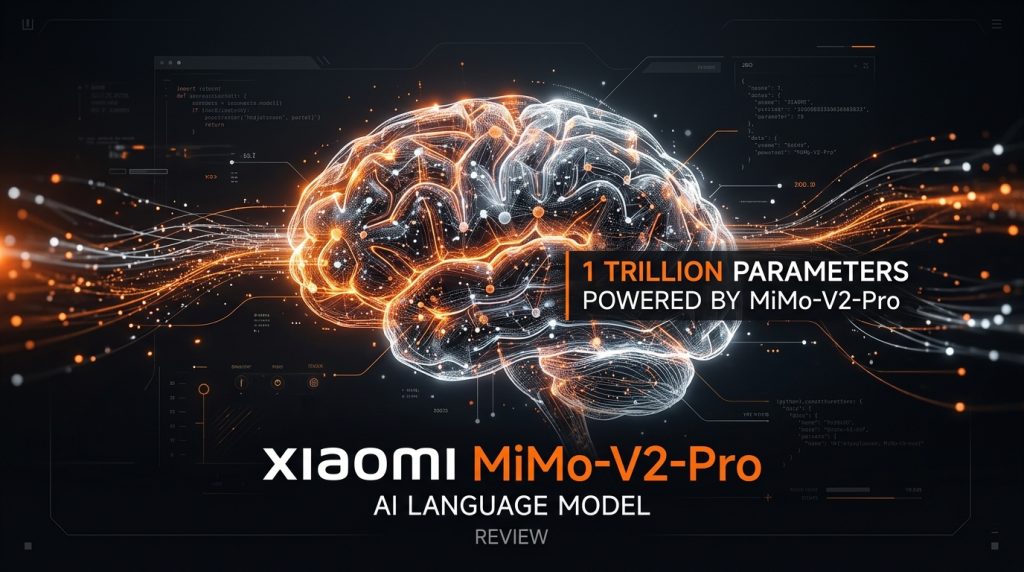
Xiaomi MiMo-V2-Pro Review 2026: The Stealth Model That Fooled the AI Community (1T Parameters)
On March 11, 2026, an anonymous AI model called “Hunter Alpha” appeared on OpenRouter and immediately started climbing the usage charts. For a week, the AI community was convinced they were testing DeepSeek V4. Then Xiaomi dropped the mic: it was their 1-trillion parameter MiMo-V2-Pro all along. The stealth launch became the most successful product validation in AI history, with the model surpassing 1 trillion tokens served before anyone knew who built it.
What Is Xiaomi MiMo-V2-Pro?
MiMo-V2-Pro is Xiaomi’s flagship large language model, officially launched March 18, 2026, built by a team led by former DeepSeek researcher Luo Fuli. This 1-trillion parameter model uses a mixture of experts (MoE) architecture with 42 billion active parameters and supports a 1-million token context window. Unlike traditional chatbots, MiMo-V2-Pro is engineered specifically for agentic AI applications—autonomous workflows, complex reasoning, and multi-step task execution.
The model represents Xiaomi’s $8.7 billion AI investment over three years and marks their aggressive entry into the “agent era” of artificial intelligence. Available through OpenRouter and Xiaomi’s direct API.
The Stealth Launch That Broke AI Twitter
The “Hunter Alpha” phenomenon started as speculation became obsession. An anonymous model appeared on OpenRouter with capabilities rivaling Claude Opus 4.6 at a fraction of the cost. Usage exploded—over 1.5 trillion tokens processed in seven days. The AI community was certain they’d found DeepSeek V4.
Then came the reveal. Luo Fuli called it a “quiet ambush”—a deliberate strategy to gather real-world feedback without brand bias. The numbers proved the approach: Hunter Alpha topped daily usage charts and demonstrated product-market fit before Xiaomi spent a dollar on marketing.
This wasn’t just a launch strategy. It was market validation at scale, turning developer adoption into proof of concept.
Benchmark Performance
| Benchmark | MiMo-V2-Pro | Claude Opus 4.6 | GPT-5.4 | DeepSeek V3.2 |
|---|---|---|---|---|
| SWE-Bench Verified | 92.5% | 80.8% | 80.0% | 73.4% |
| Terminal-Bench 2.0 | 86.7% | 65.4% | 75.1% | N/A |
| ClawEval (Agentic) | 61.5% | 66.3% | N/A | N/A |
| PinchBench (OpenClaw) | ~80%* | 80.8% | 80.5% | N/A |
*Reported as “approaching Opus 4.6 performance” – exact score not disclosed
Source: OpenRouter benchmarks, Artificial Analysis, VentureB
Pricing
| Model | Input (per 1M tokens) | Output (per 1M tokens) | Context Window | Cost vs Opus 4.6 |
|---|---|---|---|---|
| MiMo-V2-Pro (≤256K) | $1.00 | $3.00 | 1M tokens | 5x cheaper input, 8.3x cheaper output |
| MiMo-V2-Pro (256K-1M) | $2.00 | $6.00 | 1M tokens | 2.5x cheaper input, 4.2x cheaper output |
| Claude Opus 4.6 | $5.00 | $25.00 | 1M tokens | Baseline |
| GPT-5.4 Standard | $2.50 | $15.00 | Varies | 2x cheaper input, 1.7x cheaper output |
| DeepSeek V3.2 | $0.26 | $0.38 | 256K tokens | 19x cheaper input, 66x cheaper output |
Key Features
Agentic Architecture: Built for autonomous workflows, not chat. Excels at planning, tool use, and multi-step reasoning tasks. The model maintains context across complex task sequences better than chat-optimized alternatives. Limitation: Still learning from production use—some edge cases in workflow handoffs.
1-Million Token Context: Processes entire codebases, long documents, or conversation histories in a single pass. Tiered pricing means you pay less for shorter contexts. Strong performance on long-context retrieval tasks. Limitation: Output limited to 131K tokens regardless of input size.
MoE Efficiency: Only 42B parameters active during inference from the 1T total, keeping costs down while maintaining capability. Smart parameter routing reduces computational overhead. Limitation: Some specialized tasks may need parameters that aren’t frequently activated.
Developer Ecosystem: Native integration with OpenClaw, OpenCode, KiloCode, Blackbox, and Cline. One week free API access for new developers. OpenAI-compatible API standards. Limitation: Ecosystem still growing—fewer third-party tools than established models.
Coding Excellence: Surpasses Claude Sonnet 4.6 at coding tasks while costing 80% less. Strong performance on SWE-Bench and terminal-based workflows. Handles multi-file refactoring well. Limitation: Not quite matching Claude Opus 4.6’s code quality on the most complex problems.
Chinese Language Support: Native bilingual capabilities with strong performance in Mandarin and English. Understands cultural context and technical terminology in both languages. Limitation: Documentation and support primarily in English.
Who Is It For / Who Should Look Elsewhere
Use MiMo-V2-Pro if you:
- Build autonomous AI agents or workflows that need sustained reasoning
- Need Claude Opus 4.6-level coding at a fraction of the cost
- Work with large codebases or documents requiring full context
- Want to experiment with agentic AI without breaking the budget
- Use OpenClaw, OpenCode, or other supported agent frameworks
Look elsewhere if you:
- Need the absolute best code quality regardless of cost (Claude Opus 4.6 still leads)
- Require extensive fine-tuning or custom model hosting
- Work primarily with non-English languages other than Mandarin
- Need guaranteed enterprise-grade support and SLAs from day one
Comparison Table
| Feature | MiMo-V2-Pro | Claude Opus 4.6 | GPT-5.4 | DeepSeek V3.2 |
|---|---|---|---|---|
| Pricing (Input/Output) | $1-2 / $3-6 | $5 / $25 | $2.5 / $15 | $0.26 / $0.38 |
| Context Window | 1M tokens | 1M tokens | Varies by tier | 256K tokens |
| Best For | Agentic workflows | Complex reasoning | General intelligence | Cost efficiency |
| Platform | OpenRouter, Xiaomi API | Anthropic, OpenRouter | OpenAI, OpenRouter | DeepSeek, OpenRouter |
| Launch Date | March 2026 | February 2026 | March 2026 | December 2025 |
| Company | Xiaomi (China) | Anthropic (US) | OpenAI (US) | DeepSeek (China) |
| Agent Support | Native (5 frameworks) | Third-party | Third-party | Third-party |
| Free Tier | 1 week for developers | None | Limited through OpenAI | Yes (with limits) |
Controversy: The Stealth Launch Ethics Debate
The Anonymous Testing Concern: Critics argue that deploying a model anonymously on public infrastructure raises transparency issues. Developers used “Hunter Alpha” for production workloads without knowing its origin, data handling, or safety measures. While legal, this approach bypassed informed consent.
Chinese AI Anxiety: MiMo-V2-Pro’s success reignited concerns about Chinese AI capabilities and data sovereignty. The model processes user inputs on servers that likely fall under Chinese jurisdiction, raising questions for enterprises handling sensitive information. Xiaomi hasn’t published detailed data handling policies for international users.
Market Manipulation Questions: The stealth launch allowed Xiaomi to gather competitive intelligence on usage patterns, developer preferences, and benchmark gaming without revealing their hand. Some competitors argue this gave unfair advantage in positioning and pricing decisions.
OpenRouter’s Role: The platform’s willingness to host anonymous models without disclosed provenance sparked debate about platform responsibility. OpenRouter argued that performance and safety matter more than company logos, but the precedent worries some researchers.
None of these concerns appear to violate laws or platform policies, but they highlight the evolving ethics of AI model deployment in a competitive landscape.
Pros and Cons
Pros
- Exceptional value proposition—Opus 4.6-level capabilities at 1/5th to 1/25th the cost
- Purpose-built for autonomous agents with native framework integrations
- Superior coding performance compared to Sonnet 4.6 at much lower cost
- 1M token context window with intelligent tiered pricing
- Proven scalability—handled 1.5T tokens during stealth testing
- Strong bilingual capabilities (English/Mandarin)
- Free developer access week reduces barrier to entry
- Efficient MoE architecture keeps inference costs low
Cons
- Still trails Claude Opus 4.6 in the most complex reasoning tasks
- Limited ecosystem compared to OpenAI/Anthropic models
- Data sovereignty concerns for enterprise users
- Documentation and support primarily in English despite Chinese origin
- Relatively new—less battle-tested than established alternatives
- Output limited to 131K tokens regardless of input context size
Getting Started
Step 1: Sign up for OpenRouter or create a Xiaomi developer account at platform.xiaomimimo.com. OpenRouter offers easier onboarding for most developers.
Step 2: Add credits to your account. Start with $10-20 to test thoroughly—the low costs mean this goes far. The model is significantly cheaper than alternatives for experimentation.
Step 3: Test with your specific use case. If you’re using agent frameworks, install OpenClaw, OpenCode, or Cline integrations. The one-week free access applies to new developer accounts.
Step 4: Compare performance on your tasks against your current model. Focus on complex reasoning, coding, or multi-step workflows where MiMo-V2-Pro excels. Use the 256K context tier first to minimize costs.
Step 5: Monitor usage patterns and costs. The tiered pricing means optimizing context usage can significantly reduce expenses. Switch to the 1M tier only when necessary for your largest tasks.
FAQ
What was the “Hunter Alpha” controversy?
How does MiMo-V2-Pro compare to Claude Opus 4.6?
Is MiMo-V2-Pro safe for enterprise use?
What agent frameworks support MiMo-V2-Pro?
How much does MiMo-V2-Pro cost compared to alternatives?
What’s the context window size for MiMo-V2-Pro?
Can MiMo-V2-Pro replace Claude Sonnet 4.6 for coding?
Who should avoid MiMo-V2-Pro?
What makes MiMo-V2-Pro good for AI agents?
Is there a free trial for MiMo-V2-Pro?
Final Verdict
MiMo-V2-Pro delivers on its stealth launch promise: Claude Opus 4.6-level capabilities at a fraction of the cost. For developers building AI agents, this is a no-brainer switch from more expensive alternatives. The coding performance alone justifies the migration from Claude Sonnet 4.6.
Buy it TODAY if: You’re building autonomous workflows, need strong coding performance on a budget, or want to experiment with agentic AI without enterprise pricing. The one-week free trial through agent frameworks removes all risk.
Wait if: You need absolute top-tier reasoning regardless of cost, require extensive enterprise support, or have strict data sovereignty requirements. Claude Opus 4.6 still holds the performance crown for the most complex tasks.
The stealth launch wasn’t just clever marketing—it was product validation at scale. When a model can fool the AI community into thinking it’s someone else’s breakthrough, that’s not deception. That’s confidence.
Bottom line: MiMo-V2-Pro is the best price-performance ratio in AI today. Xiaomi just changed the economics of agentic AI.