The “spend three hours building slides” era is dead. AI presentation tools in 2026 can take a single sentence — “Q3 investor update for a SaaS company” — and spit out a complete, designed, content-filled deck in under a minute. We’re not talking about auto-formatted bullet points. We’re talking full decks with layouts, visuals, section structure, and copy that you’d actually show a client. The tools on this list range from genuinely impressive to overhyped cash grabs. We tested all twelve. Here’s the honest breakdown.
Quick Comparison: Best AI Presentation Tools 2026
| Tool | Best For | Free Plan | Starting Price | Slide Generation | Rating |
|---|---|---|---|---|---|
| Gamma | Best overall | Yes | $8/month | Full deck from prompt | 9.0/10 |
| Beautiful.ai | Design-obsessed teams | No | $12/month | Partial + smart formatting | 8.0/10 |
| Tome | Pitch decks & storytelling | Yes | $8/month | Full deck from prompt | 7.5/10 |
| Canva AI | Casual / free users | Yes | $15/month | Full deck from prompt | 7.5/10 |
| Copilot for PPT | Enterprise / Office users | No | $30/user/month | Full deck from prompt | 7.0/10 |
| Google Slides + Gemini | Google Workspace users | Yes (limited) | $12/user/month | Partial generation | 6.5/10 |
| Prezi AI | Non-linear presentations | No | $15/month | Partial generation | 7.0/10 |
| Slidebean | Startup pitch decks | Yes (limited) | $29/month | Content suggestions + layout | 7.5/10 |
| Pitch | Team collaboration | Yes | $8/month | AI design assist | 8.0/10 |
| SlidesAI | Budget Google Slides users | Yes (limited) | $10/month | Full deck from text | 6.5/10 |
| Decktopus | Complete AI-built decks | No | $8/month | Full deck from prompt | 7.0/10 |
| Simplified | All-in-one design suite | Yes | $12/month | Full deck from prompt | 7.0/10 |
1. Gamma — Best Overall AI Presentation Tool
Gamma is the one that actually delivers on the promise. You type a prompt, pick a theme, and get a complete deck — real layouts, real copy, real design — in about 30 seconds. It’s not PowerPoint with a chatbot bolted on. Gamma built its own document format that blends web-native flexibility with presentation structure. The results look like something a designer touched, not something an AI template puked out.
The standout AI feature is the full-deck generation from a single prompt. Where other tools give you an outline or a blank template, Gamma gives you finished slides. You can also feed it a document or URL and it’ll build a deck from that. The editing experience is intuitive — click, adjust, regenerate individual slides without blowing up the whole deck.
Pricing: Free tier available (limited AI credits). Pro starts at $8/month. Team plans available.
- Full deck generation from text prompt — legitimately fast and polished
- Generous free tier, no credit card required to start
- Not ideal for presentations that need to live in PowerPoint format — export options exist but aren’t seamless
- Free plan AI credits run out quickly if you’re generating multiple decks
Verdict: The best AI presentation tool available right now. If you only try one tool on this list, make it Gamma. Rating: 9.0/10
2. Beautiful.ai — Best for Design-Obsessed Teams
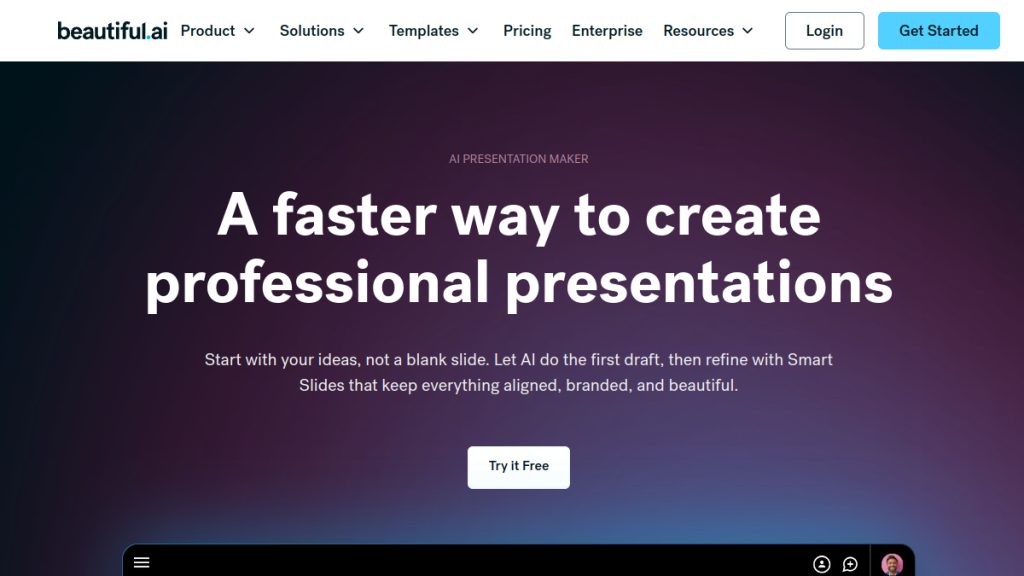
Beautiful.ai takes a different angle than Gamma. Instead of generating content from scratch, it focuses on keeping your slides visually consistent and automatically formatted as you add or edit content. Smart Slide templates adjust layouts dynamically — add a fourth bullet point and the slide restructures itself. It’s the tool that solves the “our slides look like a ransom note” problem for teams.
The AI design engine is the star feature. It enforces design consistency across slides, suggests layout improvements, and prevents the visual chaos that happens when multiple people edit the same deck. In 2026, Beautiful.ai added an AI content assistant that can generate slide copy and suggest visuals, closing the gap with Gamma for full-deck generation.
Pricing: No free plan. Pro at $12/month, Team at $40/month.
- Best-in-class smart formatting — slides always look professional
- Strong team features with brand kit enforcement and shared templates
- No free plan — you’re paying from day one
- Content generation is newer and not as strong as Gamma’s
Verdict: Solid choice for design-conscious teams who want their slides to look consistent without hiring a designer. Not the fastest for generation, but the design quality is high. Rating: 8.0/10
3. Tome — Best for Pitch Decks and Storytelling
Tome positioned itself as the AI storytelling tool, and it leans hard into narrative structure. It’s built for founders, strategists, and anyone who needs a presentation to tell a story rather than just list information. The AI understands narrative arc — it knows an investor deck needs a problem, solution, market, team, and ask structure. It won’t just dump bullet points in the right order.
The standout feature is AI-powered narrative threading. Tome’s AI keeps context across the whole deck, ensuring the story stays coherent from the first slide to the last. It also integrates generative images directly in the creation flow, so your slides have visuals that match the content — not just stock photos slapped in as an afterthought.
Pricing: Free tier available. Pro at $8/month.
- Better narrative coherence than most competitors — decks actually tell a story
- Built-in AI image generation keeps visual content relevant
- Design flexibility is more limited than Gamma or Beautiful.ai
- Less suited for data-heavy or technical presentations
Verdict: Great for pitch decks and narrative-driven presentations. If you’re raising money or trying to persuade someone, Tome is worth a look. Rating: 7.5/10
4. Canva AI Presentations — Best Free Option for Casual Users
Canva has always been the “good enough, easy enough” option, and its AI presentation features follow the same philosophy. Magic Design generates a complete deck from a prompt, and the quality is consistently decent — not jaw-dropping, but polished enough for internal meetings, school projects, or social media slides. The massive template library and drag-and-drop editor make it accessible to anyone who’s never built a presentation before.
The AI features include Magic Design (full-deck generation), Magic Write (AI copywriting), and AI-generated image integration. The generation is slower than Gamma and the output is more template-dependent, but the free tier is genuinely usable. Canva also wins on ecosystem — if you’re already using it for social graphics, adding presentations is zero friction.
Pricing: Free plan available. Canva Pro at $15/month (includes AI features).
- Best free option — the free plan covers most casual use cases
- Huge template library and dead-simple editor lowers the learning curve to zero
- AI generation quality lags behind Gamma — outputs feel more templated, less original
- Gets expensive when you need the full AI feature set (Pro plan)
Verdict: Perfect for casual users and anyone who needs slides quickly without spending money. Not the tool for professional pitches or high-stakes presentations. Rating: 7.5/10
5. Microsoft Copilot for PowerPoint — Best for Enterprise Users
If your company runs Microsoft 365, Copilot for PowerPoint is the natural choice — not because it’s the best AI presentation tool, but because it lives inside the tool your IT department already manages. Copilot can generate presentations from prompts, pull content from Word documents, summarize existing decks, write speaker notes, and suggest design improvements, all without leaving the PowerPoint interface.
The integration with Microsoft 365 is the real value prop. You can tell Copilot to “create a presentation based on this Word document” and it actually does it, pulling content, structure, and key points from your existing files. The generation quality is solid but conservative — expect clean corporate slides, not creative design.
Pricing: Requires Microsoft 365 Copilot license at $30/user/month on top of existing Microsoft 365 subscription.
- Deep Microsoft 365 integration — generates from Word docs, emails, and existing files
- Enterprise security and compliance already built in
- Expensive — $30/user/month is hard to justify for casual use
- Outputs are functional but rarely exciting — very corporate design sensibility
Verdict: The right call for enterprise teams already in the Microsoft ecosystem. Overkill and expensive for individuals or small teams. Rating: 7.0/10
6. Google Slides + Gemini — Best for Google Workspace Users
Google’s answer to Copilot is Gemini in Google Slides, and it’s decent — emphasis on decent. Gemini can generate slides from prompts, write content, suggest images from Google’s image library, and help restructure presentations. If your team lives in Google Workspace, it’s the path of least resistance. No new tools to learn, no additional software to install.
The honest assessment: Gemini in Slides isn’t keeping pace with Gamma or even Copilot on generation quality. The outputs are functional and the Google Workspace integration is seamless, but the AI doesn’t have the design sophistication of dedicated tools. It’s a solid “good enough” option that’s improving with each update — but in 2026 it still feels like playing catch-up.
Pricing: Gemini features available with Google Workspace plans starting around $12/user/month (Business Starter).
- Zero friction for existing Google Workspace users
- Real-time collaboration remains best-in-class
- AI generation quality is behind the dedicated tools on this list
- Design output is basic — it’s not going to impress anyone with visual taste
Verdict: Use it if you’re all-in on Google Workspace. Don’t use it if design quality matters. Rating: 6.5/10
7. Prezi AI — Best for Non-Linear, Cinematic Presentations
Prezi was polarizing when it launched (half the world loved it, half got motion sick), and that hasn’t changed. What has changed is that Prezi’s AI features have matured enough to make the creation process significantly less painful. The AI can generate non-linear presentation structures, suggest visual paths through content, and help with copy — all while maintaining Prezi’s signature zooming, cinematic presentation style.
If you need to stand out — a conference keynote, a sales demo, a presentation to a room that’s seen 10,000 PowerPoint decks — Prezi’s format still delivers. The AI helps reduce the steep learning curve that always made Prezi hard to recommend. But it’s still more complex than a slide-based tool, and the pricing is higher than most competitors.
Pricing: No free plan. Standard at $15/month, Plus at $25/month, Premium at $59/month.
- Unique non-linear format is genuinely memorable for live presentations
- AI reduces the complexity that previously made Prezi hard to use
- Expensive compared to competitors with similar or better AI features
- Overkill for internal meetings or quick-turnaround decks
Verdict: Worth considering if you present live and want to stand out. Not the right tool for document-style decks or quick content creation. Rating: 7.0/10
8. Slidebean — Best for Startup Pitch Decks
Slidebean is purpose-built for founders, and it shows. Unlike general presentation tools with AI bolted on, Slidebean was designed from the ground up around the startup fundraising use case. It understands pitch deck structure — problem, solution, market size, business model, traction, team, ask — and its AI helps you fill in the content with investor-appropriate language and framing.
The AI content suggestions are the standout feature. Slidebean doesn’t just format your text; it suggests what each slide should say based on your company type and stage. The design engine keeps everything polished and consistent. The tradeoff is that Slidebean is expensive and narrow — great for pitch decks, overkill and overpriced for anything else.
Pricing: Limited free plan. Content plan at $29/month. Premium services (deck reviews, consulting) cost extra.
- Best understanding of pitch deck structure and investor-ready content of any tool on this list
- Consistently polished design output without requiring any design input
- Expensive for a single-use-case tool
- Limited usefulness outside of pitch decks and startup presentations
Verdict: The go-to for startup founders building pitch decks. If that’s not your use case, save your money. Rating: 7.5/10
9. Pitch — Best for Team Collaboration + AI Design
Pitch combines real-time collaboration with AI design assistance in a way that feels genuinely integrated rather than tacked on. Teams can work on decks simultaneously, leave comments, manage versions, and use AI to generate slide content and design — all in one tool. It’s the closest thing to “Google Docs for presentations” with actual AI functionality.
The AI features include deck generation from outlines, design suggestions, and content rewrites. They’re solid but not class-leading — Pitch’s real differentiation is the collaboration layer. The interface is clean, the performance is fast, and the version history is robust. For marketing and sales teams building and iterating on decks regularly, Pitch reduces a lot of the friction that comes from emailing files back and forth.
Pricing: Free plan available. Pro at $8/month. Business plans available.
- Best team collaboration experience in this category
- Clean interface with strong version management and commenting
- AI generation isn’t as strong as Gamma for building from scratch
- Template library is smaller than Canva or Beautiful.ai
Verdict: The right pick for teams that iterate on presentations frequently. Solo users would be better served by Gamma. Rating: 8.0/10
10. SlidesAI — Budget Google Slides Add-On
SlidesAI is a Google Slides add-on that converts text into a presentation. You paste in content — an article, notes, a document — and it generates slides inside Google Slides. It’s simple, cheap, and does what it says. There’s not much more to it than that, which is both its strength and its limitation.
The standout feature is the simplicity of the input. Drop in a wall of text and get a structured presentation. The output quality is basic — think functional bullet-point slides, not visual masterpieces — but for anyone who just needs to quickly structure information into slide format, SlidesAI gets it done. It’s also the cheapest paid option on this list by a wide margin.
Pricing: Free plan (limited presentations). Basic at $10/month, Pro at $20/month.
- Dead simple to use — no new tools to learn if you’re already in Google Slides
- Cheapest paid option on this list
- Output quality is basic — don’t expect impressive design
- Limited compared to native Gemini features that Google is building into Slides anyway
Verdict: Fine for quick content structuring on a budget. Getting squeezed from above by Google’s own AI integration. Rating: 6.5/10
11. Decktopus — Complete AI-Built Decks
Decktopus markets itself as the AI tool that builds your entire presentation — content, design, speaker notes, and all. That claim holds up reasonably well. Enter a topic and a few parameters, and Decktopus generates a complete deck in under a minute. The design quality is above average for fully automated output, and the included speaker notes are a useful bonus that most competitors ignore.
Where Decktopus falls short is customization. The tool is strongest when you let the AI drive; the manual editing experience is more limited than Gamma, Beautiful.ai, or Pitch. If you need a quick deck and plan to use most of what the AI generates, Decktopus is efficient. If you need deep customization, you’ll hit walls.
Pricing: AI plans starting at $8/month. No strong free tier.
- Fast full-deck generation with speaker notes included
- Design quality is consistently above average for auto-generated output
- Manual editing and customization is more restricted than competitors
- Limited template variety means similar-looking output across different topics
Verdict: Good for speed over customization. A solid Gamma alternative but doesn’t beat it on any dimension. Rating: 7.0/10
12. Simplified — AI Slides + Broader Design Suite
Simplified positions itself as an all-in-one AI creative suite — social content, copy, images, video, and presentations under one roof. The presentation tool is competent, generating full decks from prompts with reasonable design quality. If you already use Simplified for other content tasks, adding presentations is frictionless. If presentations are your primary use case, there are better-focused options.
The AI presentation generator works well for marketing and social-style decks. Templates lean toward visually bold layouts with strong color use. The integration with Simplified’s broader suite means you can generate a presentation and repurpose it as social content in the same workflow — a genuine advantage for content marketing teams. But the presentation tool on its own doesn’t outperform the specialists on this list.
Pricing: Free plan available. Pro plans starting at $12/month.
- Strong integration with broader design and content tools in the Simplified suite
- Good template quality for marketing and social-oriented presentations
- Jack of all trades — the presentation tool doesn’t lead the category in any specific area
- Best value only if you’re using the full Simplified suite
Verdict: Worth it if you’re a content team that wants one tool for everything. Overkill if presentations are your only need. Rating: 7.0/10
How We Tested
Every tool on this list was tested using the same set of tasks: generate a deck from a cold prompt (“create a pitch deck for a B2B SaaS company targeting HR teams”), generate a presentation from an existing document, manually edit and customize output, and export to PowerPoint or PDF. We evaluated on generation speed, output quality (design and content), editing flexibility, collaboration features, and value relative to price. Tools were tested across multiple prompt types — technical, creative, and business use cases — to assess consistency. We also considered free tier usability, since a tool that’s only good when you pay $30/month has limited real-world utility for most users. Ratings reflect the honest experience of someone who needs to build actual presentations, not a vendor’s feature checklist.
How to Choose an AI Presentation Tool
What do you actually need it to do? If you need full decks from scratch, Gamma and Decktopus are built for that. If you need design consistency for a team, Beautiful.ai is the call. If you’re a founder building a pitch deck, Slidebean understands that problem better than anyone. Define the use case before you evaluate tools.
What’s your workflow? If you live in Google Workspace, the path of least resistance is Gemini in Slides. If you’re all-in on Microsoft 365, Copilot for PowerPoint keeps you in your existing ecosystem. Switching tools has a real time cost — only do it if the capability gain is worth the friction.
Does design quality matter for this use case? For internal team meetings, functional and fast wins. For investor pitches, client presentations, or conference talks, design quality directly affects credibility. Match the tool to the stakes of the presentation.
Are you working solo or with a team? Solo users get the most value from generation-focused tools (Gamma, Decktopus, Tome). Teams benefit from collaboration features — Pitch is the strongest here, followed by Beautiful.ai and Google Slides.
What’s the actual cost? Free tiers vary wildly. Gamma’s free plan is genuinely useful. SlidesAI’s free plan is nearly useless. Canva Pro at $15/month covers most casual use cases. Microsoft Copilot at $30/user/month on top of your existing Microsoft subscription adds up fast. Factor in how frequently you’ll actually build presentations before committing to a paid plan.
Frequently Asked Questions
What is the best AI presentation tool in 2026?
Gamma is the best overall AI presentation tool in 2026. It generates complete, design-ready decks from a single text prompt, offers a generous free tier, and produces results that actually look professional without requiring design skills.
Can AI tools really generate a full presentation from a prompt?
Yes. Tools like Gamma, Decktopus, and Tome can generate a full presentation — including slide structure, content, and design — from a single text prompt in under 60 seconds. Quality varies, but the output is typically usable with minor edits.
Are there free AI presentation tools?
Yes. Gamma, Canva AI, Google Slides with Gemini, and SlidesAI all offer free plans or free tiers. Gamma’s free plan is the most generous, allowing multiple AI-generated decks per month.
What is the best AI tool for startup pitch decks?
Slidebean is purpose-built for startup pitch decks. It understands pitch deck structure, suggests investor-ready content, and formats everything cleanly. Gamma is also a strong option for rapid prototyping pitch decks.
Does Microsoft PowerPoint have AI features in 2026?
Yes. Microsoft Copilot for PowerPoint can generate slides from prompts, summarize documents into decks, suggest design improvements, and write speaker notes. It requires a Microsoft 365 Copilot subscription, which starts at $30/user/month.
What’s the difference between Gamma and Beautiful.ai?
Gamma focuses on AI generation from scratch — give it a prompt, get a full deck. Beautiful.ai focuses on smart design automation, keeping slides visually consistent as you edit. Gamma is faster for creation; Beautiful.ai is better for teams that want design guardrails.
Can I use AI to improve an existing PowerPoint presentation?
Yes. Microsoft Copilot for PowerPoint and Beautiful.ai both allow you to import existing presentations and apply AI-driven design improvements, content rewrites, and structural suggestions.
What AI presentation tool is best for teams?
Pitch is the strongest option for team collaboration combined with AI design assistance. It features real-time collaboration, version history, commenting, and AI-assisted design — making it ideal for marketing and sales teams.
Is Prezi still relevant in 2026?
Prezi is still relevant for presenters who want non-linear, cinematic presentations that stand out. Its AI features help with content and flow, though the learning curve and pricing are higher than most competitors.
How much do AI presentation tools cost?
AI presentation tools range from free (Canva, Gamma free tier, Google Slides + Gemini) to $30+/month for enterprise tools like Microsoft Copilot. Most mid-tier tools like Beautiful.ai, Tome, and Pitch run $8–$20/month per user.