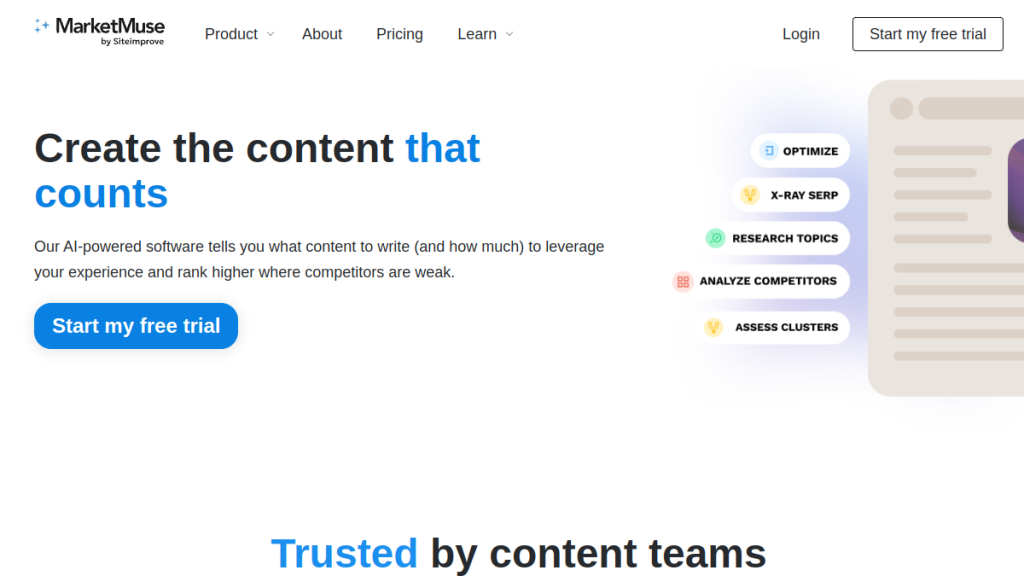
Your content strategy is guesswork disguised as planning — you’re publishing articles based on hunches, not data about what your audience actually searches for. MarketMuse uses AI to build content strategies based on topic modeling and competitive gaps, but its opaque pricing and complex interface scare off many teams. Here’s our honest assessment of whether MarketMuse’s advanced features justify its learning curve and cost.
What Is MarketMuse?
MarketMuse is an AI-powered content intelligence platform founded in 2013 by Aki Balogh and Jeff Coyle. Headquartered in Boston, it’s one of the original players in the content optimization space — it was using AI and natural language processing for content analysis years before the current AI hype cycle.
At its core, MarketMuse does three things:
- Analyzes your entire content inventory to find strengths, weaknesses, and gaps
- Models topics using patented AI that goes beyond basic keyword research
- Generates content briefs and strategy documents that tell you exactly what to create, update, or kill
What sets it apart from tools like Surfer SEO or Frase is its emphasis on content strategy at scale rather than page-level optimization. MarketMuse doesn’t just tell you which keywords to sprinkle into a blog post. It maps out your entire topical authority landscape and shows you where to invest your content dollars for maximum impact.
That sounds great on paper. But is it worth the investment in 2026? Let’s break it down.
Key Features (Detailed Breakdown)
1. Content Inventory & Site Analysis
This is MarketMuse’s crown jewel — and the feature that most competitors simply can’t match.
When you connect your site, MarketMuse’s AI crawls your entire content inventory and analyzes every page. It doesn’t just look at meta tags and word counts. It reads your content, extracts entities and topics, and builds a comprehensive map of what your site covers (and what it doesn’t).
For each page, you get:
- Content Score — how well your page covers its target topic compared to competitors
- Topic Authority — a proprietary metric measuring your domain’s depth and breadth on a topic
- Personalized Difficulty — how hard it is for your specific site to rank for a topic (not a generic difficulty score)
- Competitive Advantage — the gap between generic difficulty and your personalized difficulty
This is genuinely useful. Most SEO tools give you a one-size-fits-all “keyword difficulty” number. MarketMuse says, “Based on your existing authority in machine learning topics, this keyword is actually easier for you than the generic score suggests.” That kind of personalized intelligence is a real differentiator.
The catch: This feature is only available on paid plans. Free users don’t get site inventory access.
2. Topic Navigator & Research
MarketMuse’s Topic Navigator lets you explore any topic and see related subtopics, questions, and content opportunities. It uses a patented topic modeling algorithm that analyzes hundreds to thousands of pages per query — not just the top 10 Google results.
This matters because most competing tools (including Surfer SEO and Frase) build their topic models from the top 20-30 SERP results. MarketMuse goes wider and deeper, which generally produces more comprehensive and less “copycat” recommendations.
You can use Topic Navigator to:
- Discover subtopics you haven’t covered
- Identify questions your audience is asking
- Find content gaps in your competitors’ coverage
- Understand the semantic relationships between topics
3. Content Briefs
MarketMuse’s content brief generator is one of the most robust on the market. Unlike basic brief generators that spit out a keyword list and a suggested word count, MarketMuse briefs are comprehensive production documents.
Each brief includes:
- Recommended topics and subtopics to cover
- Suggested headings and content structure
- Questions to answer
- Internal and external linking suggestions
- Target Content Score to aim for
- Competitor analysis showing what top-ranking pages cover
What’s particularly impressive is the brief customization. You can specify:
- Point of View — the core message you want to convey
- Expertise level — how deep to go technically
- Style and tone — conversational, academic, persuasive, etc.
- Target market — persona, location, reading level
- Buyer journey stage — awareness, consideration, decision
- Fact statements — verifiable claims to include
MarketMuse offers 9 content brief types tailored to different formats:
- Article
- Comparison
- FAQ Collection
- Guide
- How-to
- Listicle
- Local
- News/Event
- Product Review
This is a genuine advantage for teams managing freelance writers. Instead of spending an hour crafting a brief, you generate one in minutes, customize it, and hand it off. The writer knows exactly what to cover, and the editor can score the draft against MarketMuse’s topic model to check completeness.
The catch: Brief types beyond Article are only available on the Strategy tier.
4. Content Strategy Documents
Content Strategy Documents are essentially AI-generated editorial plans. You give MarketMuse a topic area, and it analyzes your site, your competitors, and the SERP landscape to produce a structured content plan.
Each document includes:
- Executive Summary — competitive forces and analysis overview
- Content Plan Recommendations — specific pages to create or update, with priorities
- Content Strategy — content groups and descriptions for thorough topic coverage
- Cluster Details — keywords in each cluster, your current rankings, and opportunities
This feature is designed to replace the weeks-long content audit and planning process that most teams do in spreadsheets. In my experience, it does a solid job of identifying low-hanging fruit and gaps — though you’ll still want a human strategist to layer on business context and editorial judgment.
5. SERP X-Ray & Heatmap
The SERP X-Ray tool lets you analyze what’s currently ranking for any topic. It breaks down the top results by:
- Content Score
- Word count
- Number of headings, images, and links
- Topic coverage gaps
- Search intent signals
The Heatmap feature is a visual representation of topic coverage across the top SERP results (or across your own site’s content cluster). Green squares mean the topic is well-covered; red squares indicate gaps. It’s an intuitive way to spot opportunities at a glance.
All subscription tiers have access to the SERP heatmap. The site-level heatmap (which is the really valuable one for your own content) is limited to the Strategy tier.
6. Optimize (Content Editor)
MarketMuse’s Optimize application is where you actually write or edit content. It works similarly to Surfer SEO’s Content Editor or Clearscope’s editor — you paste in your text, and it scores your content in real-time against the topic model.
As you write, you see:
- Your current Content Score vs. the target
- Recommended topics you haven’t mentioned yet
- Topics you’ve over-optimized (keyword stuffing warnings)
- Structural recommendations
MarketMuse also includes a generative AI component for drafting content, though they position themselves primarily as a research and strategy platform rather than an AI writing tool. The AI drafting is there to speed up production, not replace your writers.
7. Content Clusters & Internal Linking
MarketMuse helps you plan and build topic clusters — groups of interrelated content pieces that establish topical authority. It shows you:
- Which clusters you already have strength in
- Where your clusters have gaps
- How deep competitors go on the same topics
- Recommended internal links to connect your cluster pages
This is increasingly important for SEO in 2026. Google’s algorithms heavily favor sites that demonstrate comprehensive topical coverage. A single page on “content marketing” won’t cut it — you need a cluster of supporting content, and MarketMuse helps you plan that strategically.
Pricing & Plans
Here’s where things get complicated — and frankly, a bit frustrating.
MarketMuse offers four tiers, but they no longer publish dollar pricing on their website for paid plans. You have to contact their sales team or start a free trial to see actual numbers. This is a trend in B2B SaaS that drives buyers (and reviewers) crazy, but here’s what we know:
Free Plan
- Price: $0/month
- Users: 1
- Queries: 10/month
- Site Inventory: No
- Content Briefs: No
- Strategy Documents: No
- Tracked Topics: None
- Export: Saved writing only
The free plan is useful for kicking the tires, but 10 queries per month is extremely limiting. You’ll burn through that in a single research session.
Optimize Plan
- Price: Contact sales (historically ~$99-149/month based on third-party reports)
- Users: 1
- Queries: 100/month
- Site Inventory: 1 site
- Content Briefs: 5/month (Article type only)
- Strategy Documents: 1/month
- Tracked Topics: 100
Research Plan
- Price: Contact sales (historically ~$249-399/month)
- Users: 3
- Queries: Unlimited
- Site Inventory: 1 site
- Content Briefs: 10/month (Article type)
- Strategy Documents: 3/month
- Tracked Topics: 1,000
Strategy Plan
- Price: Contact sales (historically ~$499-999/month)
- Users: 5
- Queries: Unlimited
- Site Inventory: 1 site
- Content Briefs: 20/month (all 9 brief types)
- Strategy Documents: 5/month
- Tracked Topics: 10,000
Important note: These price estimates are based on historical pricing and third-party reports. MarketMuse has changed their pricing structure multiple times over the years. The only way to get a current quote is to contact them directly. Enterprise plans with custom pricing are also available.
My take on the pricing: The lack of transparent pricing is a legitimate knock against MarketMuse. In 2026, buyers expect to see numbers before hopping on a sales call. Competitors like Surfer SEO ($89-$219/month) and Frase ($15-$115/month) publish pricing right on their websites. If you’re an agency or enterprise team, the sales process is expected. But if you’re a small business or solo content marketer, the pricing opacity feels like a barrier by design.
Pros & Cons
✅ Pros
- Best-in-class topic modeling — MarketMuse’s patented AI goes deeper than any competitor. It doesn’t just scrape the top 10 SERP results; it analyzes hundreds to thousands of pages to build genuinely comprehensive topic models.
❌ Cons
- Opaque pricing — Not publishing prices forces you into a sales process just to evaluate whether it fits your budget. This is especially frustrating for small teams doing tool comparisons.
- Steep learning curve — MarketMuse is powerful but not intuitive. Expect to invest several hours understanding the metrics, workflows, and interface before getting real value. The UI, while functional, feels dated compared to sleeker competitors like Surfer or Frase.
- Free plan is nearly useless — 10 queries per month with no site inventory, no briefs, and no strategy documents barely lets you test the platform. Competitors offer much more generous free tiers.
- Content limits on paid plans feel restrictive — Even on the Research plan ($250+/month), you only get 10 content briefs per month. If you’re producing 20+ pieces of content monthly, you’ll need the Strategy tier.
- Overkill for small sites — If you’re running a blog with 50 posts, you don’t need an enterprise content intelligence platform. The ROI math doesn’t work until you’re operating at scale.
- No built-in rank tracking — You’ll still need a separate tool (like Ahrefs, Semrush, or SE Ranking) for keyword rank monitoring.
- Slow loading times — Running analyses on large datasets can be slow. Some users report waiting several minutes for complex queries to process.
- Strategy Document quality varies — While often excellent, the AI-generated content plans sometimes include recommendations that don’t make strategic sense for your specific business context. Human oversight is essential.
Who Is MarketMuse For?
Ideal Users ✅
- Content teams producing 10+ articles per month — This is MarketMuse’s sweet spot. If you’re publishing at volume and need to ensure every piece is strategically aligned, the content intelligence pays for itself.
- SEO agencies managing multiple client sites — The content inventory and competitive analysis features are incredibly efficient for agency workflows, especially during the audit and strategy phases.
- Enterprise content marketing teams — If you have dedicated content strategists, editors, and writers, MarketMuse provides the data layer that makes the entire workflow more efficient.
- Publishers with large existing content libraries — If you have 500+ published pages and need to prioritize what to update, create, or consolidate, MarketMuse’s inventory analysis is unmatched.
- SaaS companies investing heavily in organic content — The topic authority and cluster planning features align perfectly with the kind of comprehensive content strategy that drives SaaS growth.
Not Ideal For ❌
- Solo bloggers or very small sites — The pricing doesn’t justify the output for sites publishing 2-4 articles per month. You’d be better served by Surfer SEO or Frase.
- Budget-conscious teams under $100/month for tools — MarketMuse’s paid plans will exceed this budget. Look at Frase or even free tools like Google Search Console + ChatGPT for keyword research.
- Teams that need an all-in-one SEO platform — MarketMuse focuses on content strategy and optimization. It doesn’t do backlink analysis, rank tracking, or technical SEO audits. You’ll still need supplementary tools.
- Anyone wanting plug-and-play simplicity — If you want to type a keyword and get a content score in 30 seconds, Surfer SEO or Clearscope will feel more immediate. MarketMuse rewards deeper engagement.
MarketMuse vs. the Alternatives
MarketMuse vs. Surfer SEO
Surfer SEO ($89-$219/month) is probably MarketMuse’s most direct competitor, but they serve different use cases.
Surfer is the better choice for page-level optimization — its Content Editor is faster, the NLP suggestions are solid, and the SERP Analyzer gives you actionable recommendations quickly. It’s also more affordable and easier to learn.
MarketMuse wins on strategy and scale. If you need to plan a 100-article content program, analyze your topic authority across thousands of pages, and generate detailed content briefs with customized formats — MarketMuse is significantly more capable.
Choose Surfer if: You need fast, affordable content optimization for individual pages.
Choose MarketMuse if: You need content intelligence and strategy planning at scale.
MarketMuse vs. Frase
Frase ($15-$115/month) is the budget-friendly alternative that’s gained a massive following among solo content creators and small teams.
Frase excels at AI-assisted content creation — its answer engine research, content brief generation, and AI writing features are solid and affordable. For the price, it’s hard to beat.
MarketMuse’s advantage is depth of analysis and proprietary data. Frase pulls from SERP data and uses standard NLP approaches. MarketMuse uses patented topic modeling that produces fundamentally different (and often better) recommendations. But you pay 3-10x more for that depth.
Choose Frase if: You want the best value for content optimization on a budget.
Choose MarketMuse if: You need enterprise-grade content intelligence with personalized metrics.
MarketMuse vs. Clearscope
Clearscope (~$170-$350/month) sits between Surfer and MarketMuse in both price and capability.
Clearscope is known for its clean interface and content grading system. It’s particularly popular with editorial teams because the interface is intuitive and writers can self-serve. The content reports are easy to understand and act on.
MarketMuse offers more strategic depth — content inventories, cluster analysis, personalized difficulty, and multiple brief types that Clearscope doesn’t match. But Clearscope is easier to adopt and has a less intimidating learning curve.
Choose Clearscope if: You want a polished content optimization tool that’s easy for writers to adopt.
Choose MarketMuse if: You need content strategy planning beyond page-level optimization.
Quick Comparison Table
| Feature | MarketMuse | Surfer SEO | Frase | Clearscope |
|---|---|---|---|---|
| Starting Price | Free (paid plans: contact sales) | $89/mo | $15/mo | ~$170/mo |
| Content Optimization | ✅ | ✅ | ✅ | ✅ |
| Content Briefs | ✅ (9 types) | ✅ (basic) | ✅ | ❌ |
| Topic Modeling Depth | ⭐⭐⭐⭐⭐ | ⭐⭐⭐ | ⭐⭐⭐ | ⭐⭐⭐⭐ |
| Site Inventory | ✅ | ❌ | ❌ | ❌ |
| Personalized Metrics | ✅ | ❌ | ❌ | ❌ |
| Cluster Analysis | ✅ | ✅ (basic) | ❌ | ❌ |
| Content Strategy Docs | ✅ | ❌ | ❌ | ❌ |
| Competitive Analysis | ✅ | ✅ | ✅ (limited) | ✅ (limited) |
| AI Writing | ✅ (basic) | ✅ | ✅ (strong) | ❌ |
| Ease of Use | ⭐⭐⭐ | ⭐⭐⭐⭐⭐ | ⭐⭐⭐⭐ | ⭐⭐⭐⭐⭐ |
| Best For | Strategy at scale | Page optimization | Budget-friendly | Editorial teams |
Related Reading
For comprehensive SEO and content optimization, consider these complementary tools:
- Clearscope Review 2026 – Content optimization and keyword research
- Surfer SEO Review 2026 – Complete SEO content platform
- Best AI SEO Tools 2026 – Complete buyer’s guide to SEO tools
- Byword Review 2026 – AI SEO article generation
- Content at Scale Review 2026 – AI-powered SEO content creation
Frequently Asked Questions
Is MarketMuse free?
Yes, MarketMuse offers a free plan — but it’s extremely limited. You get 1 user, 10 queries per month, no site inventory, no content briefs, and no strategy documents. It’s enough to see how the interface works, but you won’t get meaningful value without upgrading. Think of it as a demo, not a working tool.
Is MarketMuse worth the money?
It depends entirely on your scale. If you’re a content team producing 10+ articles per month and spending $5,000+ on content creation, MarketMuse can easily justify its cost by improving the success rate of every piece you publish. If you’re a solo blogger or small team, the ROI math probably doesn’t work — you’d be better served by Surfer SEO or Frase at a fraction of the price.
How does MarketMuse’s Content Score work?
For any given topic, MarketMuse’s AI builds a model of relevant subtopics and their semantic relationships. It then analyzes your content to score how comprehensively you cover those subtopics. It also calculates Content Scores for top-ranking competitor pages and generates a “Target Content Score” you should aim for. The scoring goes beyond simple keyword counting — it understands topical relationships and context.
Can MarketMuse replace my SEO tools?
No. MarketMuse is a content intelligence and strategy platform, not an all-in-one SEO suite. You’ll still need tools for rank tracking (SE Ranking, Ahrefs), backlink analysis (Ahrefs, Semrush), technical SEO audits (Screaming Frog, Sitebulb), and other SEO functions. MarketMuse complements these tools — it doesn’t replace them.
How is MarketMuse different from Surfer SEO?
The core difference is scope. Surfer SEO is excellent for optimizing individual pages — you get a content editor, NLP suggestions, and SERP analysis. MarketMuse operates at the strategy level — it analyzes your entire content inventory, builds topic authority models, generates multi-page content plans, and offers personalized difficulty metrics. Surfer tells you how to write a better page. MarketMuse tells you which pages to write (and why).
Does MarketMuse use AI to write content?
MarketMuse includes a generative AI component in its Optimize application for drafting content, but the company positions itself primarily as a research and planning platform. The AI writing feature is meant to accelerate production, not replace human writers. Their real value is in the topic modeling, competitive analysis, and strategic planning that informs what you should write — not in writing it for you.
How long does it take to learn MarketMuse?
Budget at least 1-2 weeks of active use before you’re comfortable with the platform. MarketMuse has a steeper learning curve than tools like Surfer or Clearscope because it offers more capabilities and uses proprietary metrics that take time to understand. Their Knowledge Base and MarketMuse Academy offer helpful onboarding resources, but this isn’t a “sign up and go” tool.
Final Verdict
🏆 Our Verdict
MarketMuse occupies a unique position in the content optimization market. While competitors like Surfer SEO and Frase have gotten easier and cheaper, MarketMuse has doubled down on being the strategic content intelligence platform — the tool for teams that need to think about their content program holistically, not just optimize individual pages.
What it does exceptionally well:
- Automated content inventory analysis with proprietary, personalized metrics
- Topic modeling that goes deeper than any competing tool
- Content planning and strategy at scale
- Comprehensive, customizable content briefs
Where it falls short:
- Pricing transparency is nonexistent for paid tiers
- The free plan barely qualifies as usable
- Learning curve is steeper than competitors
- Overkill (and overpriced) for small-scale operations
The bottom line: MarketMuse is a premium tool that delivers premium insights — but only if you have the content volume and team to act on them. If you’re publishing at scale and every piece of content represents a significant investment, MarketMuse gives you the intelligence to make that investment count. If you’re publishing a few blog posts a month, your money is better spent elsewhere.
Our recommendation:
- For enterprise/agency teams (10+ articles/month): Strongly consider MarketMuse. Start with the free trial, evaluate the content inventory and strategy features, and compare the ROI against your current planning process.
- For mid-size teams (5-10 articles/month): The Optimize tier is worth exploring, but compare carefully with Clearscope and Surfer SEO’s higher tiers.
- For solo creators/small teams (< 5 articles/month): Skip MarketMuse. Frase or Surfer SEO will serve you better at a fraction of the cost.
Rating: 4.1 / 5 — Excellent for its intended audience, but the pricing opacity and accessibility barriers prevent a higher score.
This review is based on hands-on evaluation of MarketMuse’s platform, analysis of their public documentation, and comparison with competing tools. Pricing information reflects our best available data as of February 2026 — contact MarketMuse directly for current quotes. Some links in this article may be affiliate links, meaning we earn a commission at no extra cost to you if you purchase through them.
Frequently Asked Questions
What exactly is MarketMuse and how does it work?
MarketMuse is an AI-powered content intelligence platform that analyzes your entire content inventory to identify strengths, weaknesses, and gaps. It uses patented AI technology to model topics and generate content briefs, helping you create a more effective content strategy.
How does MarketMuse differ from other SEO tools like Surfer SEO?
Unlike tools such as Surfer SEO, which focus on page-level optimization, MarketMuse emphasizes content strategy at scale. It provides a comprehensive analysis of your topical authority and suggests where to invest your content efforts for maximum impact.
Is the pricing of MarketMuse transparent?
MarketMuse’s pricing is often described as opaque, which can be a deterrent for some teams. While the specific costs may vary, potential users should reach out for a detailed quote to understand the investment required.
What are the key features of MarketMuse?
Key features of MarketMuse include content inventory and site analysis, which evaluates your entire content for strengths and gaps, and personalized difficulty scores that assess how hard it is for your site to rank on specific topics.
Can MarketMuse help improve my content strategy?
Yes, MarketMuse is designed to enhance your content strategy by providing data-driven insights into what topics to cover and how to optimize existing content. Its AI-generated content briefs guide you on what to create, update, or remove.
Is MarketMuse worth the investment in 2026?
While MarketMuse has a learning curve and a potentially high cost, many find its advanced features and comprehensive analysis justify the investment. It ultimately depends on your specific content needs and budget.
Who founded MarketMuse and when?
MarketMuse was founded in 2013 by Aki Balogh and Jeff Coyle. It has been a pioneer in the content optimization space, utilizing AI and natural language processing long before the current AI trend.