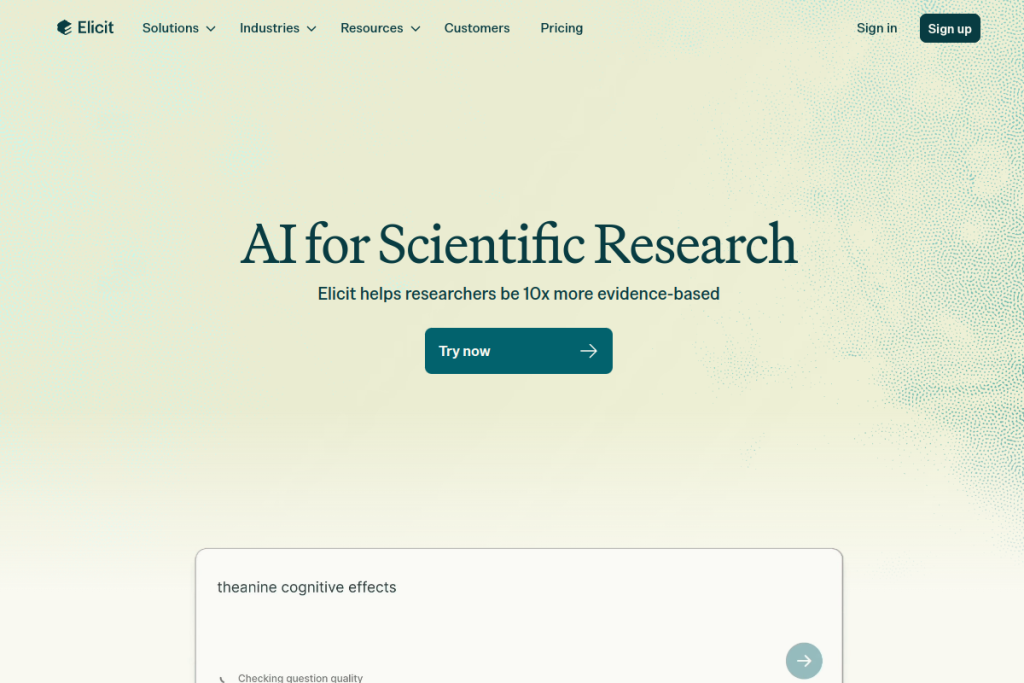
Academic research used to take weeks of library diving and citation chasing, but you need systematic literature reviews done in hours, not months. Elicit has access to 138 million scientific papers and can run automated research workflows that replace traditional systematic reviews. After testing it against manual research methods, here’s whether this AI research assistant lives up to its ambitious promises.
Table of Contents
What Is Elicit?
Elicit is an AI-powered research assistant designed specifically for scientific and academic research. Unlike general-purpose AI tools like ChatGPT or Perplexity, Elicit is built from the ground up to help you find, analyze, and synthesize information from peer-reviewed research papers.
Founded by a team with deep roots in effective altruism and AI safety research, Elicit started as a tool focused on literature review automation. It has since evolved into a comprehensive research platform that can handle everything from quick literature searches to full systematic reviews — and as of late 2025, agentic research workflows that go well beyond academic papers.
The core philosophy behind Elicit is what sets it apart: systematic, transparent, and evidence-grounded. Every claim the AI makes can be traced back to a specific source. Every summary links to the original paper. This isn’t a tool that makes things up and hopes you won’t notice — it’s designed for people who care about accuracy and rigor.
Elicit currently indexes more than 138 million academic papers and over 500,000 clinical trials, making its database one of the most comprehensive in the AI research tool space.
Key Features (Detailed Breakdown)
1. Semantic Paper Search
At its core, Elicit lets you search for research papers using natural language queries. Instead of wrestling with Boolean operators and keyword combinations like you would on PubMed or Google Scholar, you can ask questions the way you’d ask a colleague.
Type something like “What are the long-term cognitive effects of intermittent fasting?” and Elicit returns relevant papers ranked by semantic relevance — not just keyword matching. This means it understands the meaning behind your question and surfaces papers that address your actual research question, even if they use different terminology.
The search covers over 138 million papers from sources like Semantic Scholar’s corpus, and Plus users get access to a dedicated clinical trials database with over 500,000 entries.
2. AI-Powered Paper Summaries
For every paper Elicit finds, it generates a concise, plain-language summary of the key findings. These aren’t generic abstracts copied from the journal — they’re AI-generated summaries tailored to your specific research question.
This is a massive time-saver. Instead of opening 50 PDFs and skimming each one, you can scan Elicit’s summaries to quickly identify which papers are actually relevant to your work. The summaries are available on the free plan with unlimited usage, which is genuinely generous.
3. Interactive Data Tables
One of Elicit’s most powerful features is its table-based extraction system. You can create structured tables where each row is a paper, and each column extracts specific information — things like sample size, methodology, key findings, population studied, or any custom field you define.
This effectively automates the data extraction phase of literature reviews that traditionally takes researchers days or weeks. The AI reads through full papers and populates your table columns automatically.
The number of columns you can add at once depends on your plan:
- Basic (Free): 2 columns at a time
- Plus: 5 columns at a time
- Pro: 20 columns at a time
- Scale: 30 columns at a time
4. Chat with Papers (Full-Text Access)
Elicit lets you have a conversation with individual papers or groups of papers. Upload a PDF or select papers from your search results, and you can ask specific questions about the methodology, findings, limitations, or anything else.
What makes this better than just pasting a PDF into ChatGPT? Elicit’s chat is grounded in the actual text — it shows you exactly which passages it’s drawing from, so you can verify the AI’s interpretation against the source material. This is unlimited on all plans, including the free tier.
5. Automated Reports
Elicit can generate comprehensive research reports that synthesize findings across multiple papers. Think of it as an AI-written literature review that you can use as a starting point for your own work.
The report feature pulls together themes, identifies consensus and disagreement across studies, and organizes the information into a readable narrative — all with citations back to the source papers. As of late 2025, reports can draw from up to 80 papers (doubled from the previous limit of 40), giving you genuinely comprehensive coverage.
Report allowances by plan:
- Basic: 2 per month
- Plus: 4 per month
- Pro: 12 per month (reports or systematic reviews)
- Scale: 20 per month
6. Systematic Review Workflow (Pro+)
This is where Elicit really separates itself from every competitor. The dedicated systematic review workflow walks you through the entire process:
- Define your research question and screening criteria
- Search across the full paper database
- Screen papers against your inclusion/exclusion criteria (AI-assisted)
- Extract data into structured tables
- Generate a synthesis report from included papers
The December 2025 update added strict screening criteria — you can mark specific criteria as mandatory, and papers that fail any strict criterion are automatically excluded. This mirrors how traditional systematic reviews work and makes the screening process far more rigorous.
For medical researchers, policy analysts, and anyone required to conduct formal literature reviews, this feature alone justifies the Pro subscription.
7. Research Agent Workflows (Pro+)
Launched in December 2025, Elicit’s Research Agent represents a major expansion of what the platform can do. Rather than being limited to academic papers, the Research Agent can search the broader web, including:
- Clinical trial databases (ClinicalTrials.gov)
- Regulatory documents
- Press releases and company announcements
- Product labels and filings
Four pre-built workflows are available:
- Competitive Landscapes — Compare products, companies, or therapeutic approaches across multiple source types
- Research Landscapes — Map the full scope of work happening in a field
- Clinical Trial Analyses — Analyze trial designs, endpoints, and outcomes across studies
- Topic Exploration — Open-ended research on any topic with iterative chat
The agent doesn’t just search and dump results. It first asks clarifying questions to understand your needs, then breaks your prompt into a systematic program, executes it, and produces structured output. You can then iterate — asking follow-up questions, requesting modifications, or spinning up new analyses within the same session.
This is currently in beta and available to Pro, Scale, and Enterprise users.
8. Research Alerts
Pro users can subscribe to up to 10 personalized research alerts, so Elicit notifies you when new papers matching your interests are published. This is great for staying current in fast-moving fields without manually checking databases every week.
9. Zotero Integration & Export Options
Elicit integrates with Zotero (free tier and above) for importing your existing reference library. Plus users and above can export to RIS, CSV, BIB, PDF, and DOCX formats — essential for anyone who needs to move data into reference managers, spreadsheets, or word processors.
10. Figure Interpretation (Scale+)
Scale and Enterprise users get the ability to extract and interpret data from figures and charts within research papers. This is a feature that most competitors don’t even attempt, and it’s incredibly useful for extracting quantitative data that’s only presented visually in publications.
11. Real-Time Collaboration (Scale+)
For teams working on joint research projects, the Scale plan offers live editing and real-time collaboration features, along with an admin panel for usage tracking and seat management.
Pricing & Plans (2026)
Elicit offers five tiers. Annual billing is significantly cheaper than monthly for all paid plans.
| Plan | Annual Price | Monthly Equivalent | Best For |
|---|---|---|---|
| Basic | Free | Free | Casual exploration, students |
| Plus | $120/year | ~$10/month | Regular researchers, grad students |
| Pro | $499/year | ~$41.58/month | Serious researchers, professionals |
| Scale | $780/year | ~$65/month | Research teams, departments |
| Enterprise | Custom | Custom | Large organizations, pharma |
Basic (Free) — What You Get
Don’t underestimate the free tier. You get:
- Unlimited search across 138M+ papers
- Unlimited AI summaries
- Unlimited chat with papers (full-text)
- 2 automated reports per month
- 2 table columns at a time
- Source viewing for all answers
- Zotero import
This is enough for a student doing occasional research or someone evaluating the platform. The unlimited search and summaries alone are more generous than most competitors’ free tiers.
Plus ($120/year) — The Sweet Spot for Most Users
Everything in Basic, plus:
- Export to RIS, CSV, BIB, PDF, DOCX
- 4 automated reports per month
- 5 table columns at a time
- Clinical trials database access (500K+ trials)
At $10/month, this is the plan most individual researchers should consider. The export functionality is essential for anyone doing serious work, and access to the clinical trials database is a significant upgrade.
Pro ($499/year) — For Power Users
Everything in Plus, plus:
- Dedicated Systematic Review workflow
- Research Agent workflows (beta)
- 12 reports or systematic reviews per month
- 20 table columns at a time
- Reports extract from up to 40 data sources (vs. 10)
- 10 personalized research alerts
- Custom extractions from uploaded papers
- Explanations for AI-generated answers
The Pro tier is where Elicit transforms from a helpful search tool into a genuine research workstation. If your job involves conducting literature reviews, the systematic review workflow and Research Agent alone are worth the investment.
Scale ($780/year) — For Teams
Everything in Pro, plus:
- Figure interpretation from papers
- Live editing and real-time collaboration
- 20 reports or systematic reviews per month
- 30 table columns at a time
- Admin panel with usage tracking and seat management
Enterprise (Custom Pricing)
For large organizations needing:
- Volume discounts
- Custom data configuration
- Co-branding of notebooks and assets
- Custom workflow development
- Screening from 1,000 papers at a time
Pros and Cons
✅ Pros
- Unmatched for systematic reviews — No other AI tool offers a dedicated, end-to-end systematic review workflow this comprehensive
- Massive paper database — 138M+ papers and 500K+ clinical trials means you’re unlikely to miss relevant literature
- Transparency and citations — Every AI-generated claim links back to the source, making verification easy
- Generous free tier — Unlimited search, summaries, and chat with papers on the free plan is genuinely useful
- Research Agent is a significant — The ability to search beyond academic papers (regulatory docs, trials databases, web sources) dramatically expands what’s possible
- Structured data extraction — The table feature automates one of the most tedious parts of literature reviews
- Active development — The team ships meaningful updates regularly (strict screening, 80-paper reports, Research Agent all landed in late 2025)
- Clean, intuitive interface — Despite the power under the hood, the UX is well-designed and doesn’t overwhelm new users
- Zotero integration — Plays nicely with existing academic workflows
❌ Cons
- Pro plan is expensive for students — At $499/year, the Pro tier (where the best features live) is a significant investment for grad students and independent researchers
- Not a general-purpose AI assistant — If you need help writing essays, coding, or non-research tasks, this isn’t the tool for you
- AI summaries can occasionally miss nuance — While generally accurate, complex statistical findings or nuanced methodological points can sometimes be oversimplified
- Research Agent is still in beta — The agentic workflows are promising but still being refined; expect occasional rough edges
- No API access for individual users — Developers and power users who want to build on top of Elicit will need an Enterprise plan
- Limited non-English paper coverage — While the database is massive, coverage of non-English language journals is less comprehensive than English-language sources
- Table column limits on lower tiers feel restrictive — Only 2 columns at a time on the free plan and 5 on Plus can slow down complex extractions
- No mobile app — Elicit is web-only, which can be inconvenient for researchers who want to review papers on the go
Who Is Elicit Best For?
🎓 Graduate Students & PhD Candidates
If you’re writing a thesis or dissertation, Elicit can save you hundreds of hours on literature review. The free tier is enough to get started, and the Plus plan at $10/month is a no-brainer if you’re doing regular research. The systematic review features on Pro are worth considering if your program requires formal reviews.
🔬 Academic Researchers
For faculty and postdocs conducting ongoing research, Elicit streamlines the most tedious parts of the research process. The automated data extraction tables and report generation are particularly valuable when you’re reviewing literature across multiple projects simultaneously.
💊 Medical & Clinical Researchers
Elicit’s clinical trials database, systematic review workflow, and Research Agent’s ability to pull from ClinicalTrials.gov and regulatory documents make it especially powerful for healthcare research. If you’re doing evidence synthesis, health technology assessments, or clinical guideline development, the Pro plan is worth serious consideration.
📊 Policy Analysts & Think Tanks
Anyone who needs to rapidly synthesize evidence on policy questions will find Elicit’s structured approach invaluable. The Research Agent workflows for competitive landscapes and topic exploration go beyond pure academia into practical policy research.
🏢 Pharma & Biotech Companies
The Enterprise and Scale tiers are built for organizations that need collaborative research capabilities, custom workflows, and the ability to screen thousands of papers at once. Elicit’s blog content suggests they’re actively courting this market with features like biopharma evidence orchestration.
❌ Who Should Skip Elicit
- Casual users who just want quick answers to random questions (use Perplexity instead)
- Content writers looking for a general writing assistant
- Developers who need AI coding help
- Anyone not doing research-related work — Elicit is laser-focused on its niche
Elicit vs. Competitors
Elicit vs. Consensus AI
Consensus focuses on giving you yes/no answers to scientific questions by analyzing research papers. It’s simpler and more accessible — great for quickly checking whether the evidence supports a specific claim.
Elicit is far more powerful for in-depth research. If you just need to know “Does creatine improve cognitive performance?”, Consensus gives a fast, clean answer. If you need to conduct a systematic review of creatine’s cognitive effects across different populations, dosages, and study designs — that’s Elicit territory.
Bottom line: Consensus is for quick evidence checks. Elicit is for serious research work.
Elicit vs. Semantic Scholar
Semantic Scholar (by AI2) is a free academic search engine with AI-powered features like TLDR summaries and citation analysis. It’s an excellent free tool for discovering papers and understanding citation networks.
Elicit goes much further with structured data extraction, systematic review workflows, and report generation. Elicit actually uses Semantic Scholar’s paper corpus as one of its data sources, so you’re getting that same coverage plus powerful analysis tools on top.
Bottom line: Semantic Scholar is a great free search engine. Elicit is a research workflow platform.
Elicit vs. Connected Papers
Connected Papers creates visual graphs showing how papers relate to each other, making it great for exploring a research field and discovering related work you might have missed.
Elicit doesn’t offer visual citation mapping, but its search, extraction, and synthesis capabilities are far more comprehensive. These tools actually complement each other well — use Connected Papers to map the landscape, then bring those papers into Elicit for deeper analysis.
Bottom line: Different tools for different jobs. Connected Papers maps relationships; Elicit analyzes content.
Elicit vs. Perplexity AI
Perplexity is a general-purpose AI search engine that cites its sources. It’s fantastic for everyday research questions and gives quick, well-sourced answers across any topic.
Elicit is narrower but deeper. Perplexity might cite 5–10 sources in an answer; Elicit can systematically analyze 80 papers and extract structured data from each one. Perplexity is great when you want a quick answer; Elicit is for when you need rigorous, comprehensive analysis.
Bottom line: Perplexity for everyday questions. Elicit for academic and scientific deep dives.
Quick Comparison Table
| Feature | Elicit | Consensus | Semantic Scholar | Connected Papers | Perplexity |
|---|---|---|---|---|---|
| Paper Database | 138M+ | 200M+ (claimed) | 200M+ | Semantic Scholar-based | Web-wide |
| Systematic Reviews | ✅ Dedicated workflow | ❌ | ❌ | ❌ | ❌ |
| Data Extraction Tables | ✅ | ❌ | ❌ | ❌ | ❌ |
| AI Summaries | ✅ Unlimited | ✅ | ✅ (TLDR) | ❌ | ✅ |
| Chat with Papers | ✅ | ✅ (limited) | ❌ | ❌ | ✅ |
| Citation Graphs | ❌ | ❌ | ✅ | ✅ | ❌ |
| Non-Academic Sources | ✅ (Research Agent) | ❌ | ❌ | ❌ | ✅ |
| Free Tier | ✅ Generous | ✅ Limited | ✅ Fully free | ✅ Limited | ✅ Limited |
| Starting Price | $10/mo | ~$8.99/mo | Free | ~$3/mo | $20/mo |
Related Reading
For comprehensive research workflows, consider these complementary AI tools:
- ChatPDF Review 2026 – Chat with PDF documents and research papers
- Humata AI Review 2026 – AI-powered document analysis
- Content at Scale Review 2026 – AI content creation for research summaries
- Byword Review 2026 – AI SEO articles for research-based content
- Best AI Writing Tools 2026 – Tools for writing up your research
Frequently Asked Questions
Is Elicit free to use?
Yes, Elicit offers a genuinely useful free tier (Basic plan). You get unlimited search across 138 million papers, unlimited AI-generated summaries, unlimited chat with papers, 2 automated reports per month, and Zotero import. There’s no credit card required and no time limit. For many users — especially students doing occasional research — the free tier is sufficient.
Is Elicit accurate? Can I trust the AI summaries?
Elicit is one of the most transparent AI research tools available. Every summary and data extraction links back to the specific source paper and passage, so you can always verify what the AI tells you. The team also publishes evaluations of the AI models they use — their December 2025 blog post tested Claude Opus 4.5, Gemini 3 Pro, and GPT-5 for extraction accuracy and hallucination rates. That said, AI summaries can occasionally oversimplify nuanced findings, so you should always verify critical claims against the original papers. Use Elicit to accelerate your research, not replace your critical thinking.
How does Elicit compare to just using ChatGPT for research?
ChatGPT can hallucinate sources that don’t exist. Elicit cannot — it only works with real papers from its indexed database. ChatGPT also has a knowledge cutoff and can’t search live databases, while Elicit searches a continuously updated corpus of 138M+ papers. For general questions, ChatGPT is faster. For anything where accuracy and sourcing matter, Elicit is the significantly better choice.
Can Elicit do a full systematic review?
Yes — and this is one of its standout features. The Pro plan ($499/year) includes a dedicated Systematic Review workflow that guides you through question formulation, comprehensive search, screening (with AI-assisted strict criteria), data extraction, and report synthesis from up to 80 papers. It’s not a replacement for human judgment in the review process, but it automates the most time-consuming parts and can reduce weeks of work to days.
Is Elicit worth paying for, or is the free plan enough?
It depends on your needs. The free plan is great for exploration, quick searches, and occasional summaries. If you need to export data (CSV, RIS, BIB), access clinical trials, or generate more than 2 reports per month, the Plus plan at $10/month is well worth it. If you’re doing systematic reviews or need the Research Agent workflows, the Pro plan is where the real power lives. For most serious researchers, at minimum the Plus plan pays for itself quickly in time saved.
Does Elicit support languages other than English?
Elicit’s interface is in English, and its AI processing is optimized for English-language papers. The database does include non-English publications, but coverage is less comprehensive, and the AI summaries and extraction features perform best on English-language content. If your research is primarily in another language, you may want to supplement Elicit with language-specific databases.
Can I upload my own PDFs to Elicit?
Yes. You can upload your own papers and use Elicit’s chat and extraction features on them. Pro users get custom extractions from uploaded papers, which is especially useful for analyzing documents that aren’t in Elicit’s main database — such as preprints, working papers, or internal reports.
Final Verdict
🏆 Our Verdict
Elicit is the best AI research assistant available in 2026 for anyone doing serious, evidence-based research work.
It’s not trying to be everything to everyone. It’s not a chatbot. It’s not a writing assistant. It’s a purpose-built research platform that does one thing exceptionally well: helping you find, analyze, and synthesize scientific literature faster and more rigorously than you could on your own.
The free tier is generous enough to be genuinely useful — unlimited search and summaries across 138 million papers is remarkable for $0. The Plus plan at $10/month is the sweet spot for most individual researchers, unlocking exports and clinical trial access. And the Pro plan at ~$42/month is where Elicit becomes truly transformative, with systematic review workflows, the new Research Agent, and deep extraction capabilities.
The areas where Elicit falls short are predictable: it’s not cheap at the higher tiers, it’s narrowly focused on research (by design), and some of the most exciting features (Research Agent) are still in beta. Non-English coverage could be better, and the lack of a mobile app is a notable gap.
But for its target audience — researchers, academics, medical professionals, policy analysts, and anyone who needs to work with scientific evidence — there’s simply nothing else that matches what Elicit offers. The combination of a massive paper database, AI-powered extraction, structured tables, and end-to-end systematic review support is unmatched.
Our Rating: 9/10
If research papers are part of your daily work, try the free tier today. You’ll understand within 10 minutes why Elicit has become the go-to tool for thousands of researchers worldwide.
This review reflects features and pricing as of February 2026. Elicit is actively developing new features — particularly around its Research Agent platform — so capabilities may expand beyond what’s described here. We’ll update this review as significant changes are announced.
Frequently Asked Questions
What exactly is Elicit and how does it work?
Elicit is an AI-powered research assistant tailored for scientific and academic research. It allows users to conduct systematic literature reviews and find, analyze, and synthesize information from over 138 million academic papers using natural language queries.
How does Elicit compare to traditional research methods?
Elicit significantly speeds up the research process by automating systematic literature reviews that would typically take weeks. It provides access to a vast database of research papers and uses AI to deliver results based on semantic relevance, making it more efficient than manual methods.
What are the key features of Elicit?
Key features of Elicit include semantic paper search, automated research workflows, and the ability to trace every AI claim back to its source. This ensures that users receive accurate and evidence-based information, enhancing the rigor of their research.
Is Elicit suitable for all types of researchers?
Elicit is particularly beneficial for academic researchers, students, and professionals who need to conduct thorough literature reviews quickly. Its design focuses on systematic and evidence-grounded research, making it ideal for those who prioritize accuracy.
What are the pros and cons of using Elicit?
Pros of Elicit include its comprehensive database, user-friendly natural language search, and automated workflows that save time. However, some users might find it less effective for non-academic research or specific niche topics not well-covered in its database.
How much does Elicit cost and what are the pricing plans?
Elicit offers various pricing plans to accommodate different user needs, but specific costs are not detailed in the review. It’s recommended to visit their official website for the most current pricing information and any available trials.
Can Elicit help with systematic reviews?
Yes, Elicit is specifically designed to assist with systematic reviews by automating many of the traditional steps involved. Its features allow researchers to efficiently gather and synthesize relevant literature, making the process much faster and more manageable.