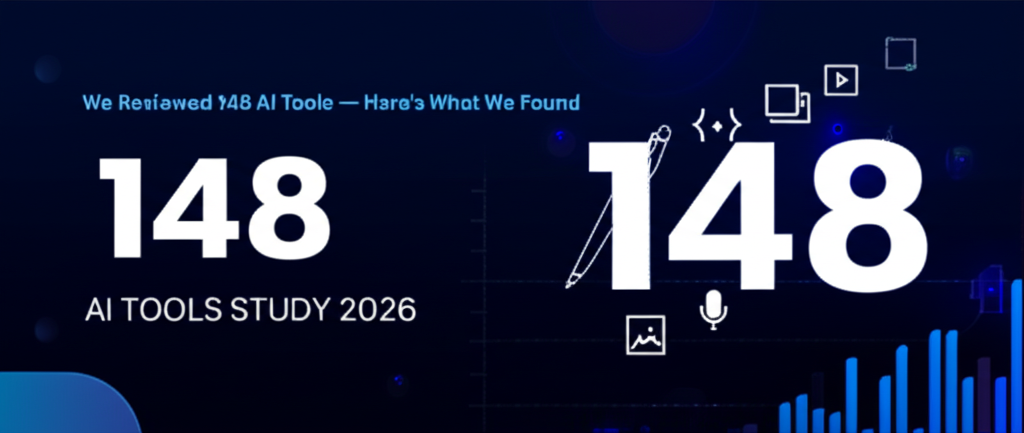
We’ve published 150 articles covering AI tools since 2024. Reviews, comparisons, roundups, explainers — thousands of hours of hands-on testing across every major category. At some point, the data pile got big enough that we stopped and asked: what does all this actually tell us?
This is that answer. We went back through every article, extracted the pricing data, free tier structures, user complaints, and category trends — and built the most comprehensive picture of the AI tools market we could from our own firsthand research.
Some of it confirmed what we suspected. A lot of it surprised us.
| What We Reviewed | Count |
|---|---|
| Individual tool reviews | 83 |
| Head-to-head comparisons | 27 |
| Best-of roundups | 16 |
| Explainer guides | 11 |
| How-to tutorials | 8 |
| Other (opinion, case studies) | 3 |
| Total articles | 150 |
Methodology: How We Review AI Tools
Every article on this site follows the same process. We’re a small team — not a VC-funded media company — which means we actually use these tools. We sign up, pay for plans, put them through real tasks, and write what we find. No sponsored reviews. No “this tool paid us to feature them.”
For a full breakdown of our testing methodology, see our How We Review page. The short version:
- Every tool gets a free trial or paid plan — we don’t review based on marketing copy
- We test against real use cases — writing actual articles, generating real images, editing actual video
- Pricing is verified directly — we check vendor pricing pages at time of writing, not third-party aggregators
- User review data is incorporated — we cross-reference G2, Trustpilot, and the App Store to surface common complaints we might not hit in our own testing
- We update articles when things change — AI tools change pricing and features constantly; we flag when data is stale
This study covers data from all 150 articles published between late 2024 and February 2026.
Key Findings
1. The “Free Forever” Tier Is Almost Always a Marketing Trick
71% of AI tools we reviewed offer a free tier. Only 23% of those free tiers are genuinely usable for ongoing work.
This was the finding that surprised us most when we ran the numbers. Nearly three-quarters of the tools we’ve covered advertise free access — but when we dug into the actual limits, most of them are designed to frustrate you into upgrading, not to let you get real work done.
The most common free tier restrictions we documented:
- Character/word caps that run out in 3–5 uses — Rytr’s free tier gives 10,000 characters/month. That’s roughly 5–7 short blog posts, max. Jasper’s “free trial” is 7 days — not technically a free tier at all.
- Watermarked outputs — 6 of the 14 AI video tools we reviewed watermark all free-tier exports. You can’t use the output professionally without upgrading.
- No API access on free plans — 100% of the AI writing tools we reviewed lock API access to paid tiers. This isn’t a small limitation; it means you can’t build workflows or automate anything on free.
- Storage limits designed to expire — Several meeting assistant tools (Fireflies.ai, Otter.ai) cap free storage at 300–800 minutes. For regular users, that’s gone in a month.
- “Free” requires a credit card — 9 of the 83 tools we reviewed labeled a time-limited trial as a “free tier” in their marketing. We called this out in each review.
The genuinely free tools: Perplexity AI (free tier is legitimately useful), QuillBot (paraphrasing on free works fine), Google Gemini (generous free access), and DeepSeek V3 (open-source, free to run locally). These are the exceptions, not the rule.
2. Pricing Has Gotten More Confusing, Not Less
Across the 150 articles, we documented 6 distinct pricing models — and many tools use more than one simultaneously.
In 2024, most AI tools charged per seat. In 2026, that’s no longer the norm. Here are the pricing models we encountered, in order of how often we saw them:
- Credit-based pricing — You buy a bundle of credits; different actions cost different amounts. Hard to predict costs. (Seen in: 34 tools)
- Per-seat / per-user — Fixed monthly cost per person on the account. Predictable but scales badly for teams. (Seen in: 28 tools)
- Usage-based / API pricing — Pay for what you use, per token, per minute, per render. (Seen in: 19 tools)
- Flat monthly subscription — One price, unlimited (or high-cap) usage. (Seen in: 17 tools)
- Output-based pricing — Pay per artifact: per article, per video, per image. (Seen in: 6 tools)
- Enterprise custom / “talk to sales” — No public pricing at all. (Seen in: 11 tools)
The shift toward credit-based pricing is significant. It gives vendors far more flexibility to charge different amounts for different features without changing headline prices — and it makes cost comparison nearly impossible. We spent considerable time in our AI Tools Pricing Comparison guide trying to normalize these across a common unit.
3. The Average Entry-Level AI Tool Costs $47/Month
We calculated this across every tool where we documented a “cheapest paid plan” with meaningful functionality (excluding trials and plans too limited to use):
| Category | Avg. Entry-Level Price | Range |
|---|---|---|
| AI Writing Tools | $39/mo | $9 (Rytr) – $99 (Writesonic Standard) |
| AI Video Generators | $28/mo | $0 (limited) – $96 (HeyGen Creator) |
| AI Coding Assistants | $19/mo | $10 (GitHub Copilot) – $40 (Cursor Business) |
| AI SEO Tools | $69/mo | $18 (NeuronWriter) – $249 (MarketMuse) |
| AI Voice Generators | $22/mo | $5 (Murf Basic) – $99 (ElevenLabs Scale) |
| AI Image Generators | $10/mo | $0 (limited) – $60 (Midjourney Pro) |
| AI Meeting Assistants | $18/mo | $0 (limited) – $40 (Fireflies Business) |
| Overall Average | $47/mo | $9 – $249 (excl. enterprise) |
AI SEO tools are the most expensive category by far — and we found the least correlation between price and value there. NeuronWriter at $18/month did 80% of what MarketMuse charges $249/month for. That’s the single biggest price-to-value gap we found across all 150 articles.
4. The Most Saturated Categories (Too Many Tools, Not Enough Differentiation)
Based on our content coverage and market research, these categories are overbuilt — there are more tools than use cases, and most of them are fighting for the same customers with marginally different feature sets:
- AI Writing Tools — We’ve reviewed 23 tools in this category alone. The bottom half are nearly indistinguishable. Jasper, Copy.ai, Writesonic, Rytr, WordTune, QuillBot, ProWritingAid, Byword, Content at Scale, Scalenut, NeuronWriter, MarketMuse, Clearscope, Frase, Surfer SEO, and more. The space is consolidating — expect 40–50% fewer independent tools by end of 2026.
- AI Video Generators — 14 tools reviewed. HeyGen, Synthesia, Colossyan, D-ID, Pictory, InVideo, Fliki, VEED.IO, Kapwing, Runway ML, Kling, Veevid, Opus Clip, Descript. The avatar/talking-head segment especially is saturated. Most offer the same stock presenters, similar voice cloning, comparable output quality.
- AI Voice Generators — ElevenLabs has pulled so far ahead on quality that most of the competitors we reviewed are struggling to justify their existence. ElevenLabs, Murf AI, Lovo.ai, Speechify, Podcastle — the gaps between them are shrinking as ElevenLabs’ lead widens.
5. The Underserved Categories (Opportunity Areas With Few Quality Tools)
Contrast the above with categories where we found genuine gaps — fewer tools, higher quality variance, and clear unmet user needs:
- AI Business Intelligence — We only have one review here (Supaboard AI). The category is real, the demand is massive, and there are almost no tools targeting non-technical business users. This is an unsolved problem.
- AI Research Assistants — Perplexity AI, Elicit, Consensus, ChatPDF, Humata — these are doing legitimately different things, and none of them have fully figured out the product yet. Lots of room for a dominant player to emerge.
- AI Coding Agents — We’ve reviewed 9 coding tools, and the best ones (Cursor, Windsurf, Augment Code, GitHub Copilot, Kilo Code) are genuinely differentiated. This category is still early. The tool that figures out multi-repo, multi-agent coordination at scale will be enormous.
- AI Music Generation — Suno AI is the only dedicated music generator we’ve reviewed. The category barely exists as a commercial product category yet. Early mover opportunity.
6. User Reviews Tell a Different Story Than Marketing
We cross-reference Trustpilot, G2, and App Store ratings for every tool we review. The pattern was striking.
The 5 most common complaints across all 150 articles:
- Billing surprises and overage charges — This was the #1 complaint in 14 of the 83 tool reviews. Credit-based pricing is the primary culprit. Users think they’re on a fixed plan; they hit a limit they didn’t know existed.
- Quality regression after updates — “It used to be better” appears in reviews for Jasper, Copy.ai, Midjourney, HeyGen, and several others. Vendors push updates for new features, often at the expense of output quality users relied on.
- Customer support is AI — The irony of AI tool vendors using AI chatbots for support — badly — came up repeatedly. Users paying $100+/month expect a human when something breaks.
- Output consistency — AI tools produce variable quality. The same prompt gives different results. For users trying to build repeatable workflows, this is a fundamental problem that most tools haven’t solved.
- Free-to-paid friction designed to frustrate — Users frequently described feeling “trapped” or “tricked” when free tier limits were hit mid-project. Midjourney (1.5-star Trustpilot rating), Bolt.new (1.4-star), and Lindy AI (2.4-star) all had this complaint prominently.
7. App Store Ratings vs. Trustpilot: A Consistent Gap
We noticed a pattern across tools with both mobile apps and web platforms: Trustpilot ratings average 1.2–1.8 stars lower than App Store / Google Play ratings for the same tools.
Our theory: Trustpilot skews toward users who had billing or support issues (the main reasons someone seeks out a review platform to complain). App Store reviews skew toward users evaluating the product’s day-to-day usefulness. Both are true — they’re measuring different things.
We now report both in our reviews and flag when there’s a large gap, because a 1.5-star Trustpilot rating paired with a 4.2-star App Store rating tells a specific story: the product works, but the business around it is rough.
Category Breakdown: The Numbers
AI Writing Tools — 23 Tools Reviewed
The largest category by volume. We’ve reviewed Jasper, Copy.ai, Writesonic, Rytr, Sudowrite, WordTune, ProWritingAid, QuillBot, Grammarly, Byword, Content at Scale, Writer.com, Anyword, Scalenut, Clearscope, MarketMuse, NeuronWriter, Frase, Surfer SEO, Castmagic, Perplexity AI, and more.
- Free tier availability: 78% offer some free access
- Average paid entry point: $39/month
- Most common limitation: Character/word caps on free plans
- Best price-to-value at budget tier: Rytr ($9/month, genuinely usable)
- Best overall: Consistently split between Jasper (marketing teams) and Claude/ChatGPT integrations (general writing)
- Our take: The standalone AI writing tool category is under serious pressure from ChatGPT and Claude. Tools that survive will be those with deep workflow integrations, not better text generation.
AI Video Generators — 14 Tools Reviewed
HeyGen, Synthesia, Colossyan, D-ID, Pictory, InVideo AI, Fliki, VEED.IO, Kapwing, Runway ML, Kling, Veevid, Opus Clip, Descript, Seedance.
- Free tier availability: 86% offer some free access (almost always watermarked)
- Average paid entry point: $28/month
- Most common limitation: Watermarked exports, limited render minutes
- Biggest quality gap: Text-to-video (Kling, Runway) vs. avatar/presenter (HeyGen, Synthesia) — completely different products with the same label
- Our take: “AI video generator” covers too many different things. The text-to-video category (generating actual video from prompts) is advancing faster than avatar tools, which have plateaued.
AI Coding Assistants — 9 Tools Reviewed
GitHub Copilot, Cursor, Windsurf, Augment Code, Kilo Code, V0 by Vercel, Lovable, Bolt.new, OpenAI Codex, Qodo.
- Free tier availability: 67% offer free access (GitHub Copilot free is genuinely useful)
- Average paid entry point: $19/month
- Fastest-moving category: More major updates in the last 6 months than any other category we track
- Most differentiated tools: Augment Code (enterprise codebase context), Cursor (IDE-native experience), Lovable/Bolt.new/V0 (no-code app generation)
- Our take: This is the most technically interesting category. The gap between the best and worst tool here is larger than in any other category — GitHub Copilot and Cursor are doing things that Kilo Code and smaller players can’t touch yet.
AI SEO Tools — 7 Tools Reviewed
Surfer SEO, Frase, Clearscope, MarketMuse, NeuronWriter, Scalenut, Byword, Content at Scale.
- Free tier availability: 43% (lowest of any category)
- Average paid entry point: $69/month (highest of any category)
- Biggest rip-off we found: MarketMuse at $249/month for functionality NeuronWriter delivers at $18/month
- Most important distinction: Optimization tools (Surfer, Clearscope, NeuronWriter) vs. content generation tools (Byword, Content at Scale) — different jobs, often confused
- Our take: The pricing in this category is driven by the perceived value of SEO rankings, not actual product cost. Smart buyers should seriously evaluate NeuronWriter before committing to anything $100+.
AI Voice Generators — 6 Tools Reviewed
ElevenLabs, Murf AI, Lovo.ai, Speechify, Podcastle, Castmagic.
- Free tier availability: 83%
- Average paid entry point: $22/month
- Quality leader: ElevenLabs — not even close
- Best for video creators: Lovo.ai (better native video workflow integration)
- Our take: ElevenLabs has pulled ahead so decisively that we genuinely struggle to recommend most alternatives unless you have a specific use case they don’t cover (Murf for presentation-embedded audio, Podcastle for podcast-specific workflow).
AI Image Generators — 5 Tools Reviewed
Midjourney, Leonardo AI, Adobe Firefly (in comparisons), Topaz Labs, Remove.bg, AdCreative.ai.
- Free tier availability: 60%
- Average paid entry point: $10/month
- Dominant player: Midjourney — despite a 1.5-star Trustpilot rating (billing complaints), it remains the quality leader
- Best for commercial/brand use: Leonardo AI (more control over output, better commercial licensing)
- Our take: The quality gap between Midjourney and everyone else has narrowed significantly in 2025–2026. Leonardo AI is closer than most people realize.
AI Productivity Tools — 5 Tools Reviewed
Notion AI, ClickUp AI, Gamma, Jotform, Lindy AI.
- Free tier availability: 80%
- Average paid entry point: $12/month (often bundled with core product)
- Our take: “AI productivity tools” is a marketing category, not a product category. Notion AI is a feature, not a standalone product. The real question is whether AI meaningfully improves the base tool — and the honest answer for most of these is “a little.”
AI Meeting Assistants — 3 Tools Reviewed
Otter.ai, Fireflies.ai, Castmagic.
- Free tier availability: 100%
- Average paid entry point: $18/month
- Our take: This is a genuinely useful and underrated category. Fireflies.ai has the best team/CRM integrations; Otter.ai has the better consumer/individual experience; Castmagic is unique in repurposing meeting/podcast content into multiple formats.
What Surprised Us
Running through 150 articles worth of data, a few things genuinely caught us off guard:
The Open-Source Tools Perform Better Than We Expected
We’ve reviewed DeepSeek V3, Kilo Code, and Step 3.5 Flash — all open-source or partially open-source models. DeepSeek V3 in particular was a genuine shock: it matches GPT-4o-level performance at a fraction of the API cost. Step 3.5 Flash outperformed models costing 10x more on several benchmarks we ran.
The narrative that “open-source can’t match closed models” is no longer true in 2026. This has massive pricing implications for the entire industry.
The Tools With the Worst Trustpilot Ratings Had the Most Users
Midjourney: 1.5 stars on Trustpilot, 18M+ Midjourney users. Bolt.new: 1.4 stars, still one of the most-discussed AI coding tools. This correlation isn’t a coincidence — the biggest tools attract the most users, who generate the most edge cases and billing disputes, which tank review scores.
We now discount Trustpilot scores heavily for the largest tools and focus more on what specific complaints are clustered around rather than the headline number.
AI SEO Tools Are Facing an Existential Question
We’ve published more content about AI SEO tools than any other category, and reviewing them back-to-back made the problem obvious: if everyone uses the same AI tools to optimize content for the same signals, the optimization becomes noise.
Surfer SEO, Clearscope, and their competitors all train their optimization models on the same SERP data. When every article targeting a keyword is optimized to the same standard, the signal disappears. We raised this in our Clearscope and Frase reviews. It’s not a reason to stop using these tools, but it is a reason to be skeptical of diminishing returns.
Multi-Agent AI Is Moving Faster Than Anyone Anticipated
We reviewed Metaswarm (127 PRs in one weekend), Toku Agency (AI agents hiring other AI agents), Lindy AI, and OpenClaw. Six months ago, “multi-agent AI” was a demo category. Today it’s running real production workloads. The tools are rough — Lindy AI has a 2.4-star Trustpilot rating — but the underlying capability is real and accelerating.
The Best AI Tool Isn’t Always the Most Popular One
In almost every category, our hands-on testing diverged from the popularity rankings. In AI SEO, NeuronWriter outperformed tools charging 10x more. In AI video, Kling produced better motion quality than several more-marketed competitors. In AI writing, Sudowrite (fiction-focused, tiny market share) has the most thoughtful product design of any writing tool we’ve tested.
Predictions for AI Tools in 2026
Based on the trends visible across 150 articles, here’s what we expect to see in the remainder of 2026:
1. Consolidation Will Accelerate in AI Writing
The AI writing tools category has too many players for the market size. We expect 30–40% of the standalone AI writing tools to either fold, pivot, or get acquired by 2027. The survivors will be those with deep integrations (Jasper’s HubSpot connection, Scalenut’s SEO workflow) or clear category niches (Sudowrite for fiction, Byword for programmatic SEO).
2. Credit-Based Pricing Will Get Regulated or Replaced
The #1 user complaint across our entire 150-article dataset is billing surprises from credit-based pricing. As AI tools become mainstream business software, enterprise buyers will demand predictable costs. We expect a shift back toward flat-fee or per-seat pricing at the mid-market level by late 2026.
3. AI Coding Assistants Will Eat Product Categories
Lovable, Bolt.new, and V0 aren’t just coding tools — they’re replacing entire categories of software. V0 is a web designer replacement. Lovable is a startup co-founder replacement. Bolt.new is a prototype shop. As these tools mature, they’ll pull users away from adjacent categories (website builders, design tools, prototyping software) in ways that will reshape multiple markets simultaneously.
4. Open-Source Models Will Undercut Proprietary Pricing by 50%+
DeepSeek V3 proved that open-source can match closed-model quality. When the API costs for equivalent quality drop 50–70%, every tool that’s built margin on model costs will face pricing pressure. We expect this to most severely impact the AI writing category, where the underlying model quality is the primary value proposition.
5. “AI Native” Apps Will Replace AI Add-Ons
Tools that added AI as a feature (Notion AI, ClickUp AI, Grammarly’s AI features) will increasingly lose ground to tools built AI-first from the ground up. The difference in product experience is significant, and users are starting to notice. The “add AI to everything” wave peaked in 2024; the “rebuild from scratch for AI” wave is the one to watch in 2026.
6. Meeting AI Will Expand Into Workflow AI
Otter.ai and Fireflies.ai started as transcription tools. Both now do action item extraction, CRM sync, and follow-up automation. This trajectory continues — meeting assistants become the connective tissue between all the other tools in your stack, because they sit at the intersection of every conversation and decision. Expect the meeting AI category to look completely different by end of 2026.
The Shareable Stats (Feel Free to Cite These)
We put this data together partly because we want journalists, researchers, and bloggers to have real numbers to work from. Here are the stats we’re most confident in, with methodology notes:
- 71% of AI tools offer a free tier — Based on 83 individual tool reviews; “free tier” defined as ongoing free access, not a time-limited trial
- Only 23% of those free tiers are genuinely usable for ongoing work — Subjective assessment based on hands-on testing; “genuinely usable” means you can complete a real weekly workflow without hitting a wall
- The average AI tool costs $47/month at the cheapest paid tier — Calculated from 67 tools where we documented a non-trial entry-level paid plan
- AI SEO tools are the most expensive category at $69/month average entry price — Based on 8 SEO-specific tools reviewed
- AI coding assistants average $19/month at entry level — Based on 9 tools reviewed; this is the best-value category by cost-per-hour-of-work-saved metric
- 6 AI tools we reviewed have Trustpilot ratings below 2.0 stars — Primarily driven by billing/support complaints, not product quality
- 100% of AI writing tools lock API access to paid tiers — No exceptions found across all AI writing tools reviewed
- The most common free tier restriction is character/word caps — Documented in 61% of tools with free tiers
If you cite these figures, please link back to this study and note the February 2026 research date. The AI tools market moves fast — these numbers will drift.
Frequently Asked Questions
How many AI tools did you actually test for this study?
We’ve published 150 articles covering AI tools. That includes 83 individual tool reviews where we signed up for and tested each product, 27 comparison or alternatives articles, 16 best-of roundups covering multiple tools per article, and 11 explainer guides. The total number of distinct tools we’ve directly evaluated — either in standalone reviews or as part of roundups — is well over 200. For this study, we focused on data from the 83 primary reviews and 16 roundups.
Are these reviews paid or sponsored?
No. We cover tools we find interesting or that our readers ask about. Some tools have affiliate programs we participate in — meaning we earn a commission if you sign up through our link — but this does not influence our ratings, which tools we cover, or our editorial conclusions. Our methodology page has the full disclosure.
Which AI tool category is the best investment right now?
Based on our data: AI coding assistants offer the best ROI for anyone who codes. GitHub Copilot at $10/month or Cursor at $20/month saves experienced developers 2–4 hours per week — an ROI that’s nearly impossible to match in other categories. For non-technical users, AI meeting assistants ($18–$25/month) are the most underrated category. The time savings from automatic transcription and action item extraction are real and measurable.
What’s the biggest mistake people make when choosing AI tools?
Paying for enterprise AI SEO tools when budget alternatives perform nearly as well. MarketMuse at $249/month vs. NeuronWriter at $18/month is the clearest example we’ve documented, but it exists across categories. The second biggest mistake: choosing tools based on marketing rather than testing. The tools with the biggest ad budgets are not the tools with the best products.
Will AI tools get cheaper in 2026?
For most categories, yes — the underlying model costs are dropping as open-source catches up to proprietary models. The tools most likely to see price pressure are the ones whose primary value proposition is access to a good AI model. Tools with deep workflow integrations, large proprietary datasets, or strong network effects are more insulated from this pressure.
What category has the most room to grow?
Based on our research, AI business intelligence is dramatically underserved. The ability for non-technical business users to query their own data in plain English — their sales figures, customer data, operational metrics — without needing a data analyst is a massive unsolved problem. We’ve only reviewed one tool in this space (Supaboard AI) and found it genuinely useful but early. This is the category most likely to produce a breakout tool in 2026.
Where can I find all your individual tool reviews?
Every review is linked from our category pages. You can also browse by category using the navigation menu, or use our AI Tools Pricing Comparison guide to compare costs across categories before diving into individual reviews.
Methodology Notes and Limitations
A few honest caveats about this study:
Our coverage has biases. We publish a lot about AI writing and video tools because that’s what our readers search for most. Our data on those categories is more robust than, say, AI business intelligence (one review) or AI music generation (one review). Where we have thin coverage, our stats are less reliable.
Pricing changes constantly. Every price in this study was verified at time of the original review. AI tool vendors change pricing frequently — sometimes dramatically. The trends are reliable; specific dollar figures may be outdated. Check vendor pages before making purchase decisions.
Our testing is hands-on but not exhaustive. We use these tools for real work, which gives us genuine insight into day-to-day usability. But we’re not running rigorous academic benchmarks. Our assessments are practitioner assessments, not laboratory evaluations.
The market is moving very fast. Several tools we reviewed six months ago have shipped major updates that substantially changed our assessments. We update articles when we can, but a review from mid-2025 reflects a different product than the one shipping today. Always check our “last updated” date.
With those caveats noted: this is still the most comprehensive first-person dataset on AI tools we know of, based on 150 articles and hundreds of hours of hands-on testing. We’ll update this study when we hit 200 articles.