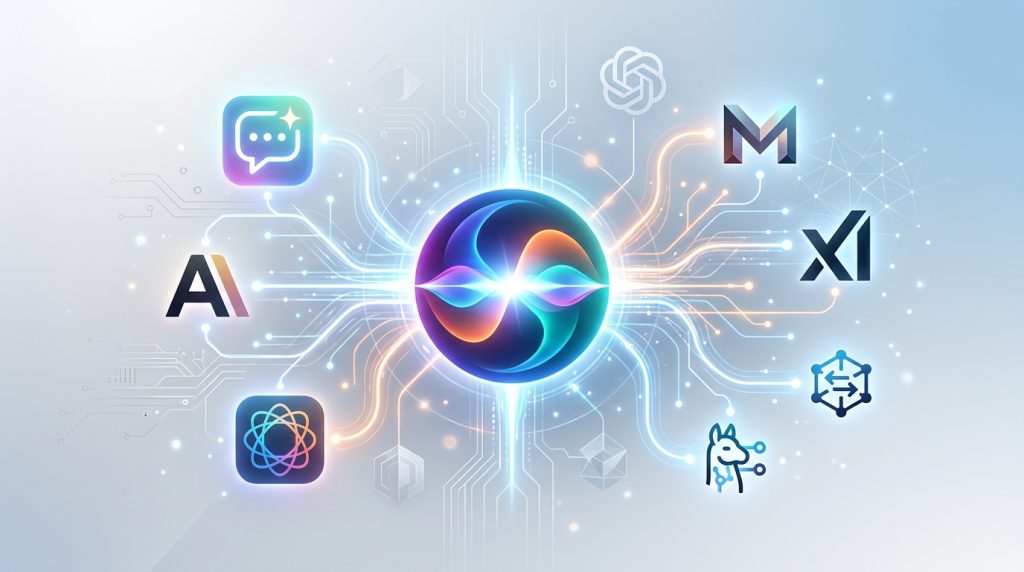
Apple announced on March 26–27, 2026 that it will open Siri to third-party AI providers — including Google Gemini, Anthropic Claude, and OpenAI ChatGPT — via a new “Extensions” system arriving in iOS 27. This ends OpenAI’s exclusive Siri deal and fundamentally reframes what Siri is: not an AI assistant trying to compete with the best models in the world, but the platform that connects you to all of them.
It’s a significant strategic bet. Apple spent years being embarrassed by Siri’s limitations compared to ChatGPT and Gemini. Rather than keep trying to win an AI model arms race it was losing, Apple is pivoting to a model that plays to its actual strength: 2.2 billion active Apple devices and the tightest device ecosystem on the planet.
Here’s everything you need to know — what’s actually changing, who wins, who loses, and what the fine print looks like.
What Was Announced
Bloomberg broke the story on March 26, 2026, reporting that Apple is building a new “Extensions” API for Siri as part of iOS 27. The system lets users install third-party AI chatbot apps from the App Store — Gemini, Claude, ChatGPT, and others — and route Siri queries to whichever provider they prefer.
Key details from the announcement and subsequent reporting:
- Extensions system: A dedicated API that AI companies integrate with via updated versions of their iOS apps. Users choose which provider handles which queries through Settings.
- End of OpenAI exclusivity: OpenAI has been Siri’s only third-party AI partner since iOS 18.2 in late 2024. That exclusive arrangement ends.
- Confirmed providers at launch: Google Gemini, Anthropic Claude, and OpenAI ChatGPT. Additional providers expected as the developer API opens ahead of WWDC.
- Dual-track Siri: Separately from Extensions, Apple is rebuilding Siri’s core intelligence with a more conversational, system-aware AI engine reportedly powered by a custom Google Gemini model. These are two different things — the rebuilt Siri is the new default brain; Extensions is the user-controlled gateway to external models.
- Timeline: WWDC in June 2026 for announcement and developer tools; iOS 27 public release in fall 2026.
The Providers: Who’s In
Three major AI providers are confirmed for the launch of Siri Extensions:
Google Gemini
Gemini gets an unprecedented distribution win — access to iPhone users who never opened the Gemini app. If you have Gemini installed and select it as your default Siri extension, queries that Siri can’t handle natively get routed there automatically. Gemini is also, separately, reportedly powering the rebuilt version of Siri’s core engine under the hood, which means Google is playing on both sides of this game board.
Anthropic Claude
Claude lands on the most coveted AI real estate in the world: the Siri button on 2 billion Apple devices. For Anthropic, which has no consumer hardware and a smaller public brand than OpenAI or Google, this is enormous. Users who’ve never heard of Claude will discover it through Siri. We’ve covered Claude Sonnet 4.6 in depth — it’s one of the most capable models available right now for reasoning and long-context tasks.
OpenAI ChatGPT
ChatGPT loses its exclusive status but keeps its Siri integration. Losing the exclusivity advantage hurts — OpenAI had a meaningful edge as the only non-Apple AI baked into Siri. Now it competes on a level playing field with Gemini and Claude. That said, ChatGPT still has the highest consumer brand recognition in AI, which matters when users scroll a settings list and pick a default. We’ve published a full ChatGPT review if you want to see how it holds up head-to-head.
What About Others?
Apple will open the Extensions API to developers ahead of WWDC, meaning additional providers — Perplexity, Mistral, xAI’s Grok, Meta AI — could appear in the Extensions list if they update their iOS apps to support the feature. Apple has not confirmed a full list, but the framing of “Extensions” as a developer platform strongly implies it won’t be limited to three providers at launch.
How It Works (User Perspective)
The technical implementation is simpler than you might expect. From a user standpoint:
- Install your AI app(s) of choice from the App Store — Gemini, Claude, ChatGPT.
- Go to Settings → Apple Intelligence & Siri → Extensions. You’ll see a list of installed apps that have registered for the Siri Extensions feature.
- Select your preferred provider as the default for externally-routed queries.
- Use Siri normally. When you ask something Siri handles natively (set a timer, call someone, check the weather), Siri answers. When you ask something outside Siri’s native capabilities — write me an email, explain quantum entanglement, help me debug this script — Siri routes that to your chosen external AI.
- On first use, Apple will prompt you to confirm before sending a query to the external provider. Subsequent queries go automatically once you’ve consented.
Developers on the back end need to update their iOS apps to implement Apple’s Extensions API, which extends the existing App Intents framework. Apple is providing new developer tools at WWDC to make this straightforward for AI companies to integrate.
Before vs. After: What Changes for Siri Users
| Scenario | Before iOS 27 | After iOS 27 |
|---|---|---|
| Ask Siri a complex question | Siri answers poorly or opens a web search | Routed to your preferred AI (Claude, Gemini, ChatGPT) |
| Third-party AI choice | ChatGPT only (via iOS 18.2) | Gemini, Claude, ChatGPT, and more |
| Switching providers | Not possible — ChatGPT was fixed | Settings → Extensions → pick your default |
| Siri’s core intelligence | Apple’s in-house models (limited) | Rebuilt Siri engine, reportedly powered by custom Gemini |
| AI assistant on lock screen | Siri with limited capability | Siri as a gateway to frontier AI models |
| Developer integration options | SiriKit (narrow, domain-specific) | Extensions API (broad, LLM-powered) |
The biggest shift isn’t just choice — it’s the architectural change in what Siri is. Siri is no longer Apple’s answer to ChatGPT. It’s the interface layer that sits on top of the best AI models in the world and orchestrates between them.
Who Should Read This
This article is for you if:
- You’re an iPhone user wondering whether Siri is about to become actually useful — yes, it is.
- You’re a developer building iOS apps or voice agents who needs to understand the new Extensions API opportunity before WWDC 2026.
- You’re tracking the AI assistant wars — this is the most significant platform shift since ChatGPT launched the modern era. The implications for OpenAI, Google, and Anthropic are different in each case.
- You’re deciding which AI chatbot to use daily — if you’re comparing your options, our best AI chatbots roundup breaks down the top picks in detail.
If you just want to know “will Siri be better?” — the answer is yes, and the “How to Switch Your Default AI in Siri” section below tells you exactly how when iOS 27 lands.
Who Wins
iPhone Users
The clearest winner. You no longer have to choose between using Siri (convenient, integrated) and using a capable AI (actually useful). You get both. The device-level integrations — reading your contacts, calendar, controlling apps, setting reminders — stay in Siri. The heavy reasoning, writing, and research goes to whichever frontier model you trust most.
Anthropic
Disproportionate beneficiary. Anthropic doesn’t have Google’s distribution or OpenAI’s brand recognition with consumers. A spot in Siri Extensions on launch day is worth more to Anthropic than to either competitor. Claude reaching users who’ve never considered it before is a genuine growth unlock.
Apple
Apple wins in several ways simultaneously. First, it stops taking reputation damage from a bad Siri. Second, it monetizes AI — estimates suggest Apple will generate over $1 billion in App Store commissions from AI apps in 2026, and the Extensions system creates a new subscription monetization layer on top of that. Third, it defends the iPhone as the must-own device in an AI-first world. The argument for Android — “better Google AI integration” — collapses when Google Gemini runs natively through Siri on an iPhone.
Google Gemini (as a product)
Gemini gets iPhone distribution it couldn’t buy. Google built and is building for Android users — Siri Extensions drops it onto the home screens of Apple’s premium, high-spending install base.
Who Loses
Google Search
This is the quiet earthquake in this announcement. Google’s $20 billion annual deal to be the default search engine on Safari and iOS has already been under pressure from the DOJ antitrust case. Now, as more iPhone users answer questions through AI chatbots via Siri instead of typing queries into Safari, Google Search loses query volume from its most profitable audience. Gemini the AI product wins. Google Search the ad-revenue machine takes a hit.
OpenAI’s Exclusivity Premium
OpenAI had something no one else had: the only non-Siri AI baked into the world’s most popular mobile OS. That moat just got filled in. OpenAI remains in the lineup, but it’s now competing on merit rather than benefiting from a default advantage. Given where Claude and Gemini have been trending on capability benchmarks, that competition is real. See our full ChatGPT review for a current assessment of where it stands.
Smaller AI Startups Without an iOS App
The Extensions system is an App Store-first distribution model. AI providers that don’t have a polished iOS app — or can’t build one fast enough before iOS 27 ships — won’t be in the Extensions list at launch. First mover advantage in consumer settings lists is real.
Concerns and Controversy
Privacy: Where Does Your Data Go?
This is the most legitimate concern and it doesn’t have a clean answer. Apple’s existing model with ChatGPT established the template:
- Siri prompts for consent before routing queries externally.
- IP addresses are obscured when users aren’t signed into the provider’s account.
- Providers are contractually prohibited from storing queries or using them for model training (without consent).
- But: once you’re signed into Gemini, Claude, or ChatGPT on your device, that provider’s own privacy policy governs what happens with your data — not Apple’s.
This is a meaningful distinction. The protections Apple provides work best for anonymous use. Heavy users who are signed in for personalization give up Apple’s privacy umbrella the moment they authenticate. Apple’s $95 million settlement over Siri’s accidental recording history doesn’t help public confidence here either.
App Store Gatekeeping Risk
Apple controls which AI apps can participate in Extensions. The same 30% commission structure that made App Store a target for Epic Games litigation applies here. If you’re an AI company and Apple decides your app doesn’t meet review guidelines — or charges punishing commission rates — you’re not in Siri Extensions. You’re simply invisible to Siri users.
This is the “App Store for AI” risk that regulators will watch closely, particularly under the EU’s Digital Markets Act. Apple has already been forced to make concessions in Europe on alternative payment methods. How the DMA intersects with a new AI distribution layer will be a 2026–2027 regulatory storyline.
Apple’s “Neutral Platform” Problem
Apple is both building the Extensions platform and competing through Apple Intelligence — its own AI features baked into iOS. Every Siri interaction that Apple’s on-device features can handle natively is one that doesn’t reach a third-party Extension. Apple has every incentive to expand what “native Siri” does, effectively shrinking the surface area available to Gemini and Claude. Developers have seen this pattern before.
Version Fragmentation
iOS 27 won’t reach all iPhones at once. Apple Intelligence requires iPhone 15 Pro or later hardware (and iOS 18+ introduced that requirement). Users on older devices won’t benefit from Extensions regardless of what iOS version they’re running.
How to Switch Your Default AI in Siri (iOS 27)
This feature won’t be available until iOS 27 ships in fall 2026, but here’s exactly how it will work based on Apple’s confirmed implementation:
- Update to iOS 27 when available (fall 2026).
- Download your preferred AI app(s): Gemini, Claude, or ChatGPT from the App Store (if you haven’t already). Make sure they’re updated to iOS 27-compatible versions that support the Extensions API.
- Open Settings on your iPhone.
- Tap Apple Intelligence & Siri.
- Tap Extensions. Any installed AI apps that have implemented Apple’s Extensions API will appear here.
- Select your preferred provider. This becomes the default AI that Siri routes complex queries to.
- Optional: Download links for supported AI apps will also appear in this settings screen if you want to try additional providers.
You’ll be prompted to confirm when Siri first routes a query to your selected external provider. After that, the handoff happens automatically for qualifying queries.
Not sure which AI to pick? Our best AI chatbots guide compares Gemini, Claude, ChatGPT, and more with real testing. The Claude Sonnet 4.6 review and the Gemini 3.1 Flash Live review are solid starting points if you want the technical breakdown on the two strongest contenders right now.
The Bigger Picture: Apple’s Platform Play
The framing that captures this best: “Apple decided Siri doesn’t need to be smart; it just needs to be the building everyone else rents space in.”
That’s a precise read. Apple couldn’t win the model war — it doesn’t have the research bench of Google, the startup aggression of Anthropic, or the deployment scale of OpenAI. What it has is the lock screen, the voice button, and 2.2 billion devices. The Extensions play converts those assets into AI distribution leverage instead of running a losing race to build a better LLM.
Compare it to Google’s simultaneous move on the same day: Gemini went the opposite direction — importing full chat histories from rival AI apps, trying to make Gemini so sticky that users migrate entirely. Apple’s bet is that users don’t want to migrate — they want everything accessible from where they already are.
Both bets could work. They’re just very different theories of how the AI assistant era plays out.
For users, the immediate practical effect is simple: the next iPhone software update will make your voice assistant actually useful. That’s not a small thing.
Frequently Asked Questions
Which AI providers will be available in Siri via iOS 27?
Confirmed at launch: Google Gemini, Anthropic Claude, and OpenAI ChatGPT. Additional providers are expected as Apple opens the Extensions API to developers ahead of WWDC in June 2026.
When will iOS 27 with Siri AI Extensions launch?
Apple is expected to announce the Extensions system at WWDC in June 2026. The public iOS 27 release will follow in fall 2026, likely September or October — consistent with Apple’s annual iOS release cadence.
Does Apple lose its exclusive deal with OpenAI?
Yes. OpenAI’s exclusive Siri partnership — established with iOS 18 in 2024 — ends with iOS 27. ChatGPT becomes one option among many rather than the sole third-party AI integrated into Siri.
How do I switch which AI Siri uses?
In iOS 27: Settings → Apple Intelligence & Siri → Extensions. Tap your preferred provider from the list of installed compatible apps. That becomes your default for externally-routed Siri queries.
Is my data private when Siri hands off to a third-party AI?
Apple requires consent before routing queries externally and obscures IP addresses for unauthenticated requests. Providers are prohibited from training on your queries. However, if you’re signed into a provider’s account, their own privacy policy governs your data — not Apple’s.
Will third-party AI providers have to pay Apple a commission?
Yes. Apple is expected to apply its standard App Store commission structure to AI subscription transactions made through the Extensions system. Apple is projected to generate over $1 billion in App Store commissions from AI apps in 2026 alone.
Is the new Siri powered by Gemini the same as the Extensions feature?
No. Apple is rebuilding Siri’s core engine with a more conversational AI — reportedly powered by a custom Gemini model — as Siri’s new default brain. The Extensions system is a separate layer that lets users manually route queries to any compatible third-party AI app. Two different things, both arriving with iOS 27.
Does Google benefit or lose from Apple opening Siri to third parties?
Both. Google Gemini gains distribution on iPhone through Siri Extensions — a massive new surface for its AI product. But Google Search loses query volume as iPhone users increasingly answer questions through AI chatbots via Siri rather than typing into Safari and hitting Google’s ad-supported results.