You’re building a voice product. You need enterprise-grade TTS that doesn’t send your customer audio to some third-party server in a jurisdiction you don’t control. Until today, your options were: pay ElevenLabs indefinitely and accept vendor lock-in, or settle for inferior open-source models that sound like a robot from 2008. Mistral just changed that equation.
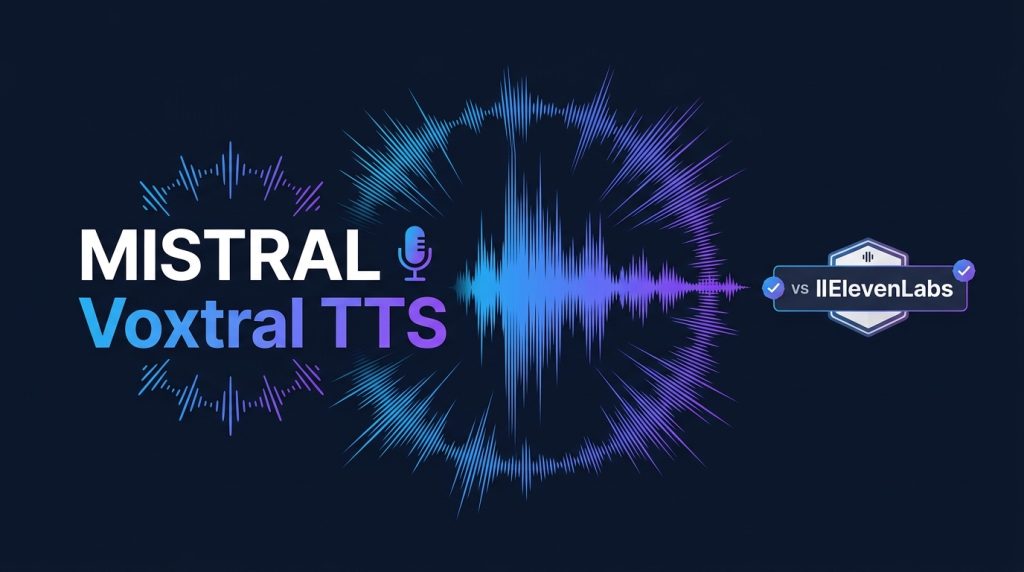
On March 26, 2026, Mistral AI released Voxtral TTS, a 4-billion-parameter open-source text-to-speech model that achieved a 62.8% human preference rate against ElevenLabs Flash v2.5 in blind listening tests — and 69.9% on voice customization tasks. For the first time, “open-source” and “enterprise-grade voice quality” are the same sentence.
Rating: 8.5/10
What Is Mistral Voxtral TTS?
Mistral Voxtral TTS is an open-source text-to-speech model that generates human-like speech in 9 languages with zero-shot voice cloning capability. Unlike proprietary competitors like ElevenLabs or OpenAI TTS that require API calls and ongoing subscription costs, Voxtral provides downloadable model weights that enterprises can run on their own hardware — including smartphones and laptops.
The key differentiator is ownership versus rental: while every major TTS provider operates an API-first business model where companies rent voice capabilities, Mistral gives enterprises the full model to deploy locally, modify, and scale without sending sensitive audio data to third parties.
Think of it like the difference between renting a generator and buying one. The rental is easier to start with. But at scale, the math changes fast — and when the power company goes down, the guy who owns the generator is the only one still operating.
Voxtral TTS is part of Mistral’s broader Voxtral audio family, which also includes speech-to-text transcription models. For context on Mistral’s trajectory as a company, their Small 4 model earlier this year was already punching above its weight class. Voxtral continues that pattern.
The Benchmark Story: First Open Model to Beat ElevenLabs
Mistral’s internal human evaluation study represents the most significant competitive benchmark in TTS since ElevenLabs established quality dominance. Using native speakers across all 9 supported languages, three annotators performed side-by-side preference tests measuring naturalness, accent adherence, and acoustic similarity.
| Comparison Category | Voxtral TTS Win Rate | Testing Methodology |
|---|---|---|
| Flagship Voices vs ElevenLabs Flash v2.5 | 62.8% | Native speakers, 9 languages |
| Voice Customization vs ElevenLabs Flash v2.5 | 69.9% | Zero-shot custom voice cloning |
| Emotional Expressiveness vs ElevenLabs v3 | At parity | Emotion-steering evaluation |
| Latency Performance | 90ms time-to-first-audio | Similar to ElevenLabs Flash |
Source: Mistral AI internal evaluation, March 2026
The caveat worth noting: this is Mistral’s own evaluation, not a third-party study. The 69.9% rate is against ElevenLabs Flash v2.5 specifically — not the premium ElevenLabs v3 model. We’ll dig into what this means in the controversies section. But even with that asterisk, the gap in voice customization is large enough that it can’t be explained away as measurement error.
Pricing
Voxtral TTS API pricing had not been officially published on Mistral’s pricing page at time of review — the model launched today. The figures in the table below are based on available information and may be updated as Mistral publishes official rates. The open-weight version remains free for non-commercial use under CC BY NC 4.0.
| Provider | Model/Tier | Cost per 1K Characters | Monthly Plans | Open Source |
|---|---|---|---|---|
| Mistral Voxtral TTS | API (est.) | TBD — check mistral.ai/pricing | Pay-as-you-go | ✓ Yes (CC BY NC 4.0) |
| ElevenLabs | Starter | ~$0.17 | $5/mo (30k chars) | ✗ No |
| ElevenLabs | Creator | ~$0.22 | $22/mo (100k chars) | ✗ No |
| OpenAI TTS | Standard (tts-1) | $0.015 | Pay-as-you-go | ✗ No |
| OpenAI TTS | HD (tts-1-hd) | $0.030 | Pay-as-you-go | ✗ No |
| Google Cloud TTS | Standard | $0.004 | Pay-as-you-go | ✗ No |
| Google Cloud TTS | WaveNet/Neural2 | $0.016 | Pay-as-you-go | ✗ No |
| Fish Audio S2 | API | ~$0.05/minute | $11–$75/mo | ✓ Yes |
The real cost comparison isn’t API rates anyway. If you’re running a voice-heavy product at any meaningful scale, the self-hosted path is where Voxtral completely changes the math. You pay for compute once. You don’t pay per character forever. For a customer support bot handling 10,000 calls a month, the economics are not close.
Key Features
Zero-Shot Voice Cloning in 3 Seconds
Voxtral can adapt to any voice using just 3 seconds of reference audio, capturing not just vocal characteristics but personality traits like natural pauses, rhythm, and emotional range. Unlike traditional voice cloning that requires extensive training data, this works immediately with minimal input.
The practical use case: you record a 3-second sample of your support agent, and Voxtral clones that voice for your entire automated IVR system. Brand consistency without a voice actor on retainer. Cross-lingual too — same voice, different language, covered below.
Cross-Lingual Voice Adaptation
The model demonstrates zero-shot cross-lingual capabilities without explicit training. Provide a 10-second French voice sample, input German text, and generate German speech that maintains the French speaker’s accent and vocal characteristics. Useful for multinational customer support or dubbing applications where you need consistent character voice across markets.
This is genuinely novel. Most TTS systems treat each language as a separate model with separate voice libraries. Voxtral treats the speaker identity as portable across language boundaries. That’s the architecture decision that makes the cross-lingual cloning possible.
Edge Deployment at 3GB RAM
When quantized for inference, Voxtral requires only 3GB of memory and runs at 6x real-time speed on consumer hardware. This enables on-device deployment for privacy-sensitive applications where sending audio to cloud APIs is prohibited.
Real-world implication: a medical transcription company can run Voxtral locally on each workstation without touching the internet. A defense contractor can deploy voice synthesis without any data leaving their air-gapped network. Those use cases simply don’t exist with ElevenLabs or OpenAI TTS, full stop.
Enterprise-Grade Latency
With 90ms time-to-first-audio and real-time factor of 9.7x, Voxtral meets the latency requirements for interactive voice agents. The model can generate up to 2 minutes of continuous audio natively, with API support for arbitrarily long generations through smart interleaving.
For context on why 90ms matters: human conversation works at roughly 250ms response expectations. Anything under 150ms time-to-first-audio feels natural in a voice interface. Voxtral comfortably clears that bar, which is the same ballpark as ElevenLabs Flash.
Nine-Language Multilingual Support
Native support for English, French, German, Spanish, Dutch, Portuguese, Italian, Hindi, and Arabic, with cultural nuance recognition for different dialects — French in Paris vs. Montreal, for example. The model was trained with native speaker evaluation, which matters more than the training data volume for accent accuracy.
Contextual Emotional Expression
The model interprets contextual cues from text to generate appropriate emotional tone — neutral, happy, sarcastic — without requiring explicit markup or additional parameters. Write a sentence that’s clearly sarcastic, and Voxtral reads it that way. This is different from Fish Audio S2’s tag-based approach ([whisper], [angry]) but handles natural conversation flow better for most applications.
Who Is This For?
Voxtral TTS is the right call if you:
- Need enterprise-grade voice AI with data sovereignty requirements (regulated industries: healthcare, finance, government)
- Are building voice-heavy products at scale where API costs become a margin problem
- Require multilingual voice agents with consistent accent preservation across languages
- Want to deploy voice AI on edge devices or fully local infrastructure
- Need customizable voice personalities that stay consistent across your product
- Are building in any of the 9 supported languages and want the highest open-source quality available
Look elsewhere if you:
- Need the absolute highest quality English voices for premium content (ElevenLabs v3 still leads here)
- Require extensive emotion markup and granular voice control for creative work (Fish Audio S2)
- Want simple plug-and-play without model deployment complexity
- Need voice synthesis in languages beyond the 9 currently supported — Voxtral’s 9 vs. Google’s 75+ is a real gap
- Prefer established enterprise support and SLAs from major cloud providers
- Are an individual creator who just needs a fast, good-quality voice for YouTube — the deployment overhead isn’t worth it for low-volume use
Comparison: Voxtral vs. The Big Players
| Feature | Mistral Voxtral TTS | ElevenLabs | OpenAI TTS | Google Cloud TTS | Fish Audio S2 |
|---|---|---|---|---|---|
| Languages | 9 languages | 29 languages | 13+ languages | 75+ languages | 80+ languages |
| Voice Cloning | 3-second zero-shot | 1-minute instant | No custom voices | No voice cloning | Zero-shot with tags |
| Open Source | ✓ Yes | ✗ No | ✗ No | ✗ No | ✓ Yes |
| Edge Deployment | ✓ 3GB RAM | ✗ Cloud only | ✗ Cloud only | ✗ Cloud only | ✗ GPU required |
| Latency (TTFA) | 90ms | ~100ms (Flash) | ~200ms | ~150ms | 100ms |
| Cost Model | API + Self-hosted | Subscription tiers | Pay-per-use | Pay-per-use | API + Self-hosted |
| Best For | Owned voice stack | Premium content | Simple integration | Enterprise scale | Creative control |
The honest comparison: Voxtral wins on the ownership and privacy axis, is competitive with Flash-tier ElevenLabs on quality, and loses on language breadth and ecosystem maturity. If you’re building for enterprise data sovereignty, it’s the only real option. If you’re building for global coverage or creative premium content, ElevenLabs and Google Cloud still hold advantages.
It’s worth reading our Mistral Small 4 review for context on how Mistral approaches model architecture — their lightweight-first philosophy runs through everything they build, and Voxtral is no exception.
Alternatives Worth Considering
Before committing to Voxtral, these are the alternatives that deserve a real look:
ElevenLabs
Still the quality benchmark for English voice synthesis. The v3 model produces expressiveness that Voxtral doesn’t match for creative content like audiobooks or character dialogue. The drawback: you’re renting indefinitely, your data goes to their servers, and pricing scales fast at volume. For individuals and small teams who don’t have data sovereignty requirements, ElevenLabs remains the easier starting point.
OpenAI TTS
If you’re already deep in the ChatGPT/OpenAI ecosystem, their TTS API is the path of least resistance. Simple integration, reliable uptime, competitive pricing. But no voice cloning, limited language selection vs. Google, and you’re paying per call forever.
Google Cloud Text-to-Speech
The language coverage winner at 75+ languages. Neural2 voices are solid quality. The right choice if you need global deployment at enterprise scale with existing Google Cloud infrastructure. Not open-source, but Google’s reliability and support SLAs are genuinely industry-leading.
Fish Audio S2
The creative professional’s choice. Granular emotion tags, the best multilingual coverage among open-source options, and strong voice cloning. The GPU requirement makes edge deployment more complex than Voxtral, but for fine-grained voice control in creative work, it’s the better tool.
What Other Reviews Won’t Tell You
The 69.9% preference rate headline is doing a lot of work. Read past the number and you notice: this is Mistral’s own study, conducted against ElevenLabs Flash v2.5 — not the v3 model that ElevenLabs positioned as their creative quality flagship. When Mistral tested against ElevenLabs v3 for emotional expressiveness, the result was “at parity” — not a win.
That’s a meaningful distinction for the use case that actually matters for most content creators. The 69.9% win is real and significant for voice customization and cloning tasks — that’s where Voxtral’s architecture genuinely shines. But if you’re building a podcast with expressive, character-driven narration, ElevenLabs v3 is still the benchmark and Voxtral isn’t there yet.
The other thing nobody’s talking about: the CC BY NC 4.0 license creates a two-tier reality. The open-source weights are technically non-commercial — meaning if you self-host and build a revenue-generating product on Voxtral without a commercial license from Mistral, you’re in a legal grey zone. The API sidesteps this issue, but then you’re back to the rental model the open weights were supposed to solve. Mistral needs to clarify commercial licensing terms fast if they want enterprise adoption of the self-hosted path.
Controversy / What They Don’t Advertise
Limited Language Coverage: Despite supporting 9 languages, Voxtral significantly trails competitors like Google Cloud TTS (75+ languages) and Fish Audio S2 (80+ languages). For global enterprises, this is a genuine dealbreaker for markets like Japanese, Korean, or sub-Saharan African languages.
CC BY NC 4.0 License Ambiguity: The “Non-Commercial” clause in Mistral’s license could pose problems for enterprise use. The open-source version technically prohibits commercial deployment — creating confusion about when enterprises need to pay for commercial access.
Hardware Reality Gap: While Mistral claims smartphone compatibility, achieving the advertised 6x real-time speed requires meaningful computational resources. On older hardware, performance degrades significantly. “Runs on smartphones” and “runs well on smartphones” are different claims.
Evaluation Methodology: Mistral’s study was conducted internally without third-party validation. The 69.9% preference rate is against ElevenLabs Flash v2.5 — not the latest v3. This is common practice in the industry but worth knowing when you see the headline number.
API Pricing Not Officially Published at Launch: As of March 26, 2026, Mistral had not published official per-character API pricing for Voxtral TTS on their pricing page. Check mistral.ai/pricing directly for current rates.
Pros and Cons
Pros
- True data sovereignty: Deploy locally without sending audio to third-party APIs — the only enterprise-grade option for regulated industries
- Cost-effective at scale: Self-hosted path eliminates ongoing API charges; fixed compute cost vs. variable per-character billing
- Exceptional voice cloning: 3-second adaptation with personality preservation outperforms ElevenLabs Flash in head-to-head evaluations
- Cross-lingual capabilities: Maintain speaker identity across language boundaries — genuinely novel for open-source TTS
- Enterprise-grade latency: 90ms time-to-first-audio, competitive with ElevenLabs Flash for real-time voice agents
- Lightweight edge deployment: 3GB RAM quantized — runs on consumer hardware without cloud dependency
Cons
- Limited language support: Only 9 languages vs. competitors’ 29–80+ — a real gap for global enterprise applications
- License ambiguity: CC BY NC 4.0 non-commercial restriction creates confusion for self-hosted commercial deployments
- Hardware performance gap: Advertised speeds require capable hardware; older devices underperform the benchmarks
- Emotion control limitations: Contextual interpretation less precise than tag-based systems like Fish Audio S2
- New model with no track record: No long-term performance data, no enterprise case studies, no established support ecosystem yet
- Pricing not confirmed at launch: API pricing not officially published as of release date
Getting Started
Step 1: Test Voxtral TTS in Mistral Studio using preset voices or your own 3-second voice sample. No commitment, no billing setup required.
Step 2: Sign up for Mistral API access for production testing. Check mistral.ai/pricing for current TTS rates.
Step 3: Download open weights from Hugging Face for self-hosting evaluation. Ensure your use case complies with CC BY NC 4.0 license terms before deploying commercially.
Step 4: Integrate using Mistral’s official documentation and Python SDK for voice customization workflows.
Step 5: Contact Mistral directly for commercial licensing if deploying in production environments where the NC restriction is a concern.
If you’re already running an AI stack and want to see how tools like this fit into a broader automation setup, the OpenClaw AI employee build guide shows how to integrate voice capabilities into an automated workflow that runs continuously.
Frequently Asked Questions
What is Mistral Voxtral TTS and how does it work?
Mistral Voxtral TTS is a 4-billion-parameter open-source text-to-speech model that converts text into human-like speech in 9 languages. It uses a transformer-based architecture with flow-matching and can clone voices using just 3 seconds of reference audio while maintaining speaker personality and accent characteristics.
How does Voxtral TTS compare to ElevenLabs in quality?
In Mistral’s human evaluation study, Voxtral TTS achieved a 62.8% preference rate against ElevenLabs Flash v2.5 on flagship voices and 69.9% on voice customization tasks. It performs at parity with ElevenLabs v3 for emotional expressiveness. Note: this is Mistral’s own internal evaluation, not a third-party study.
What does Voxtral TTS cost?
Official Voxtral TTS API pricing was not published at launch. Check mistral.ai/pricing for current rates. The open-weight model is free for non-commercial use under CC BY NC 4.0 license. Commercial API access requires a Mistral account; self-hosted commercial use requires a separate commercial license from Mistral.
Can Voxtral TTS run on local hardware without cloud APIs?
Yes. Voxtral TTS can run locally on devices with approximately 3GB of RAM when quantized. It achieves 6x real-time speed on capable consumer hardware and runs on laptops and smartphones, enabling on-device deployment for privacy-sensitive applications.
What languages does Voxtral TTS support?
Voxtral TTS supports 9 languages: English, French, German, Spanish, Dutch, Portuguese, Italian, Hindi, and Arabic. It recognizes cultural nuances and different dialects within these languages. For broader language coverage, Google Cloud TTS (75+) or Fish Audio S2 (80+) are better options.
How fast is Voxtral TTS for real-time applications?
Voxtral TTS achieves 90ms time-to-first-audio and generates speech at approximately 6x real-time speed with a real-time factor (RTF) of 9.7x, making it suitable for interactive voice agents and real-time applications. This is competitive with ElevenLabs Flash v2.5.
What are the licensing terms for Voxtral TTS?
Voxtral TTS is released under CC BY NC 4.0 license, which restricts commercial use of the open-source weights. Enterprises requiring commercial deployment via self-hosting should contact Mistral for commercial licensing. API-based access sidesteps this restriction.
Can Voxtral TTS clone voices across different languages?
Yes. Voxtral TTS supports zero-shot cross-lingual voice adaptation. Provide a voice sample in one language and generate speech in another language while maintaining the original speaker’s accent and vocal characteristics — a unique capability among current TTS models.
What hardware is required to run Voxtral TTS locally?
Voxtral TTS requires approximately 3GB of RAM when quantized for inference. It runs on consumer laptops and smartphones. For optimal 6x real-time performance, more capable hardware is recommended. Older or lower-powered devices may underperform the benchmark specs.
Is Voxtral TTS suitable for enterprise voice applications?
Yes, particularly for regulated industries requiring data sovereignty (healthcare, finance, government), high-volume applications where per-character API costs become significant, and applications needing cross-lingual voice consistency. It’s less suited for enterprises needing 30+ language coverage or premium English voice quality beyond what Flash-tier ElevenLabs offers.
Final Verdict
Mistral Voxtral TTS is a milestone for the open-source AI community — the first model to credibly challenge ElevenLabs’ quality leadership while offering something no proprietary competitor can: complete ownership of your voice stack. The 69.9% preference win in voice customization tasks is the real story, not the headline benchmark. That’s where Voxtral’s architecture actually delivers a meaningful advantage over rental-based alternatives.
The limitations are real. Nine languages is a short list. The CC BY NC 4.0 license needs commercial clarity fast if Mistral wants enterprise adoption of the self-hosted path. And the performance gap narrows when you compare against ElevenLabs v3 rather than Flash.
But for the specific use case this is built for — enterprise voice AI where data sovereignty matters, where you’re building at a scale where API costs compound, where cross-lingual consistency is a product requirement — Voxtral changes the calculus entirely. You now have a first-class open-source option. That didn’t exist yesterday.
Use Voxtral TTS if you’re building voice agents for enterprise applications requiring data sovereignty, multilingual support with accent preservation, or cost-effective scaling beyond API limitations. The combination of competitive quality and ownership economics makes this the right architecture for voice-heavy products in regulated or high-volume contexts.
Stick with ElevenLabs or OpenAI TTS if you need premium English voice quality for creative content, require language coverage beyond the current 9, or want the simplest possible integration without model deployment overhead. Those use cases aren’t solved by Voxtral yet.
Want to see how AI tools stack up in a broader context? Our Sora alternatives roundup covers how to evaluate open-source vs. proprietary AI models across categories — the same framework applies here.