Claude Operon Review 2026: Anthropic’s $400M Biology Bet Leaks Early — And It Changes Everything for Life Sciences AI
The number that explains everything: $400,000,000.
That’s what Anthropic paid — in all-stock — to acquire Coefficient Bio, a sub-10-person stealth biotech AI startup, on April 3, 2026. The same day, screenshots of a never-announced Claude workspace mode called Operon leaked via Geeky Gadgets. Not a coincidence. This is Anthropic making its most explicit declaration yet: they’re not just building a smarter chatbot — they’re building the operating system for 21st-century biology research.
We’ve already covered how Anthropic is expanding into specialized workspaces — if you haven’t read our Claude Mythos review, that’s the strategic context you need. But Operon is different. It’s not about being smarter or faster. It’s about being native to the specific workflows that bioinformaticians, drug discovery teams, and computational biologists live inside every single day.
Here’s everything we know — and what it means for anyone in life sciences.
What Is Claude Operon?
Claude Operon is a specialized research workspace mode within the Claude desktop application — sitting alongside existing modes like Chat, Code, and Cowork. Where Chat gives you a conversation and Code helps you ship software, Operon gives you something neither can: a persistent, biology-aware research environment that maintains context across days, weeks, or months of scientific investigation.
The name itself is a signal. In molecular biology, an operon is a cluster of genes under the control of a single promoter — a coordinated unit that executes a biological function. Anthropic isn’t accidentally naming things. This is a workspace built to coordinate the multi-step, multi-session complexity of real scientific work.
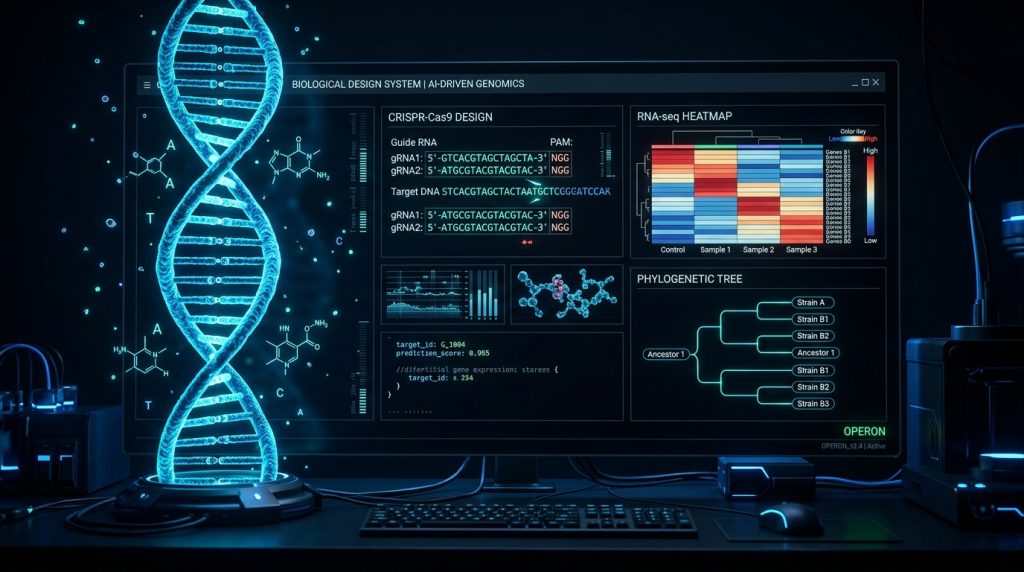
The leak — surfaced by Universe of AI and reported by Geeky Gadgets on April 3 — revealed a mode purpose-built for computational biology with four headline capabilities:
- CRISPR sequence optimization and design — design guide RNAs, optimize for on-target efficiency, minimize off-target risk
- RNA sequencing data analysis — differential expression, pathway analysis, multi-sample comparisons with natural-language interpretation
- Phylogenetic tree construction — evolutionary relationship mapping from sequence data
- Enzyme variant ranking — biochemical property prediction and comparative ranking for protein engineering
Beyond those core features, the architecture itself is the story. Operon offers:
- Persistent workspace memory — your project context persists between sessions; no re-explaining your organism, your experimental design, or your data schema every time you open the app
- Local file integration — direct access to FASTQ files, CSV outputs, FASTA sequences, and research databases on your machine
- Planning and automation modes — structured multi-step research plans that break complex investigations into manageable workflows
- Natural language abstraction — interact with complex genomic data without writing BioPython scripts from scratch every session
The Coefficient Bio Acquisition: Why $400M for 10 People?
On the surface, paying $400 million for a company with fewer than 10 employees sounds insane. Once you understand who those people are, it makes complete sense.
Coefficient Bio was founded in September 2025 by Nathan Frey (CTO) and Samuel Stanton, both veterans of Roche’s Genentech AI-powered drug discovery unit (Prescient Design). CEO Aris Theologis previously held leadership roles at Evozyne and Paragon Biosciences. The company was backed and incubated by Dimension, an AI-focused investment group that held roughly half of the equity. They were operating in complete stealth — their website was blank.
What they had wasn’t customers or revenue. It was proprietary biological understanding baked into a small team with elite-level domain expertise in applying machine learning to drug discovery and development — specifically navigating the regulatory and target-identification stages that are the hardest parts of the pipeline.
By absorbing Coefficient into its healthcare team, Anthropic isn’t just adding features to Claude. It’s acquiring the institutional knowledge to build biology-native AI from scratch — not bolt biology onto a general model. This is the same strategic thesis OpenAI used when it absorbed Codex talent for programming. The result was a qualitative leap. Expect the same here.
For context: large pharma clients already running on Claude include Sanofi, Novo Nordisk, and AbbVie. Eli Lilly committed up to $2.75 billion to expand engagement with Insilico Medicine on the same day. This is the battle for the AI layer of the entire drug discovery stack, and Anthropic just made its most significant move.
Claude Operon Pricing (Expected)
Anthropic has not announced official Operon pricing. Based on the structure of existing Claude subscriptions and the compute intensity of features like RNA-seq analysis, here’s the most informed projection available as of April 7, 2026:
| Plan | Monthly Price | Annual Price | Operon Access | Best For |
|---|---|---|---|---|
| Free | $0 | $0 | ❌ No access expected | Casual use |
| Pro | $20/mo | $17/mo ($204/yr) | ⚠️ Likely limited access | Individual researchers, grad students |
| Max | $100/mo | ~$85/mo (est.) | ✅ Full access expected | Power users, lab PIs, heavy RNA-seq workloads |
| Team | ~$30/user/mo (est.) | ~$25/user/mo (est.) | ✅ Full access + shared context | Research labs, biotech startups (5–50 users) |
| Enterprise | Custom | Custom | ✅ Full access + HIPAA/regulatory compliance | Pharma companies (Sanofi, Novo Nordisk, AbbVie) |
| API (Opus 4.6) | $5/M input tokens | $25/M output tokens | Via API calls; batch discounts available | Developers building biology tooling on Claude |
Note: All pricing projections are based on existing Claude tier structures and community analysis. Official Operon pricing pending Anthropic announcement.
Claude Operon vs. The Competition: 4-Way Comparison
Claude Operon enters a field with several entrenched players. Here’s how it stacks up against the three most relevant alternatives in biology AI:
| Feature / Dimension | Claude Operon | AlphaFold 3 (Google DeepMind) |
Benchling AI (Platform) |
BioGPT (Microsoft) |
|---|---|---|---|---|
| Primary Strength | End-to-end research orchestration | Protein structure prediction | R&D data platform + multi-model integration | Biomedical literature NLP |
| CRISPR Design | ✅ Native feature | ❌ Not applicable | ⚠️ Via integrations | ❌ Not applicable |
| RNA-Seq Analysis | ✅ Native feature | ❌ Not applicable | ⚠️ Via agents | ⚠️ Text-only analysis |
| Protein Structure | ⚠️ Enzyme variants (not 3D structure) | ✅ Best-in-class | ✅ Via AlphaFold integration | ❌ Text generation only |
| Persistent Research Memory | ✅ Cross-session context | ❌ Single-query tool | ✅ Via platform data layer | ❌ Stateless |
| Natural Language Interface | ✅ Core design principle | ⚠️ Limited (web UI) | ✅ AI agents | ✅ Primary mode |
| Drug Discovery Support | ✅ Via Coefficient Bio expertise | ✅ Structural drug design | ✅ End-to-end pipeline | ⚠️ Literature/hypothesis only |
| Local File Integration | ✅ Direct desktop access | ❌ Upload required | ✅ Cloud platform | ❌ No file handling |
| Pricing (Entry) | ~$20–$100/mo (est.) | Free (non-commercial) | Custom enterprise pricing | Free (open source) |
| Release Status | 🔐 Leaked, pre-release | ✅ Live (AlphaFold3) | ✅ Live | ✅ Live (open source) |
The verdict on the comparison: Claude Operon isn’t trying to out-AlphaFold AlphaFold. It’s gunning for the layer those tools live underneath — the research workflow itself. Its most direct competitor is Benchling AI, which already provides integrated R&D workflows for labs. But Benchling requires institutional setup, is priced for enterprise, and integrates models rather than building them. Operon’s edge is the natural-language-first interface powered by Claude’s reasoning capabilities, plus the biology-native expertise from Coefficient Bio.
Feature Deep Dive
CRISPR Sequence Design & Optimization
CRISPR guide RNA design has historically required bioinformaticians to juggle multiple specialized tools — CRISPRscan, Benchling’s CRISPR module, Cas-OFFinder — and manually synthesize results. Claude Operon appears to consolidate this into a conversational interface where researchers can describe their target gene, organism, and editing goals in plain language and receive optimized guide RNA candidates ranked by on-target efficacy and off-target risk.
This is significant not just for convenience, but for access. Many biology labs outside top-tier research institutions don’t have dedicated bioinformaticians. Operon’s natural language abstraction layer could democratize CRISPR design in a meaningful way — bringing PhD-level computational biology to bench scientists who are experts in their experimental domain but not in command-line tooling.
RNA Sequencing Analysis
RNA-seq analysis is one of the most compute-heavy, bioinformatically complex workflows in modern molecular biology. A typical pipeline involves quality control (FastQC), trimming (Trimmomatic), alignment (HISAT2 or STAR), quantification (HTSeq or featureCounts), and differential expression analysis (DESeq2 or edgeR) — often requiring custom scripts and hours of troubleshooting.
Claude Operon’s RNA-seq feature reportedly abstracts this pipeline complexity behind natural language, allowing researchers to upload FASTQ files directly and receive differential expression results, pathway analysis, and biological interpretation through a conversation. For labs that are expert in cell biology but not pipeline engineering, this is potentially transformative.
Phylogenetic Tree Construction
Evolutionary biology research requires constructing and interpreting phylogenetic trees from sequence data — a workflow that typically requires MUSCLE or MAFFT for alignment, IQ-TREE or RAxML for tree building, and FigTree for visualization. Claude Operon aims to manage this end-to-end with natural language input, generating trees from sequence data and providing biological interpretation of the evolutionary relationships.
Enzyme Variant Ranking
Protein engineering research often involves screening large libraries of enzyme variants for desired properties — catalytic efficiency, thermostability, substrate specificity. Claude Operon’s enzyme variant ranking feature positions it to assist in silico screening before costly wet-lab experiments, integrating with Anthropic’s structural biology capabilities (and potentially Coefficient Bio’s drug target expertise) to predict and rank variant properties.
Persistent Research Memory
This might be the most underrated feature of all. Research is inherently multi-session. A PhD project or drug discovery program unfolds over months. Current AI tools require re-loading context with every session — you’re always re-explaining your organism, your experimental history, your hypotheses. Operon’s persistent memory means the workspace knows your project the same way a long-term collaborator does. It maintains awareness of what’s been done, what’s in progress, and what needs to happen next.
This is the same category of improvement we discussed in our Claude Interactive Visuals review — when Claude stops being a tool you pick up and put down, and starts being a genuine research partner.
Who Claude Operon Is For
✅ Perfect Fit
- Computational biologists managing complex multi-tool pipelines who want a unified natural language interface without sacrificing analytical rigor
- Academic lab PIs running underfunded labs without dedicated bioinformatics staff — Operon could serve as a 24/7 computational biologist
- Pharmaceutical R&D teams doing target identification and drug candidate screening — especially with Coefficient Bio’s drug discovery expertise baked in
- Grad students and postdocs learning bioinformatics workflows who need a tool that can explain what it’s doing, not just do it
- Biotech startups building lean research pipelines who can’t afford enterprise Benchling contracts
- Clinical research coordinators at biopharma firms (Sanofi, Novo Nordisk) already using Claude for Life Sciences workflows
⚠️ Proceed with Caution
- Researchers requiring validated clinical-grade outputs — Operon’s AI outputs will need rigorous wet-lab validation before any clinical application
- Teams with proprietary genomic data and strict data governance — cloud processing raises questions not yet fully addressed by Anthropic’s data policies
- Pure structural biologists — AlphaFold remains the gold standard for 3D protein structure; Operon is not trying to compete here
❌ Not the Right Tool
- General biology students looking for homework help — standard Claude does that fine at free tier
- Labs requiring on-premise AI deployment due to data sovereignty regulations — Operon is cloud-based
- Pure wet-lab scientists with no computational workflow needs — Operon is built for the computational side of biology
Controversy, Limitations & Bioethics Concerns
Claude Operon arrives at a moment when AI in biology is under intensifying scrutiny — and for good reason.
Dual-Use Risk: CRISPR Is Not Trivial
CRISPR guide RNA design tools are inherently dual-use. The same capability that helps a researcher eliminate a cancer gene could, in theory, be misused. Most bioinformatics tools require enough technical knowledge that this risk is self-limiting. A natural-language interface that lowers that bar deserves serious thought. Anthropic has not yet published a formal framework for how Operon will handle requests that approach dual-use territory. This is a gap that needs to be filled before release, not after.
Data Privacy and Genomic Sovereignty
Genomic data is the most personal data that exists. Uploading patient-derived RNA-seq files or proprietary drug discovery datasets to a cloud AI service raises major questions under GDPR, HIPAA, and emerging genomic data regulations. Claude for Healthcare (launched January 2026) addressed some of this for clinical contexts, but the intersection of Operon’s research-focused capabilities and real patient data remains murky. Enterprise customers will need explicit data processing agreements and probably on-premise deployment options before they can responsibly use Operon for regulated research.
Regulatory Validation Gap
AI-generated outputs in drug discovery are not FDA-approved analytical methods. Any CRISPR design, RNA-seq interpretation, or drug target identification produced by Operon will need to pass through rigorous experimental validation before it can be cited in regulatory submissions. This isn’t a criticism unique to Operon — it applies to all AI in drug discovery — but researchers need to maintain this distinction clearly. AI accelerates; it doesn’t validate.
Hallucination Risk in Biology
Large language models hallucinate. In a biology context, a confident-sounding but incorrect gene name, pathway association, or sequence recommendation could cost weeks of wet-lab time. Even Microsoft’s BioGPT, explicitly trained on biomedical literature, carries hallucination warnings. Claude Operon will need robust citation and uncertainty quantification to be trusted by serious researchers. Until Anthropic publishes accuracy benchmarks on domain-specific biology tasks, users should treat outputs as hypotheses to test, not conclusions to act on.
What We Don’t Know Yet
As of April 7, 2026, there is no public information on: audit trail capabilities for regulatory compliance, data residency options for EU and other regulated markets, accuracy benchmarks against established bioinformatics tools, offline/on-premise deployment options, or integration with institutional databases (PubChem, UniProt, NCBI). These gaps will determine whether Operon becomes a trusted tool for regulated research or remains a productivity layer for exploratory work.
Getting Started with Claude Operon
Operon is not publicly available as of this writing. Here’s how to prepare for access when it launches:
Step 1: Get the Claude Desktop App
Operon will live inside the Claude desktop application, not just the web interface. Download Claude desktop from claude.ai/download for macOS or Windows and sign in to your account.
Step 2: Upgrade to Pro or Max
Based on Claude’s existing feature structure, Operon will require at minimum a Pro subscription ($20/month). Given the computational intensity of RNA-seq analysis and the persistent memory features, Max tier ($100/month) is likely needed for heavy research use. If you’re at an institution, explore whether your organization has an existing Claude for Life Sciences agreement.
Step 3: Watch for the Operon Mode in the Mode Selector
When Operon launches, it will appear as a new mode option alongside Chat, Code, and Cowork in the Claude desktop interface. Look for it in the mode selector dropdown. Based on community analysis, a public launch window is estimated between late April and June 2026.
Step 4: Prepare Your Research Data
Operon’s local file integration means you’ll get the most out of it if your data is already organized. Prepare FASTA/FASTQ files, CSV outputs from sequencing instruments, and any reference databases you use regularly. Having a clear project description ready will help you set up persistent context from your first session.
Step 5: Start with a Known Workflow
When you first access Operon, start with a workflow you already understand well — a pipeline you’ve run manually before. This lets you evaluate Operon’s outputs against known results before trusting it for novel analysis. The goal is calibration, not blind faith.
Already using Claude for coding or computer use? Our Claude Computer Use review has context on how Claude’s agentic capabilities work in practice — Operon’s automation modes will build on that same infrastructure.
The Bigger Picture: Anthropic’s Life Sciences Play
Claude Operon doesn’t exist in isolation. It’s the fourth major move in an 18-month life sciences strategy:
- October 2025: Claude for Life Sciences launched — biopharma workflow assistance, hypothesis generation, regulatory document management
- January 2026: Claude for Healthcare — HIPAA-compliant clinical environments, hospital systems
- February 2026: Partnerships with Allen Institute and HHMI — agentic AI for academic biological research
- April 2026: Coefficient Bio acquisition ($400M) + Claude Operon leak — biology-native AI, drug discovery capability
The pattern is clear. Anthropic is building a complete stack: general AI model → specialized life sciences deployment → clinical healthcare compliance → academic research → drug discovery. Each layer deepens the moat. By the time Operon launches publicly, Anthropic will have real biopharma relationships (Sanofi, Novo Nordisk, AbbVie), academic credibility (Allen Institute, HHMI), clinical compliance frameworks, and a biology-native AI team courtesy of Coefficient Bio.
OpenAI and Google are both in this race. Google DeepMind’s AlphaFold franchise is legitimately dominant in structural biology. But neither has made a commitment at the workflow orchestration layer as explicit as Claude Operon. If Operon delivers on what the leak suggests, Anthropic may have just made its most durable strategic bet.
For more on how Anthropic’s specialized workspace strategy is evolving, see our coverage in the Claude Sonnet 4.6 review — the model likely powering many of Operon’s core reasoning tasks.
Final Verdict
Claude Operon — Pre-Release Score: 4.6 / 5
- Innovation: 5/5 — Nothing else on the market integrates CRISPR design, RNA-seq, phylogenetics, and persistent research memory in a single natural-language workspace
- Potential Impact: 5/5 — Could fundamentally change how biology research is conducted in underfunded labs worldwide
- Execution Risk: ⚠️ 3.5/5 — Hallucination risk, data privacy gaps, and regulatory validation questions are real concerns that could limit adoption
- Timing: 4/5 — The Coefficient Bio acquisition timing alongside the leak suggests intentional momentum-building ahead of an imminent launch
- Competitive Position: 4.5/5 — Strong differentiation vs. existing tools; Benchling remains a more mature platform for enterprise data management
Claude Operon, even before it officially exists, is already the most interesting thing happening in biology AI in 2026. The $400M Coefficient Bio acquisition isn’t the price of a feature — it’s the price of a data moat and a talent moat that no competitor can easily replicate. Whether it delivers on the promise of the leak depends heavily on how Anthropic handles the bioethics questions (CRISPR dual-use, data privacy, hallucination risk) that come with this territory.
But if Anthropic gets this right? Claude Operon has the potential to be to computational biology what Claude Computer Use was to software automation — the moment where AI stops being a productivity tool and becomes a genuine research collaborator.
Watch this space. This is moving fast.
Disclosure: This is a pre-release review based on publicly available leak information, research from Geeky Gadgets, BioSpace, FierceBiotech, and community analysis. computertech.co has no affiliation with Anthropic. This article may contain affiliate links. Claude Operon is not yet publicly available; all feature descriptions and pricing projections are based on leaked screenshots and informed analysis of Anthropic’s existing product structure.