Last Updated: February 3, 2026 | Reading Time: 12 min
AI content detection is the process of using specialized software to identify whether text was written by a human or generated by artificial intelligence. As AI writing tools like ChatGPT, Claude, and Jasper become ubiquitous, the ability to distinguish between human and machine-generated content has become essential for educators, publishers, marketers, and businesses.
In this comprehensive guide, we’ll explain exactly how AI content detection works, why it matters, the key tools available, and the limitations you need to understand.
Table of Contents
- Understanding AI Content Detection
- How AI Content Detectors Work
- Why AI Content Detection Matters
- Types of AI Content Detectors
- Top AI Content Detection Tools
- Accuracy and Limitations
- Best Practices for Using AI Detectors
- The Future of AI Content Detection
- FAQs
- Final Thoughts
Understanding AI Content Detection
AI content detection refers to the technology and methods used to determine whether a piece of text was created by artificial intelligence or written by a human. These detection systems analyze writing patterns, linguistic characteristics, and statistical markers to assess the likelihood that content originated from an AI model.
The Rise of AI-Generated Content
The explosion of generative AI tools has fundamentally changed how content is created. Tools like ChatGPT, Claude, Jasper AI, and Copy.ai can produce human-quality text in seconds—from blog posts and marketing copy to academic essays and code documentation.
This capability brings tremendous productivity benefits, but it also raises important questions:
- Academic integrity: Are students submitting AI-written essays?
- Content authenticity: Is published content genuinely human-created?
- SEO quality: Does AI content meet Google’s helpful content standards?
- Brand trust: Are businesses passing off AI content as human expertise?
AI content detectors emerged to address these concerns, providing tools to verify content origin and maintain trust in digital communication.
Key Terminology
Before diving deeper, let’s clarify some important terms:
| Term | Definition |
|---|---|
| AI-generated content | Text created primarily or entirely by artificial intelligence systems |
| Detection confidence | A percentage or score indicating how likely content is AI-generated |
| Perplexity | A measure of how predictable text is—AI text often has lower perplexity |
| Burstiness | Variation in sentence structure—humans typically write with more “bursts” of complexity |
| False positive | Human-written content incorrectly flagged as AI-generated |
| False negative | AI-generated content that escapes detection |
How AI Content Detectors Work
AI content detectors employ several sophisticated techniques to analyze text. Understanding these methods helps explain both their capabilities and limitations.
1. Statistical Pattern Analysis
AI models generate text by predicting the most probable next word based on training data. This creates detectable patterns:
- Predictability: AI text tends to be more statistically “average”—using common word combinations and predictable phrasing
- Perplexity scores: AI content typically scores lower on perplexity measures because it’s optimized for likelihood
- Token distribution: The frequency and placement of words follow patterns that differ from human writing
2. Linguistic Feature Detection
Detectors analyze specific writing characteristics:
- Sentence structure: AI often produces more uniform sentence lengths and structures
- Vocabulary diversity: AI may use a narrower range of vocabulary within certain contexts
- Stylistic consistency: Human writing naturally varies in style; AI tends toward consistency
- Transitional patterns: The way ideas connect often differs between AI and human writers
3. Burstiness Analysis
One of the most effective detection methods examines “burstiness”—the variation in sentence complexity throughout a text.
Human writers naturally produce varied content:
- Short, punchy sentences followed by longer, complex ones
- Informal expressions mixed with technical language
- Emotional or personal asides
AI-generated text typically maintains more consistent complexity throughout, making burstiness a reliable detection signal.
4. Machine Learning Classification
Modern detectors use trained neural networks that have learned to distinguish AI from human text:
- Training data: Models are trained on millions of examples of both AI-generated and human-written content
- Feature extraction: The model identifies patterns that correlate with each content type
- Classification: New text is analyzed and classified based on learned patterns
- Confidence scoring: The model outputs a probability score indicating AI likelihood
5. Watermark Detection
Some AI providers embed invisible “watermarks” in generated text:
- Statistical watermarks: Subtle patterns in word choice that are imperceptible to humans but detectable algorithmically
- Metadata markers: Hidden information about content origin
- Provider-specific signatures: Patterns unique to specific AI models
Note: As of 2026, watermarking adoption remains limited, and determined users can often remove watermarks through paraphrasing.
Why AI Content Detection Matters
AI content detection serves critical functions across multiple sectors:
Academic Integrity
Educational institutions face unprecedented challenges:
- Essay mills 2.0: Students can now generate entire essays in minutes
- Research integrity: Academic papers may contain AI-generated sections
- Learning assessment: AI-written submissions don’t demonstrate student learning
- Fairness concerns: Students who don’t use AI are disadvantaged if AI use goes undetected
Universities and schools increasingly require AI detection as part of submission processes, with tools integrated into learning management systems.
Publishing and Journalism
Content authenticity matters for credibility:
- Byline integrity: Readers expect human authors behind bylined content
- Source verification: AI can fabricate quotes, sources, and facts
- Editorial standards: Publishers maintain quality standards that AI may not meet
- Legal liability: Publishing false AI-generated information creates legal exposure
Major publications now routinely screen submissions, especially from new contributors.
SEO and Digital Marketing
Google’s helpful content guidelines emphasize human expertise:
- E-E-A-T signals: Experience, Expertise, Authoritativeness, and Trustworthiness favor human-created content
- Helpful content updates: Google actively demotes low-quality AI content
- User trust: Audiences increasingly value authentic human perspectives
- Brand reputation: Companies risk credibility by publishing obvious AI content
Smart marketers use detection tools to ensure their content meets quality standards before publication.
Business and Legal Contexts
Organizations have practical concerns:
- Contract compliance: Agreements may specify human-created deliverables
- Regulatory requirements: Some industries mandate human review of communications
- Quality assurance: AI content may contain errors, hallucinations, or inappropriate content
- Competitive intelligence: Understanding whether competitors use AI informs strategy
Types of AI Content Detectors
AI detection tools fall into several categories:
Standalone Detection Tools
Dedicated platforms focused entirely on AI detection:
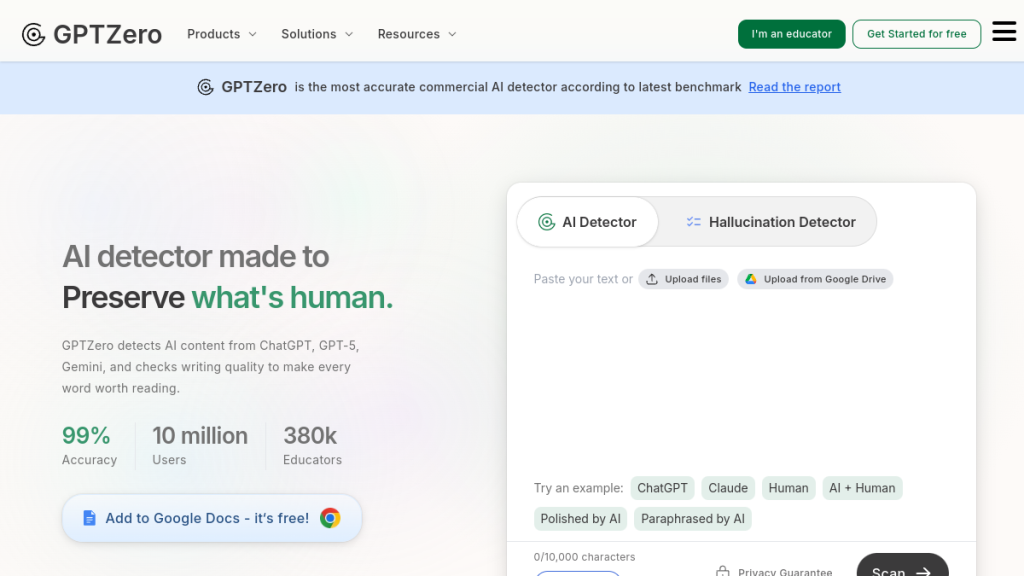
- GPTZero: Pioneer in AI detection, popular in education
- Originality.ai: Comprehensive detection with plagiarism checking
- Winston AI: High accuracy with explainable results
- Pangram: Claims up to 99% accuracy on certain content types
Integrated Writing Platforms
Detection built into broader writing tools:
- Grammarly Business: Includes AI detection alongside grammar checking
- Copyleaks: Combines plagiarism and AI detection
- Turnitin: Academic plagiarism tool now includes AI detection
API-Based Solutions
For developers and enterprises:
- OpenAI Detector: API access to AI detection capabilities
- Sapling: Detection API for integration into workflows
- Custom solutions: Some organizations build proprietary detectors
Browser Extensions
Lightweight tools for quick checks:
- GPTZero Chrome Extension: Analyze text directly in browser
- AI Content Detector extensions: Various options for on-the-fly checking
Top AI Content Detection Tools
Here’s an overview of leading detection tools in 2026:
GPTZero
Best for: Education and academic integrity
| Feature | Details |
|---|---|
| Accuracy | 85-95% on standard AI content |
| Pricing | Free tier available; Pro from $10/month |
| Strengths | Explainable results, education-focused, multilingual |
| Weaknesses | Lower accuracy on short texts (<250 words) |
GPTZero was one of the first dedicated AI detectors and remains popular in educational settings. It provides sentence-level highlighting and detailed explanations of why content was flagged.
Read our full GPTZero review →
Originality.ai
Best for: Publishers and content teams
| Feature | Details |
|---|---|
| Accuracy | 90-96% reported accuracy |
| Pricing | From $14.95 for 2,000 credits |
| Strengths | Batch scanning, plagiarism included, team features |
| Weaknesses | Credit-based pricing can add up |
Originality.ai combines AI detection with plagiarism checking, making it a comprehensive solution for content verification. Its batch scanning feature is valuable for agencies managing multiple pieces.
Read our full Originality.ai review →
Winston AI
Best for: High-accuracy requirements
| Feature | Details |
|---|---|
| Accuracy | Claims 99%+ accuracy |
| Pricing | From $12/month |
| Strengths | Detection transparency, document uploads, OCR |
| Weaknesses | Newer tool with less track record |
Winston AI emphasizes detection explainability, showing users exactly which patterns triggered AI flags. This transparency helps users understand and contest results when needed.
Copyleaks
Best for: Enterprise and education
| Feature | Details |
|---|---|
| Accuracy | 85-95% depending on content |
| Pricing | Custom enterprise pricing |
| Strengths | LMS integrations, API access, multi-language |
| Weaknesses | Premium pricing for full features |
Copyleaks offers robust integrations with learning management systems and enterprise workflows, making it suitable for organizations requiring scalable detection.
Sapling AI Detector
Best for: Developers and API integration
| Feature | Details |
|---|---|
| Accuracy | 90%+ on standard content |
| Pricing | API-based pricing |
| Strengths | Clean API, fast processing, customizable |
| Weaknesses | Less suitable for individual users |
Sapling provides a developer-friendly API for building AI detection into custom applications and workflows.
Accuracy and Limitations
Critical understanding: No AI detector is 100% accurate.
Typical Accuracy Ranges
Based on independent testing and vendor claims:
- Well-trained detectors: 85-95% accuracy on unmodified AI content
- Paraphrased content: 60-80% accuracy (significantly lower)
- Human-AI hybrid content: 50-70% accuracy (highly variable)
- Short texts (<200 words): 60-75% accuracy (insufficient data for analysis)
Factors Affecting Accuracy
Several variables impact detection reliability:
Content length: Longer texts provide more data points for analysis. Most detectors struggle with content under 250 words.
AI model used: Detectors trained on GPT-3.5 may miss content from newer models like GPT-4 or Claude 3.
Post-processing: Light editing, paraphrasing, or running AI content through humanizer tools dramatically reduces detection rates.
Writing style: Technical, legal, or formulaic content naturally resembles AI patterns, increasing false positives.
Language: Detection is most accurate in English; other languages often see reduced accuracy.
The False Positive Problem
False positives—human content incorrectly flagged as AI—remain a significant concern:
- Studies have shown 1-9% false positive rates depending on the tool and content type
- Non-native English speakers are disproportionately flagged
- Technical and academic writing styles trigger more false positives
- Some detectors have falsely accused students, damaging reputations
Best practice: Never rely solely on detector results. Use them as one data point in a broader assessment.
The Arms Race
AI detection exists in a constant cat-and-mouse dynamic:
- New AI models produce text that evades existing detectors
- Detectors update to catch new patterns
- Humanizer tools learn to disguise AI content
- Detectors evolve to catch humanized content
- Cycle repeats
This ongoing evolution means detection accuracy fluctuates and requires continuous tool updates.
Best Practices for Using AI Detectors
To get reliable results from AI detection tools:
For Educators
- Set clear policies: Define expectations about AI use before assignments
- Use multiple tools: Cross-reference results from 2-3 detectors
- Consider context: A flagged submission warrants investigation, not automatic penalties
- Allow appeals: Give students opportunities to explain or demonstrate their work
- Focus on learning: Design assignments that AI can’t easily complete (reflection, process documentation)
For Publishers
- Establish workflows: Build detection into editorial processes
- Set thresholds: Define acceptable detection scores for publication
- Verify, don’t just detect: Use detection as a starting point for human review
- Document policies: Be transparent about AI content guidelines
- Update regularly: Keep detection tools current as AI evolves
For Content Teams
- Screen before publishing: Run all content through detection before going live
- Track patterns: Monitor which writers or sources trigger frequent flags
- Quality over scores: Focus on content quality, not just detection scores
- Educate teams: Ensure everyone understands appropriate AI use
- Create guidelines: Define where AI assistance is acceptable vs. not
General Best Practices
- Test multiple samples: Run several paragraphs, not just one
- Consider source: Weight detection results against source credibility
- Look for patterns: Consistent flagging is more significant than occasional triggers
- Use human judgment: Detectors inform decisions; humans make them
- Stay updated: AI and detection tools evolve rapidly
The Future of AI Content Detection
AI content detection will continue evolving:
Emerging Trends
- Provenance tracking: Cryptographic proof of content origin
- AI watermarking standards: Industry-wide adoption of invisible watermarks
- Real-time detection: Browser-based tools that flag AI content as you read
- Multimodal detection: Identifying AI-generated images, audio, and video alongside text
- Regulatory requirements: Potential laws mandating AI content disclosure
Challenges Ahead
- Improving AI quality: As AI writing becomes indistinguishable from human writing, detection becomes harder
- Hybrid content: The line between AI-assisted and AI-generated blurs
- Privacy concerns: Detection tools require analyzing user content
- Access inequality: Some will have better detection tools than others
The Bigger Picture
The goal isn’t to eliminate AI content—it’s to maintain transparency about content origin. The future likely involves:
- Clear disclosure norms for AI-assisted content
- Better tools for verifying human authorship when it matters
- Acceptance of AI content where transparency exists
- Continued human oversight of AI-generated material
FAQs
How accurate are AI content detectors?
Most reputable AI content detectors achieve 85-95% accuracy on unmodified AI-generated text. However, accuracy drops significantly (to 60-80%) when AI content has been edited, paraphrased, or processed through “humanizer” tools. No detector is 100% accurate, and false positives (human content flagged as AI) occur in 1-9% of cases depending on the tool and content type.
Can AI content detectors be fooled?
Yes. Several methods can reduce detection accuracy: light editing and paraphrasing, using AI “humanizer” tools, mixing AI content with human writing, using newer AI models that detectors haven’t been trained on, and writing prompts that encourage more varied output. The detection landscape is an ongoing arms race between AI generators and detectors.
Do AI detectors work on all languages?
Detection accuracy varies significantly by language. Most tools perform best on English content, with accuracy dropping 10-20% for other major languages like Spanish, French, or German. Less common languages may have even lower accuracy due to limited training data. Always verify a detector’s language capabilities before relying on results for non-English content.
Should I use AI content detectors for academic integrity?
AI detectors can be a useful tool for academic integrity but should never be the sole basis for accusations or penalties. Best practices include: using multiple detection tools, treating flags as prompts for further investigation, allowing students to explain their process, and designing assignments that demonstrate learning beyond what AI can produce. False positives can seriously harm innocent students.
What’s the difference between plagiarism checkers and AI detectors?
Plagiarism checkers compare submitted text against databases of existing content to find copied material. AI detectors analyze writing patterns and statistical markers to determine if content was generated by AI, regardless of whether it matches existing text. AI-generated content is typically original (not copied) but may still violate policies. Many modern tools like Copyleaks and Originality.ai combine both functions.
Are free AI detectors reliable?
Free AI detectors can provide useful initial assessments but often have limitations: lower accuracy than paid versions, word count restrictions, fewer features (no batch processing, limited explanations), and less frequent model updates. For high-stakes decisions (academic integrity, publishing), paid tools with proven track records are worth the investment.
Will AI content detection become obsolete?
As AI writing improves, detection becomes more challenging—but detection technology evolves too. The future likely involves a combination of: improved detection algorithms, industry-standard watermarking, content provenance systems (cryptographic proof of origin), and cultural norms around disclosure. Detection may become one part of a broader authenticity verification ecosystem rather than the sole solution.
Final Thoughts
AI content detection has become an essential capability in our AI-augmented world. While no detector is perfect, these tools provide valuable signals for maintaining content integrity across education, publishing, and business contexts.
Key takeaways:
- Detection works—with limits: 85-95% accuracy on unmodified AI content, lower for edited material
- Use multiple tools: Cross-reference results for higher confidence
- Human judgment matters: Detectors inform decisions; they don’t make them
- Stay current: Both AI and detection tools evolve rapidly
- Focus on transparency: The goal is informed content consumption, not AI elimination
Whether you’re an educator maintaining academic standards, a publisher ensuring content quality, or a marketer optimizing for SEO, understanding AI content detection helps you navigate the new reality of AI-augmented content creation.
Related Content
- Best AI Writing Tools 2026 — Compare the top AI content generators
- Best AI SEO Tools 2026 — Tools for optimizing AI-assisted content
- What is an LLM? — Understand the technology behind AI content
- What is NLP? — Learn about natural language processing
- Grammarly Review 2026 — Writing assistant with AI detection features
Schema Markup Notes
FAQ Schema: Include all 7 FAQ items above
Article Schema: Use Article type with educational category
Internal Links to Add:
- Link “GPTZero” mentions to /reviews/gptzero/ (when created)
- Link “Originality.ai” mentions to /reviews/originality-ai/ (when created)
- Link to /best/ai-writing-tools/
- Link to /glossary/llm/
- Link to /glossary/nlp/
Meta Title: What is AI Content Detection? Complete Guide for 2026 | ComputerTech
Meta Description: Learn how AI content detection works, why it matters, and which tools are most accurate. Comprehensive guide covering detection methods, limitations, and best practices.
Word Count: ~2,850
Created: February 3, 2026
Author: ComputerTech Editorial Team