Manus AI handed a journalist a fully built competitive analysis report – sourced, formatted, and delivered – while she was on a lunch break. That’s not a chatbot trick. (For document-based research grounded strictly in your own sources rather than open-ended delegation, see our NotebookLM review – a different tool solving a related problem.) That’s an autonomous agent operating without a human in the loop, and it’s why this Manus AI review is worth reading before you spend a dollar on it.
Launched in early 2025 by Chinese AI startup Monica, Manus exploded onto the scene with viral demos and a waitlist that stretched for weeks. By early 2026, it had processed over 147 trillion tokens, spun up more than 80 million virtual computers, and – in a move nobody saw coming – been acquired by Meta. The product still runs independently out of Singapore, but the landscape has shifted. This is Manus AI in its most mature, post-hype form, and it’s genuinely interesting and genuinely flawed in equal measure.
This Manus AI review covers what it actually does, how the credit system will burn your budget, who it’s actually useful for, and where it falls flat. No hype, no affiliate puffery – just what we found after digging in.
What Is Manus AI? The Autonomous Agent Concept, Explained Simply
Most AI tools are reactive. You ask, they answer. ChatGPT, Claude, Gemini – they’re all conversational engines. You stay in the loop at every step. (Evaluating other autonomous agent systems? Our Perplexity Computer review covers a multi-agent approach that launched around the same time.) That’s fine for brainstorming and writing, but it means you’re still doing the work of directing and assembling everything yourself.
Manus is different in a structural way. It’s an autonomous agent – meaning you give it a goal, and it figures out the steps, executes them sequentially, and delivers a finished output. You don’t watch it work. You come back later to a result.
Think of it like the difference between hiring a consultant who calls you every 10 minutes asking for clarification versus one who takes the brief, disappears for a few hours, and hands you a polished deliverable. Manus is the second consultant. Sometimes that’s exactly what you need. Sometimes you needed the first one.
Manus achieves this by spinning up virtual machines in the cloud – isolated browser environments where it can search the web, read documents, write and run code, fill out forms, and stitch outputs together into a final product. Each task gets its own sandboxed compute environment. That’s why it takes 15-80 minutes to complete something instead of 15 seconds.
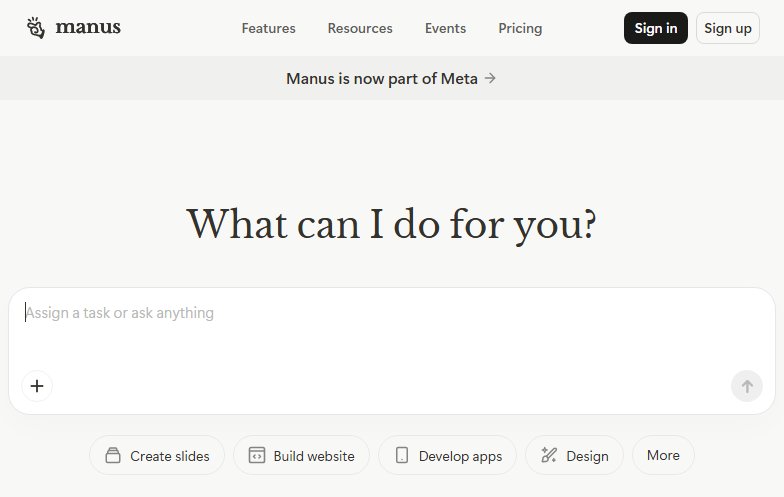
Since being acquired by Meta in early 2026, Manus operates under the tagline “Less structure, more intelligence.” The product continues to sell subscriptions and operate independently – Meta’s play appears to be long-term integration with its platform ecosystem, not an immediate rebrand. For now, users interact with the same product that went viral in 2025.
How Manus AI Works (Technical, But Readable)
Under the hood, Manus runs a multi-agent architecture. When you submit a task, a planning model breaks your goal into subtasks and sequences them. Then execution agents take over – each one operating in a virtual machine with access to a browser, file system, code interpreter, and a set of APIs.
Here’s what that workflow looks like from the user side:
- Submit a goal in plain English – no syntax, no configuration required
- Manus plans the task – it decomposes your request into a step-by-step execution path
- Agents execute in parallel or sequence – browsing, reading, writing, coding as needed
- You get a deliverable – a report, a website, a dataset, a codebase, depending on what you asked for
The key differentiator is that Manus doesn’t just tell you how to do something – it does it. Ask it to research your top five competitors and produce a comparison spreadsheet, and it will actually open their websites, read their pricing pages, extract the data, and build the file. Ask it to build a landing page and it will write the HTML, CSS, and deploy a preview.
Credits are consumed during execution by three things: LLM tokens (planning and generation), virtual machine time (cloud compute for browser and file operations), and third-party API calls (for things like financial data or professional databases). This cost structure is why the pricing section below deserves your full attention before you sign up.
Manus also supports scheduled and triggered workflows – you can set an agent to run weekly, or configure it to fire when certain conditions are met. This makes it genuinely useful for recurring research or reporting tasks, not just one-off projects.
What Can Manus Actually Do? Real Use Cases
The demo videos are impressive. The real-world performance is more nuanced. Here’s what Manus can legitimately handle well, with specific examples of task complexity and time/credit cost:
Research and Reports
This is Manus’s strongest category. Give it a research goal – “Analyze the pricing strategies of the top 10 project management SaaS tools” – and it will browse competitor sites, compile data, and produce a structured report. A market trends research task takes roughly 50 seconds of clock time and about 59 credits on the Standard plan. A full competitive analysis with data visualization can run 200+ credits and 15 minutes. Compare that to 3-4 hours of manual work, and the math starts to make sense.
Website Building
Manus can build functional websites from a text description. A wedding invitation page with styling took approximately 25 minutes and ~360 credits in documented tests. A complex web app with multiple features pushed past 900 credits and 80 minutes. These are real outputs – not instructions for you to follow, but actual deployable code. Quality varies and complex apps will need a developer’s review, but for MVPs and landing pages, it’s legitimately useful. If you need the built output to stay in sync with your design system, our OpenAI Figma integration review covers the bidirectional design-to-code workflow that keeps Figma and code aligned after the initial build.
Data Organization and Processing
Feed Manus a spreadsheet or point it at a data source and ask it to clean, transform, or visualize the data. A chart generation task runs about 15 minutes and ~200 credits. This is repetitive enough that the time savings add up quickly if you’re doing it weekly.
Trip Planning and Scheduling
A 3-day trip plan, documented in user testing, ran about 4.5 minutes and ~152 credits. Manus researched flights, hotels, and activities and compiled an itinerary. Not groundbreaking, but it’s hands-off and thorough.
Email and Workflow Automation
Through its Mail Manus and Slack integration features, Manus can handle recurring communication workflows – pulling weekly product reviews from multiple sources, compiling them, and delivering a report to your inbox. This is the strongest recurring-value use case for subscription holders.
What It Struggles With
Manus is weak on multi-app business process automation – it can’t natively sync CRM data, handle voice calls, or chain email-plus-Slack-plus-HubSpot workflows the way dedicated automation platforms can. It’s also entirely text and web based – don’t expect it to interact with desktop applications or proprietary enterprise systems. And it has no real-time response – if you need an answer in 30 seconds, you’re using the wrong tool.
Manus AI Pricing: The Credit System Explained Honestly
This is the section that will save you money or save you from buyer’s remorse. Manus uses a credit-based pricing system, and it is not straightforward.
Here are the current tiers as of 2026:
| Plan | Monthly Price | Credits/Month | Daily Refresh | Concurrent Tasks |
|---|---|---|---|---|
| Free | $0 | Starter credits (one-time) | Limited | Limited |
| Standard | $20/mo | 4,000 | 300/day | 20 |
| Customizable | $40/mo | 8,000 | 300/day | 20 |
| Extended | $200/mo | 40,000 | 300/day | 20 |
| Team | Custom | Scalable pool | Custom | Custom |
Annual billing saves 17% across all plans – bringing Standard to ~$16.60/month, Customizable to ~$33.20/month, and Extended to ~$166/month.
What the Standard Plan ($20/month) Actually Gets You
On the $20/month Standard plan, you get 4,000 credits plus 300 free daily refresh credits. Sounds like a lot. Here’s what it actually buys:
- A simple web search query: 10-20 credits
- Market trends research: ~59 credits
- A data visualization chart: ~200 credits
- Trip planning: ~152 credits
- A styled webpage: ~360 credits
- A complex web app: 900+ credits
Do the math: if you’re running complex tasks at 900 credits each, your $20 plan covers 4-5 serious tasks per month. That’s $4-5 per task in credit value. If those tasks would each take you 3-4 hours manually, the economics work. If you’re doing simple queries you could handle in ChatGPT, you’re overpaying dramatically.
The Three Traps to Know Before You Pay
Trap 1 – No upfront cost estimates. Manus cannot tell you how many credits a task will consume before you start. Users have described this as “gambling every time I submit a prompt.” A vague request might use 3x more credits than a specific one for the same output.
Trap 2 – No credit rollover. Unused monthly credits vanish at the end of your billing cycle. Use 1,000 of your 4,000 credits? The other 3,000 are gone. Only add-on credits (purchased separately, requires active subscription) never expire.
Trap 3 – Tasks stop mid-execution. When credits run out, the agent doesn’t pause – it stops completely. You’re left with a half-finished report, a broken website build, or incomplete code. The credits consumed are gone with nothing to show for them.
The 300 daily refresh credits are the smart way to test. Use them to run small tasks before committing to a paid plan. They reset at midnight and give you a real feel for how quickly Manus burns through credits for your specific use cases.
Manus AI vs Perplexity Computer Use vs OpenClaw
The autonomous agent space has three distinct flavors in 2026. Here’s how Manus stacks up against two strong alternatives: Perplexity’s Computer Use (which lets Perplexity control your computer) and OpenClaw (a local AI agent orchestration platform):
| Feature | Manus AI | Perplexity Computer Use | OpenClaw |
|---|---|---|---|
| Agent type | Cloud-based, sandboxed VMs | Computer control (local) | Local orchestration, multi-model |
| Runs tasks autonomously | Yes – fully hands-off | Yes – controls your actual desktop | Yes – via skills and sub-agents |
| Pricing model | Credit-based ($20-$200/mo) | Bundled with Perplexity Pro ($20/mo) | Free + OpenClaw subscription |
| Best for | Research, web tasks, site builds | Local file/app automation | Developer workflows, custom pipelines |
| No-code friendly | Yes | Moderate | Moderate – power user tool |
| Integration depth | Limited | Full desktop access | Extensible via skills |
| Privacy concern | Cloud-only, data leaves device | Local – your data stays local | Mostly local |
| Task transparency | Moderate (can watch agent work) | High (you see screen) | High (logs visible) |
| Meta acquisition | Yes (2026) | No | No |
Manus wins on ease-of-use and breadth of web-based tasks. Perplexity Computer Use wins on privacy and local control – it’s better for sensitive workflows where you don’t want cloud exposure. OpenClaw wins on flexibility and extensibility for power users who want to build and customize their own agent pipelines. [LINK: OpenClaw review] [LINK: Perplexity Computer Use review]
Who Should Use Manus AI?
Manus is a genuine time-saver for specific user profiles. Here’s who gets real value from it:
- Freelancers and solopreneurs handling recurring research tasks – competitive analysis, market research, weekly roundups. If you’re billing clients for this work, the time math is easy.
- Small marketing teams that need regular content research, data compilation, or prototype websites built quickly. Manus isn’t replacing your designer, but it’s taking work off someone’s plate.
- Agencies building MVPs for client validation. A functional landing page or simple web app in 25-80 minutes is worth the credit cost if it wins a client conversation.
- Researchers and analysts who spend hours gathering and formatting data. If your workflow involves collecting from multiple sources and building reports, Manus is doing real work at a pace you can’t match manually.
- Non-technical founders who need research, prototypes, and data without hiring help for every small task.
One consideration that’s now relevant: Manus is owned by Meta. If you’re in a regulated industry or handling sensitive business data, the cloud-based architecture – and the new corporate parent – may require a harder look at your data handling policy before you start piping proprietary information into it.
Honest Limitations: What Manus AI Gets Wrong
Skipping this section in a review is a trust-killer, so here it is unfiltered.
The Credit System Is Genuinely Stressful
Multiple independent reviewers have called Manus’s pricing “too volatile, expensive, and risky.” The inability to see cost before you start a task isn’t a minor UX inconvenience – it changes how you interact with the product. You start self-censoring complex requests because you don’t know if it’ll cost 100 credits or 900. That cognitive overhead partially negates the productivity benefit.
Task Failure Means Lost Credits, Full Stop
If Manus can’t complete a task – network error, agent loop, ambiguous instructions – you still pay for the compute. There’s no partial refund mechanism, no automatic pause when something goes sideways. An agent loop (where it keeps retrying the same failed step) can drain credits with zero useful output. This is a significant product maturity problem and a frequent complaint from paying users.
Integration Depth Is Shallow
Manus connects with a limited range of apps. If your workflow requires deep CRM integration, voice pipelines, or triggering actions across multiple business apps simultaneously, Manus will hit a wall. Platforms like Zapier, Make, or even Lindy have vastly more integration options. Manus is not an enterprise automation solution.
Slow By Design – And That’s Sometimes a Problem
Tasks take 4 to 80 minutes. For the right use case, that’s fine – you submit and come back. But if you need iterative back-and-forth, real-time collaboration, or quick answers while in a meeting, Manus is the wrong tool. It’s asynchronous by nature. Many users try to use it like a chatbot and are frustrated when it takes 20 minutes to respond.
The Meta Wildcard
Manus’s acquisition by Meta in 2026 is significant context. The company says nothing will change for subscribers and operations continue from Singapore. But Meta’s track record with acquired products is mixed, and “nothing will change” is a phrase with a finite shelf life. If you’re building recurring workflows around Manus, keep a contingency plan. This isn’t unique to Manus – any cloud tool carries this risk – but the Meta angle makes it worth flagging explicitly.
No Multi-Modal Support
Manus operates in the digital, web-based world only. It can’t answer phone calls, interact with physical systems, or handle voice-triggered workflows. For the niche it serves, this isn’t a problem. But it means Manus is a specialist tool, not a generalist one – and some users buy it expecting something broader.
Workflow Complexity Has a Ceiling
Manus works well when your workflow has a clear goal and a bounded scope. When workflows get complex – multiple departments, branching logic, exception handling, approval steps – Manus starts to struggle. The fixed workflow structure limits how much you can customize an agent’s behavior when things don’t go according to plan. For those use cases, dedicated automation platforms are better investments.
Verdict
Rating: 7/10
Best for: Freelancers, solopreneurs, and small marketing teams with high-volume research, reporting, or rapid prototyping needs who can work asynchronously and calculate their credit spend carefully.
Not for: Anyone who needs predictable costs, real-time responses, deep multi-app integration, or privacy guarantees – especially given the Meta acquisition. Enterprise teams should also read our Claude Enterprise review – a fundamentally different approach with structured plugin governance and audit trails.
Bottom line: Manus AI delivers on its core promise – it actually completes tasks autonomously, not just tells you how to do them yourself. The credit system is poorly designed and the Meta wildcard introduces genuine uncertainty, but for the right user with the right workflow, it’s legitimately one of the most capable autonomous agents available in 2026.
Frequently Asked Questions
What exactly is Manus AI and how does it differ from traditional AI tools?
Manus AI is an autonomous agent that operates independently to achieve specific goals you set for it. Unlike traditional AI tools like ChatGPT, which require user input at every step, Manus takes your brief and delivers a finished output without constant interaction.
How does Manus AI handle tasks and what technology does it use?
Manus AI spins up virtual machines in the cloud to perform tasks in isolated environments. This allows it to search the web, read documents, and compile results into a polished final product, taking longer than typical AI responses but delivering more comprehensive outcomes.
Is Manus AI worth the investment for small businesses?
Whether Manus AI is worth the investment depends on your specific needs. It can be particularly useful for businesses that require in-depth research or complex report generation without the need for constant oversight, but users should be aware of its credit system that can impact budgets.
What are the main advantages of using Manus AI?
The main advantages of Manus AI include its ability to autonomously execute tasks and deliver results without user intervention. This can save time and streamline workflows, especially for users who need comprehensive outputs quickly.
What are some limitations of Manus AI that users should be aware of?
While Manus AI is innovative, it does have limitations. Users may find that it occasionally falls short in terms of flexibility and may not always align perfectly with their expectations, as it operates without direct input during the execution phase.
How has Manus AI evolved since its launch in 2025?
Since its launch in early 2025, Manus AI has matured significantly, processing over 147 trillion tokens and being acquired by Meta in 2026. It continues to operate independently while integrating into Meta’s ecosystem, reflecting both its growth and the shifting landscape of AI tools.
Can Manus AI be used for document-based research?
Yes, Manus AI can be used for document-based research, but it’s important to note that it operates differently than tools designed for open-ended tasks. If you’re looking for a solution focused strictly on your own sources, you might want to explore alternatives like NotebookLM.