Perplexity Computer is the most ambitious multi-agent AI platform available today — genuinely useful for high-output professionals, but gated at a price point that only makes sense if you’re already drowning in AI tool subscriptions and ready to consolidate.
This Perplexity Computer review covers everything that matters: how the 19-model orchestration actually works in practice, what you can realistically build with it, how it stacks up against Claude Computer Use and OpenAI Operator, and whether the $200/month price tag is defensible. Launched February 25, 2026, this is one of the more interesting AI releases of the year — but interesting and worth paying for are two different things.
If you want the full background on Perplexity as a company and their core search product, check out our Perplexity AI review. This piece focuses specifically on Computer, their new agentic platform.
What Is Perplexity Computer?
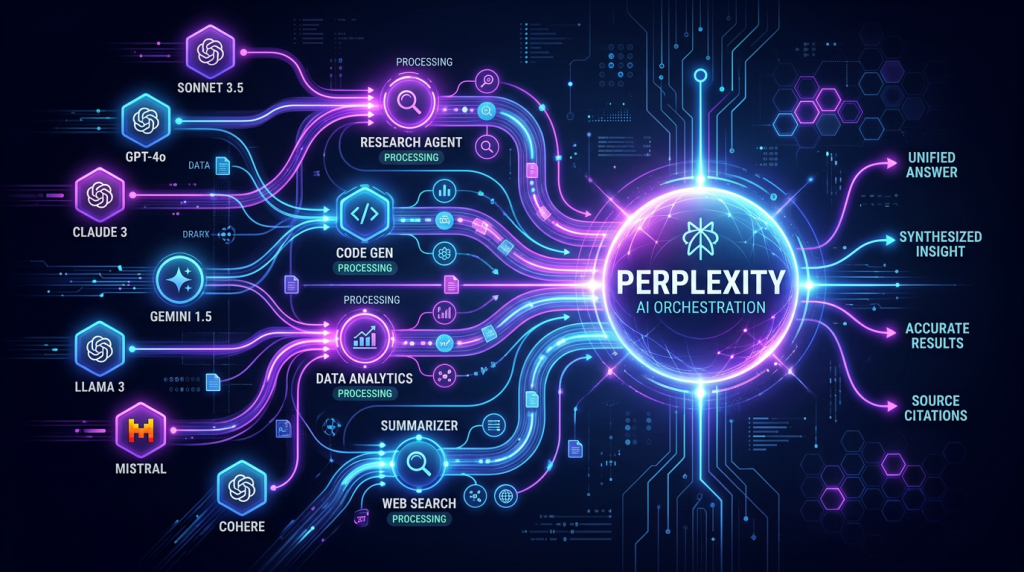
Perplexity Computer is a cloud-based multi-agent AI system that accepts a high-level objective from you, breaks it into subtasks, and delegates each subtask to whichever of its 19 AI models is best suited for the job — all running asynchronously in the background while you do something else.
It’s not a physical device. The name is a deliberate reference to the idea of replacing what your computer does: research, analysis, writing, coding, design, and deployment, handled by AI from start to finish. Perplexity describes it as “a general-purpose digital worker” — which is accurate, if a little corporate. The honest version: it’s what you’d get if you had a team of specialists (a researcher, a coder, a designer, a writer) who could all work simultaneously and hand off to each other seamlessly, except the whole team is made of AI models.
This is Perplexity’s clearest product vision yet. The company has been building toward something like this since launching their AI-powered search in 2023 and their Comet browser in 2025. Computer is the third leg: not just answering questions, not just browsing, but actually doing work end-to-end. CEO Aravind Srinivas framed it on X as: “Computer unifies every current capability of AI into a single system. Files, tools, memory, and models, orchestrated together, working for you.”
How It Works: The 19-Model Orchestration
The headline number — 19 AI models — sounds like marketing until you understand what it actually means for output quality.
Perplexity’s core thesis, backed by their own enterprise usage data, is that AI models are specializing, not commoditizing. By December 2025, no single model commanded more than 25% of usage across their enterprise customer base — down from over 90% concentrated in just two models at the start of that year. Models are getting better at different things. A model that’s excellent at software engineering tends to be mediocre at marketing copy. A model that excels at long-context document analysis isn’t the fastest at lightweight web queries.
Perplexity Computer is built around that observation. Here’s what the model stack looks like in practice:
- Claude Opus 4.6 — Core reasoning engine and orchestrator. Handles the planning layer and complex coding tasks. Perplexity has internally described it as “a terrible writer” but acknowledged its coding capability is unmatched.
- GPT-5.2 — Long-context recall, broad web search, expansive document synthesis. Deployed when tasks require pulling together large amounts of information across many sources.
- Gemini — Deep research queries. Also spawns sub-agents when tasks require parallel research tracks.
- Grok — Lightweight, speed-sensitive tasks. Used when the system needs a fast result and the query doesn’t require heavy reasoning.
- Veo 3.1 — Video generation and processing.
- Nano Banana — Image generation.
- 13 additional specialized models handling tasks like transcription, data extraction, code review, and integration-specific actions.
The orchestration layer is automatic. You describe the outcome you want — “build me a competitor analysis dashboard with live traffic data and pricing changes” — and the system decomposes it into subtasks, assigns each to a sub-agent running the optimal model, and executes in parallel. Each sub-agent operates in an isolated cloud environment with access to a real filesystem, a real browser, and integrations with over 400 external applications.
You can override the defaults. If you know you want Claude for a specific subtask or GPT-5.2 for another, you can pin models to tasks manually. The system will also check in with you when it hits a genuine decision point — it’s not a fully autonomous “set it and forget it” system, but tasks can run for hours or days without requiring your attention.
Key Features
Parallel Sub-Agent Execution
The most practically useful thing about Computer is that subtasks don’t run sequentially — they run simultaneously. When you ask for a market research report, the system isn’t doing research, then writing, then formatting. It’s running a research agent, a writing agent, and a formatting agent at the same time, with outputs feeding into each other. This compresses work that would take hours into minutes.
Persistent Memory and File Access
Computer maintains persistent memory across sessions. It remembers past projects, files you’ve uploaded, preferences you’ve expressed, and context from prior work. This is the difference between a tool that requires you to re-explain your business every session and one that functions more like a long-term colleague. It connects to your actual files and services — not a sandboxed simulation.
400+ App Integrations
Computer connects to over 400 external applications out of the box. That includes project management tools, communication platforms, databases, code repositories, and SaaS tools across most major categories. The integrations aren’t shallow read-only connections — the system can write to these services, create records, trigger workflows, and push completed work to destinations you specify.
Background Execution
Tasks can run for extended periods — hours, days, or longer — without requiring you to stay in the app. You can start a project, close your browser, and come back to a finished output. This is meaningfully different from chat-based AI interactions where you have to babysit the conversation. Computer works the way a contractor would: you give a brief, they disappear, they deliver.
Model Council
Perplexity’s Model Council feature — available separately within the platform — lets you query multiple models simultaneously and compare their outputs side-by-side. For use cases where you want diverse perspectives or need to validate an answer across models, this is useful without requiring you to manually juggle separate subscriptions.
Real-World Use Cases
Early users have pushed the platform in some genuinely interesting directions in the few days since launch:
- Live data dashboards: One user built a functional satellite tracking web application from a single prompt. Another created a real-time NVDA (Nvidia) analysis terminal pulling live financial data — described as rivaling Bloomberg’s basic functionality.
- Research packets: A product manager used Computer overnight to produce four complete research packets — competitive analysis, user research synthesis, market sizing, and regulatory landscape — while sleeping.
- Micro-app development: Multiple early users built small deployable applications (calculators, trackers, dashboards) without writing a line of code manually.
- Financial and legal data synthesis: Perplexity’s own demo workflows show the system collecting statistics, financial data, and legal information, synthesizing it into analysis, and presenting findings as finished websites or data visualizations.
- Marketing automation: Combining research, copywriting, and deployment across a campaign brief — drafting multiple assets, checking them against competitor positioning, and pushing to connected platforms.
The pattern across these use cases: Computer is most effective when the task has a clear deliverable, involves multiple types of work (research + code + writing, or data + design + deployment), and would normally require you to manually switch between several tools.
Pricing & Access
Perplexity Computer is currently available exclusively to Perplexity Max subscribers at $200 per month. That’s the company’s highest subscription tier, launched alongside Computer.
- Perplexity Max — $200/month: Full Computer access. Includes 10,000 monthly credits plus a 20,000-credit launch bonus for new Max subscribers. Credits govern how much compute the system uses across your tasks — complex, multi-model workflows consume more credits than simple queries.
- Perplexity Pro — $20/month: Does not currently include Computer access. Pro subscribers get access to the core search product, model switching, and some agentic features, but not the full orchestration system.
- Free tier: No Computer access. Standard search with rate limits.
- Enterprise: Computer access is coming to enterprise plans — timeline not yet specified.
The credit system is worth understanding before subscribing. Perplexity hasn’t published a full credit consumption table, but based on early user reports, a complex multi-step project (research + code + visualization) can consume several hundred credits. The 10,000 monthly credit allocation gives you meaningful runway for daily use, but power users running large projects continuously will want to monitor consumption.
The 10x price jump from Pro to Max ($20 → $200) is steep. The calculus only makes sense if you’re currently paying for multiple separate subscriptions — Claude Pro, ChatGPT Plus, a research tool, a code assistant — that Computer effectively replaces, and if the time savings on complex projects justify the premium.
Pros & Cons
| Pros | Cons |
|---|---|
| Genuinely parallel multi-model execution — not just model switching | $200/month is a significant commitment with limited pricing flexibility |
| Background execution — tasks run while you’re doing other things | Credit system isn’t fully transparent — hard to predict costs per project |
| 400+ app integrations out of the box | Cloud-only — no local file system access for sensitive data workflows |
| Persistent memory across sessions | Demo was cancelled at press briefing due to last-minute bugs — still early-stage |
| Automatic model selection removes the “which AI should I use?” friction | Max tier only — Pro users locked out entirely |
| Users can override and manually pin models to specific tasks | Enterprise access timeline unclear |
| Early results are impressive across research, coding, and deployment tasks | Still in initial release — edge cases and reliability issues expected |
| Cloud-based approach avoids the local security risks of tools like OpenClaw | No public affiliate program — no community incentive layer to drive adoption |
How It Compares to the Competition
vs. Claude Computer Use (Anthropic)
Claude Computer Use gives Claude direct control of your actual desktop — it can click, type, and navigate your screen like a human user. It’s more powerful for local machine tasks (interacting with software that doesn’t have an API) but carries more security risk and requires you to manage the execution environment yourself. Perplexity Computer is cloud-sandboxed, more polished for project-level work, and easier to set up — but can’t interact with local applications the way Claude Computer Use can.
vs. OpenAI Operator
Operator is OpenAI’s web-browsing agent, good at completing multi-step tasks within websites — booking reservations, filling forms, navigating commerce flows. It’s narrower in scope than Computer. Where Operator excels at web interaction, Computer excels at project completion involving research, creation, and deployment. They’re solving somewhat different problems, though the categories will likely converge.
vs. Manus AI
Manus is the closest direct competitor in philosophy — a multi-agent system focused on autonomous task completion. The key differences: Manus has broader availability and lower pricing entry points, while Computer benefits from Perplexity’s existing search infrastructure, model relationships, and data on real-world enterprise usage patterns. Manus has been around longer; Computer has a more established parent company with deeper model partnerships.
vs. OpenClaw
OpenClaw is the viral open-source autonomous agent that went wide earlier this month. It’s more powerful in terms of local system access — full file system, email, messaging apps, API keys — but that power comes with real security exposure. Perplexity Computer trades local depth for cloud safety and a more structured, deliverable-oriented workflow. If you want raw autonomy on your own machine, OpenClaw. If you want a managed, cloud-based project executor, Computer.
Who Is Perplexity Computer For?
Be honest with yourself about this before subscribing:
- Consultants and agency professionals billing at rates where 2-3 hours of saved work per week pays for the subscription. If a complex research-to-deliverable project takes you 4 hours manually and Computer does it in 45 minutes, the math works.
- Developers and technical product managers who regularly need to combine research, code, and visual output — and currently context-switch between Claude, ChatGPT, and separate tools to get there.
- Enterprise teams already spending $100+/month per person across fragmented AI tool subscriptions. Computer positions as a consolidation play — one platform, one interface, all the models.
- High-output content operations where projects involve research, writing, and visual creation in a single workflow.
It is probably not for:
- Casual AI users who primarily use chat-based AI for single queries
- Anyone on a budget — $200/month is a real commitment
- Workflows that require local system access or involve highly sensitive data that can’t touch cloud infrastructure
- Users who want to understand and control every step — Computer’s automation is a feature for some and a black box for others
The Verdict
Perplexity Computer is the most coherent implementation of the multi-agent AI thesis to date. The underlying observation — that models are specializing, not commoditizing, and that value accrues to whoever orchestrates them best — is correct. And the product executes on that thesis better than anything currently available.
That said, it launched less than a week ago with a demo cancellation on press day due to bugs. Early user results are genuinely impressive, but this is version 1.0 of an ambitious system. Reliability, edge case handling, and the credit economics under real-world workloads are still being figured out.
The $200/month price point will filter most people out immediately — which is partly the point. Perplexity has explicitly said they’re targeting users making “GDP-moving decisions,” not chasing monthly active user numbers. That’s a defensible strategy, but it also means the product’s rough edges won’t get smoothed out as fast as a mass-market tool would.
If you’re already spending close to $200/month across Claude, ChatGPT, and other AI tool subscriptions, and if your work regularly involves multi-step projects that span research, code, and creative output — Computer is worth a serious evaluation. The consolidation value alone may justify it, and the parallel execution model is faster than anything you’ll assemble manually.
If you’re not in that bucket, wait six months. The credit economics will be clearer, the bugs will be ironed out, and pricing tiers for Pro subscribers will likely arrive. The platform will be more trustworthy and possibly more affordable. The underlying technology isn’t going anywhere.
Rating: 7.5/10. Excellent concept, strong early execution, legitimately powerful for the right use case — but $200/month and version 1.0 rough edges mean most people should either commit with clear ROI math or wait for a Pro tier. Try Perplexity Computer here.
Frequently Asked Questions
What is Perplexity Computer?
Perplexity Computer is a cloud-based multi-agent AI platform that takes high-level objectives and breaks them into subtasks, delegating each to one of its 19 specialized AI models. It’s designed to handle tasks like research, analysis, writing, coding, and design seamlessly, functioning as a digital worker.
How much does Perplexity Computer cost?
Perplexity Computer is priced at $200 per month. This pricing may only be justifiable for users who are already heavily invested in multiple AI tools and are looking to consolidate their subscriptions.
How does Perplexity Computer work?
Perplexity Computer operates by taking a user’s high-level objective and breaking it down into subtasks, which are then assigned to the most suitable AI model from its 19 options. This orchestration runs asynchronously, allowing users to focus on other tasks while the AI handles the work.
How does Perplexity Computer compare to competitors like Claude Computer and OpenAI Operator?
Perplexity Computer differentiates itself by utilizing a multi-agent system with 19 specialized models, which enhances output quality by leveraging the strengths of each model. In contrast, competitors may rely on fewer models or less specialization, potentially impacting the versatility and effectiveness of their outputs.
Is Perplexity Computer worth the price?
Whether Perplexity Computer is worth the $200 monthly fee depends on your specific needs and current AI tool usage. If you’re a high-output professional looking to streamline your workflow and reduce costs from multiple subscriptions, it may be a valuable investment.
Who is Perplexity Computer designed for?
Perplexity Computer is primarily designed for high-output professionals who require efficient task management across various domains such as research, coding, and design. It is ideal for those who frequently engage with multiple AI tools and are looking to consolidate their efforts.
What tasks can Perplexity Computer handle?
Perplexity Computer can manage a wide range of tasks including research, analysis, writing, coding, design, and deployment. Its ability to break down complex objectives into manageable subtasks allows it to function effectively across different domains.
When was Perplexity Computer launched?
Perplexity Computer was launched on February 25, 2026. It represents a significant advancement in Perplexity’s offerings, building on their previous AI-powered search and Comet browser products.