- Anthropic launched Cowork & Plugins for the Enterprise on February 24, 2026 – not a feature update, a full platform play
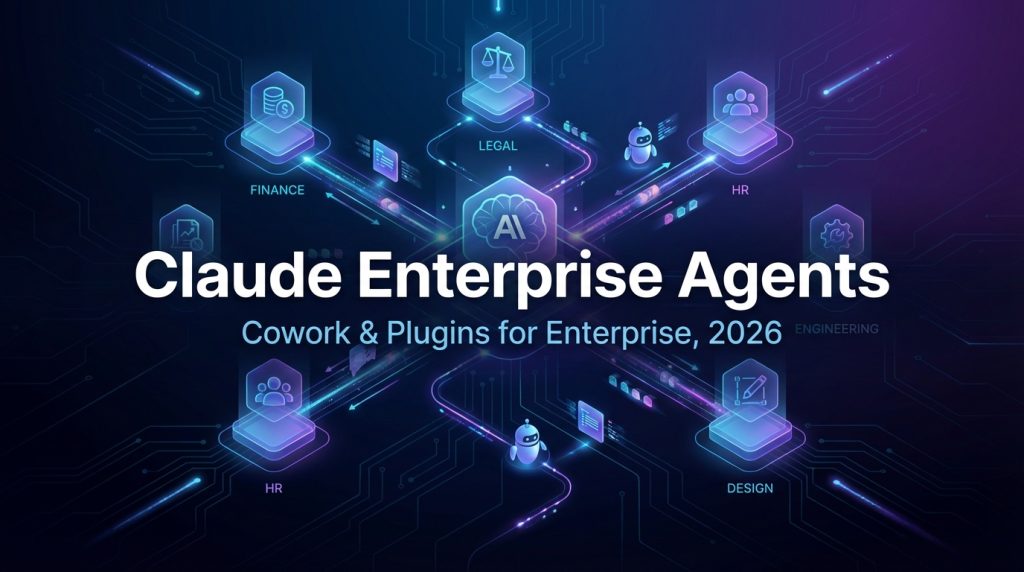
- Pre-built plugins ship for five departments: Finance, Legal, HR, Engineering, and Design
- Enterprises can build private plugin marketplaces with controlled data flows and role-based access
- Corporate IT gets centralized deployment, access management, and audit tooling
- No public pricing – enterprise sales relationships only
- This is the most architecturally sound enterprise AI launch since the hype wave peaked and broke in 2025
- Honest caveat: rollout is staggered, execution risk is real, and the competition (Microsoft, Google, Salesforce) won’t sit still
- Why Enterprise AI Failed in 2025
- What Anthropic Actually Launched
- The Architecture Shift That Matters
- Plugin Deep-Dive: Every Department
- Real-World Use Cases
- Claude vs. Microsoft, Google, Salesforce, OpenAI
- Which SaaS Categories Are at Risk
- Who Should NOT Buy This
- Pricing and Availability
- The Verdict
- FAQ
For two years, enterprise software vendors have been promising that AI agents would revolutionize how companies work. Most of those promises aged poorly. Chatbots got bolted onto existing SaaS dashboards, “agentic” workflows turned out to be glorified macros, and IT departments were left holding the bag on integrations that half-worked on a good day.
On February 24, 2026, Anthropic made a serious move to change that narrative – and if the early details hold up, it might actually work this time.
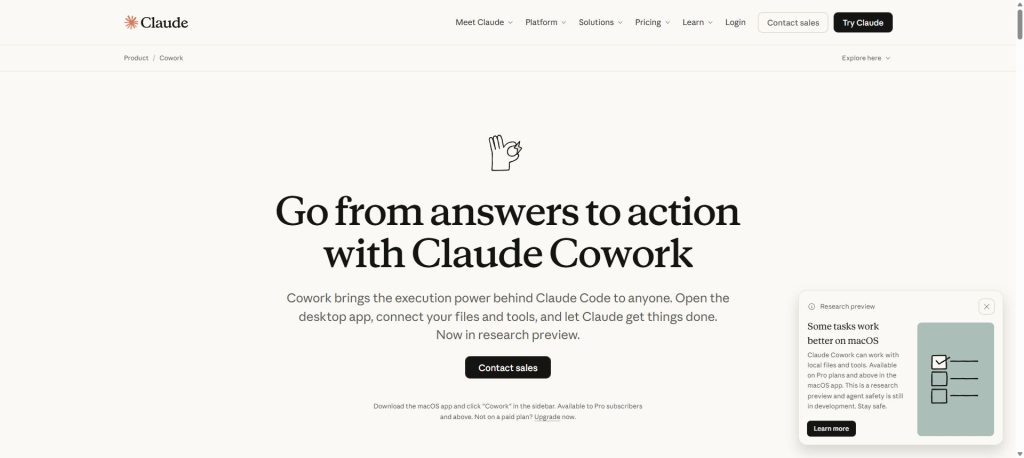
The company officially launched Cowork & Plugins for the Enterprise, a full-stack enterprise agents program built on top of the Claude Cowork platform (first previewed in research form on January 30). It includes pre-built departmental plugins, private software marketplaces, and centralized IT controls that let admins deploy tailored AI workflows across an entire organization. This isn’t a chatbot wrapper. This is infrastructure.
Anthropic’s enterprise agents launch is the most credible attempt yet to replace departmental SaaS with AI-native workflows. Pre-built plugins for finance, legal, HR, engineering, and design – combined with corporate-grade IT controls and private marketplaces – make this a genuine platform play, not a feature addition. Still early days, but the architecture is right. Enterprises actively evaluating AI platforms in 2026 should be watching this closely.
- Best for: Mid-to-large enterprises looking to consolidate fragmented SaaS stacks
- Watch out for: Availability is rolling out – not all plans or regions have access yet; pricing is opaque
- Competitive threat to: Salesforce, ServiceNow, Workday, Monday.com, and dozens of point solutions
- Sources: Launch day coverage, February 24, 2026
Why Enterprise AI Actually Failed in 2025
The story of 2025 enterprise AI is worth understanding clearly, because Anthropic’s entire pitch is built around having fixed what broke. (If you’re new to Anthropic’s product lineup, our Claude Code review covers the coding-specific side of the Claude ecosystem.)
2024 set the stage with enormous vendor promises. Every major SaaS company announced “AI features.” Microsoft launched Copilot across Microsoft 365. Salesforce shipped Agentforce. ServiceNow embedded AI across its workflow platform. Google pushed Workspace AI to millions of business seats. Billions of dollars in research and product investment poured into making AI “work” inside enterprise software.
By mid-2025, the results were underwhelming – not because the AI models got worse, but because of three structural problems that nobody wanted to admit publicly.
Problem one: Bolted-on architecture. Almost every enterprise AI launch in 2024-2025 followed the same pattern: take an existing SaaS product, add a sidebar or a button that calls an LLM, and call it “AI-powered.” The AI could see whatever the product’s UI showed it. It could do whatever the product’s API allowed. It couldn’t cross product boundaries, combine context from multiple systems, or take autonomous action outside the walled garden of that one tool. Intelligent autocomplete dressed up as an agent.
Problem two: No IT governance. Enterprise IT departments have approval processes for a reason. Shadow AI became a genuine crisis in 2025 – tools like Manus AI are highly capable autonomous agents, but without IT governance they create exactly the exposure enterprise security teams fear. Employees using personal Claude or ChatGPT accounts to process sensitive business data because the official “AI-powered” tools weren’t actually useful. When IT tried to lock down AI usage, they had no centralized controls. Every vendor had different audit logs, different access management, different data handling policies. The compliance teams got nervous, and some did. Entire AI programs got shelved in regulated industries.
Problem three: Data security theater. Vendors promised enterprise data never left the customer’s environment. That was sometimes true and sometimes not, and the documentation was consistently unclear. Legal and compliance teams in financial services, healthcare, and government had no reliable way to audit what data the AI was actually touching, processing, or potentially storing. When you can’t audit it, you can’t approve it. When you can’t approve it, nothing ships.
Kate Jensen, Anthropic’s Head of Americas, put it directly: “2025 was meant to be the year agents transformed the enterprise, but the hype turned out to be mostly premature. It wasn’t a failure of effort. It was a failure of approach.”
The failure of approach was those three problems. Anthropic watched this play out and rebuilt from scratch with the architecture problems as the design constraints.
What Anthropic Actually Launched
Cowork & Plugins for the Enterprise is three things combined into one platform:
- Departmental plugin packs – Pre-built agents for Finance, Legal, HR, Engineering, and Design. Each plugin is purpose-built for the workflows those teams actually run: contract review, headcount planning, code review, budget variance analysis, design feedback loops.
- Private software marketplaces – Companies can build and host their own internal plugin ecosystems, with controlled data flows and customized agent behavior. Think of it as an internal app store for AI agents, scoped entirely to your org’s systems and data.
- Corporate IT controls – Admins get centralized deployment, access management, and audit tooling. They can push tailored workflows to entire departments, restrict plugin access by role, and monitor agent activity – the kind of governance that enterprise IT actually demands before signing off.
This builds directly on the Claude Cowork platform announced in research preview on January 30. That announcement introduced the core concept of Claude operating as a persistent collaborative workspace rather than a one-off prompt interface. Today’s launch is the enterprise-grade productization of that vision.
Matt Piccolella, Anthropic’s product officer, described the endgame simply: “We believe that the future of work means everybody having their own custom agent.” That’s not a feature. That’s a platform thesis.
The Architecture Shift That Matters
Here’s the conceptual shift that separates what Anthropic is doing from everything that came before it, explained without the marketing layer.
The old model – call it SaaS-as-interface – works like this: you have a set of products (your CRM, your ERP, your HR system, your legal tools), and each one has a UI that employees log into. AI gets added as a feature inside each UI. The employee still has to move between five different tools to get context on anything cross-functional. The AI in each tool can only see the data that tool manages. Combining context is still a human job.
The new model – agent-as-interface – flips it. The agent becomes the primary interface. The SaaS tools stay in place as systems of record, but the agent connects to all of them through plugins. When someone needs to work across finance data, a contract, and an HR record at once, the agent handles that orchestration. The employee talks to one interface; the agent figures out which systems to query and in what order.
Think of it like the difference between a city without a map app versus one with Google Maps. Before Google Maps, you had to know your way around – or call individual businesses for directions. After it, you had one interface that orchestrated all the local knowledge. The roads didn’t change. The interface did.
For enterprises, the critical piece is controlled data flows. In the Claude Cowork model, the company defines exactly what data each plugin can access, what it can read versus write, and what actions require human approval before execution. The IT team isn’t just hoping the vendor has good data practices – they’re configuring it themselves through centralized controls. That’s the governance gap that killed so many 2025 AI deployments, solved.
The private marketplace extension matters for a different reason: company-specific plugins. No pre-built plugin pack covers every internal workflow. A pharmaceutical company’s regulatory submission process is different from a bank’s trade compliance workflow. Private marketplaces let engineering teams build custom agents scoped to internal systems and proprietary data – and deploy them through the same governance infrastructure as everything else. One platform to govern them all.
Plugin Deep-Dive: Every Department
Anthropic shipped five departmental plugin packs at launch. Here’s what each one actually does – or should do – for the teams that need it most.
Finance Plugin
Finance teams are drowning in a specific kind of misery: data lives in too many places. The ERP has the actuals. The FP&A tool has the forecast. The spreadsheets have the variance analysis. The CEO wants a summary. Getting from source data to boardroom-ready narrative is currently a multi-hour manual process that analysts hate and CFOs keep asking for faster.
The Finance plugin is designed to collapse that process. Connected to your ERP and financial data systems, it can pull actuals against forecast, compute variance, identify the largest drivers, and generate a draft narrative – not as separate steps, but as one agentic workflow triggered by a single request. It can also flag anomalies that pattern-match against historical variance, surface cash flow projections against current receivables, and generate board-ready summaries in your formatting standards.
What it probably can’t do yet: make write transactions back to your ERP without human approval (and you shouldn’t want it to). Complex multi-entity consolidation with custom intercompany eliminations will need custom plugin work. This is an augmentation tool for analysts, not a replacement for your controller.
Legal Plugin
Legal is one of the most compelling plugin targets because the workflow is highly repetitive and document-heavy – two areas where AI has consistently proven value. Contract review, in particular, has been a crowded AI market (Ironclad, Kira, Harvey AI all play here), but most of those tools are point solutions with their own UIs and data silos.
The Legal plugin integrates contract analysis into the same workspace where everything else happens. A lawyer reviewing a vendor agreement can pull the contract, cross-reference against internal playbook terms, flag non-standard clauses, summarize risk areas, and compare against prior agreements with that vendor – without leaving Cowork or switching tools. For in-house legal teams managing high contract volume, the time savings are real.
The more interesting capability is policy compliance checking. When a business team wants to launch a new product feature or run a promotional campaign, the legal plugin can check the proposed action against relevant policies and flag potential issues before the team submits a formal request. Pre-submission legal review, automated. That’s the kind of friction reduction that actually changes team behavior.
HR Plugin
HR workflows are a mix of high-volume, repetitive tasks (onboarding, policy FAQs, document management) and genuinely complex analysis (headcount planning, compensation benchmarking, attrition prediction). The HR plugin is probably strongest on the first category at launch.
An agent that can answer employee policy questions accurately, pull the right forms, route requests to the right people, and summarize headcount data against headcount plan – without an HR team member handling each interaction manually – is genuinely useful for HR teams at companies with hundreds to thousands of employees. For organizations where HR spends meaningful time on repetitive administrative tasks, the plugin makes a direct dent.
The more sophisticated headcount planning and attrition analysis use cases probably require custom plugin work to connect the agent to your specific HRIS (Workday, ADP, BambooHR), your ATS, and your compensation data. The pre-built plugin is a starting point, not a complete solution for complex People Analytics teams.
Engineering Plugin
Claude has been genuinely strong at coding since before this launch – the coding capabilities are well-established territory. What the Engineering plugin adds is enterprise context: connecting the coding assistant to your internal documentation, your incident history, your architecture decision records, and your code review processes. For teams that also want an agent-first IDE where AI handles entire feature builds autonomously, our Google Antigravity review covers how that agentic approach works at the individual developer level before it reaches enterprise governance scale.
The practical difference is significant. A generic coding AI can help write functions and debug syntax. An engineering plugin that knows your internal API contracts, your security standards, your deployment requirements, and your team’s recent incident patterns can do code review that’s actually calibrated to your environment, not just general best practices.
For larger engineering organizations, the incident response workflow is particularly interesting. An agent that can query runbooks, check recent deployment history, pull error logs, and surface similar past incidents during an active outage – and do it in one workflow rather than across five different tools – makes a real difference at 2 a.m.
Design Plugin
The Design plugin is the most conceptually ambitious and probably the most nascent. Design workflows are inherently visual and iterative, and AI’s ability to participate in that process is still maturing. What the plugin targets is the non-visual overhead: stakeholder feedback synthesis, design brief creation, brand guideline compliance checking, asset management, and project status communication.
A design team running multiple campaigns across multiple stakeholders drowns in feedback consolidation and version tracking. An agent that can pull stakeholder comments from different sources, synthesize conflicting feedback into actionable revision notes, and track which comments have been addressed across design iterations – that’s useful, even if the agent isn’t generating the designs itself.
Custom plugins for specific design tools (Figma, Adobe, etc.) will probably be where this gets interesting for creative teams specifically. For teams already exploring the code-design boundary, our OpenAI Figma MCP integration review covers a complementary approach where AI coding agents connect directly to Figma Design for bidirectional design-to-code workflows. The pre-built pack is likely most useful for design ops and project coordination rather than hands-on creative work.
What This Actually Looks Like in Practice
Abstract feature lists are one thing. Here’s how a realistic Monday morning looks with these plugins deployed.
The VP of Finance scenario: Sarah opens Claude Cowork at 8 a.m. ahead of a 9 a.m. executive team meeting. She types: “Pull last week’s revenue actuals against forecast, flag any line items more than 5% off, and draft a two-paragraph narrative for the exec team.” The Finance plugin queries the ERP, computes the variances, identifies that SaaS revenue is running 8% below forecast in the enterprise segment, and generates a draft narrative citing the specific cause (two enterprise deals that slipped into Q2). Sarah edits the last sentence, exports it, and walks into the meeting with 20 minutes to spare instead of arriving five minutes late with a partially finished slide.
The in-house counsel scenario: Mark’s team just received a new vendor MSA for a cloud infrastructure provider. He asks the Legal plugin to review it against the company’s standard terms. The plugin flags three non-standard clauses: a broad IP assignment provision, a limitation of liability cap that’s below the company’s minimum threshold, and an auto-renewal clause that doesn’t match internal policy. It cross-references against the last three agreements signed with similar vendors. Mark has a focused issues list to send to outside counsel in 10 minutes instead of spending two hours reading the full agreement himself.
The engineering lead scenario: During a production incident, a service is throwing 502 errors and nobody can immediately identify why. The engineering plugin queries the deployment log (a new service version deployed 40 minutes ago), checks the error pattern against past incidents (similar pattern occurred in March 2025 after a config change), and surfaces the relevant runbook entry. The on-call engineer has a hypothesis to test in 90 seconds instead of five minutes of frantic tab-switching.
These scenarios aren’t guaranteed – they depend on plugin quality, data connectivity, and configuration that takes real work to set up. But they’re realistic targets for what the platform is designed to enable.
How Claude Compares to the Competition
Anthropic isn’t operating in a vacuum. Four major players already have enterprise AI deployments at scale, and each one is coming from a different angle. Here’s the honest competitive picture.
Microsoft Copilot for Microsoft 365
Strengths: Deepest integration story in the market. If your company runs on Microsoft 365, Copilot has native access to your emails, documents, Teams conversations, calendar, and SharePoint – all from day one. No integration work required. (For teams evaluating cloud-native multi-agent alternatives outside the Microsoft stack, our Perplexity Computer review covers a different orchestration approach worth benchmarking.) The distribution muscle (hundreds of millions of Microsoft 365 seats) is unmatched.
Weaknesses: Still largely confined to the Microsoft ecosystem. If you’re orchestrating workflows that cross Microsoft and non-Microsoft systems, Copilot gets awkward fast. The intelligence layer (GPT-4 based) is competitive but not superior to Claude on complex reasoning tasks. And the Copilot experience has been inconsistently executed across applications – Word Copilot feels different from Teams Copilot which feels different from Excel Copilot.
Where Anthropic wins: Cross-system orchestration, complex reasoning tasks, and organizations that aren’t Microsoft-first. If half your stack is on Salesforce, AWS, and custom internal tools, Claude’s plugin model is more flexible than Copilot’s Microsoft-centric integration story.
Google Workspace AI
Strengths: Similar to Microsoft – deep native integration with Google Workspace (Docs, Sheets, Gmail, Drive, Meet). Gemini is genuinely competitive at multimodal tasks. Google’s infrastructure and pricing power are real.
Weaknesses: Enterprise AI credibility has been a harder sell for Google after Gemini’s rough public launch period. IT governance and audit tooling are less mature than enterprise buyers expect. Enterprise sales motion is weaker than Microsoft’s.
Where Anthropic wins: Enterprise-grade governance tooling, complex reasoning and writing quality, and organizations skeptical of committing their AI stack to one hyperscaler.
Salesforce Agentforce
Strengths: Deep CRM data access and customer-facing workflow automation. If your use case is customer service, sales enablement, and revenue operations – all inside Salesforce – Agentforce is purpose-built for that. The data model is mature and the integration depth is real.
Weaknesses: Lives inside Salesforce. If you need agents that work across legal, finance, HR, and engineering – not just GTM workflows – Agentforce hits walls fast. And Salesforce’s AI intelligence layer (Einstein) has historically trailed the frontier models on raw reasoning quality.
Where Anthropic wins: Cross-departmental scope and model quality. Agentforce is a CRM-native AI; Claude Cowork is attempting to be the AI layer for the entire enterprise.
OpenAI Enterprise
Strengths: GPT-4 and GPT-5 are strong models with a huge developer ecosystem. OpenAI’s name recognition and developer adoption give it a head start on custom plugin ecosystems. API flexibility is high.
Weaknesses: OpenAI’s enterprise product (ChatGPT Enterprise) is more of a managed API access with data privacy guarantees than a purpose-built enterprise platform. The pre-built departmental plugin packs and private marketplace infrastructure that Anthropic just shipped don’t have an OpenAI equivalent yet. IT governance tooling is lighter than what regulated enterprises need.
Where Anthropic wins: Enterprise-specific product features (private marketplaces, centralized IT controls, audit tooling) and Claude vs ChatGPT comparison on complex reasoning and writing tasks where Claude has a genuine edge.
Which SaaS Categories Are Actually at Risk
The SaaS disruption thesis is real, but it’s not uniform. Some categories are highly vulnerable; others are largely safe for now. Here’s the breakdown.
High risk (next 2-3 years):
- Document and knowledge management tools – Notion, Confluence, basic wikis. If an AI agent can synthesize information from multiple sources and surface answers directly, the “place to store things” use case gets commoditized fast.
- Basic workflow and approval tools – Monday.com, Asana, lighter Jira use cases. If agents can track status, route approvals, and surface blockers automatically, manual task tracking software loses value. Tools like Lindy AI already demonstrate what this looks like in practice.
- Research and information synthesis tools – Anything whose core value is “collects information and helps you find it.” Agents handle this natively.
- Lightweight legal and contract tools – Simpler contract management tools without deep workflow integration face real pressure from legal AI plugins.
Moderate risk (medium-term):
- HR and people tools – BambooHR and similar mid-market HRIS tools face risk on the service delivery side. But systems of record (storing employee data, running payroll) are stickier.
- Analytics and BI – If agents can query data and generate narratives on demand, standalone BI tools face pressure. But complex data modeling and governance remain human-intensive.
- Customer support platforms – AI agents already handle a meaningful share of customer service volume. The platform layer (Zendesk, Intercom) is more defensible than the agent itself.
Lower risk for now:
- Core ERP and financial systems – SAP, Oracle, Workday. These are systems of record with deep workflow lock-in, regulatory compliance requirements, and years of implementation investment. Agents will integrate with them, not replace them anytime soon.
- Specialized vertical software – Healthcare EMR, legal matter management, engineering CAD tools. Domain-specific depth and compliance requirements create durable moats.
- Security and compliance infrastructure – The governance layer isn’t going anywhere; it’s becoming more important.
- Collaboration infrastructure – Slack, Teams, Zoom. The communication layer is defensible because agents need somewhere to surface outputs.
Who Should NOT Buy This
This section exists because honesty is actually useful. Not every company should prioritize Claude Cowork enterprise plugins.
Small teams (under 50 people). The value of centralized IT controls, private marketplaces, and audit tooling is real – but it requires IT capacity to configure and maintain. A 20-person startup doesn’t have a dedicated IT team to govern a complex enterprise AI deployment. The overhead-to-benefit ratio is wrong. For small teams, Claude.ai Pro or Teams is the right tier, not enterprise plugins. For document-heavy research workflows, NotebookLM is a complementary tool worth adding to any knowledge-worker stack. Check our best AI tools for small business guide for right-sized options.
Companies without a data integration strategy. The Finance plugin is only as good as its connection to your financial data. The Legal plugin needs access to your contracts. The HR plugin needs your HRIS data. If your data is fragmented across legacy systems with inconsistent APIs and no clear data governance strategy, the plugins won’t work well regardless of how good the AI is. Garbage in, garbage out – agent edition. Fix the data infrastructure first.
Organizations expecting immediate ROI from AI with no change management. Enterprise AI deployments fail when they get treated as software rollouts rather than workflow changes. If leadership expects to flip a switch and have productivity increase without user adoption work, training, and process redesign – the platform will underdeliver. This is true for all enterprise AI, not just Anthropic.
Highly regulated industries without legal review of data handling. Financial services, healthcare, government, and defense contractors need to get their legal and compliance teams involved before any enterprise AI deployment. The data processing agreements need review. The audit trail requirements need to be verified against the platform’s capabilities. Don’t skip that step because the platform has “enterprise security” in the marketing copy.
Companies still evaluating whether AI is relevant to their business. If you’re genuinely uncertain whether AI has applications in your workflows, start with Claude Pro or Teams for a small pilot group. Don’t start with a full enterprise platform deployment. Build confidence and use cases first, then scale infrastructure.
Pricing and Availability
Anthropic has not published a public pricing sheet for enterprise plugin tiers as of this writing. That’s not unusual – it’s consistent with how enterprise software of this type is sold. Expect pricing to reflect per-seat or per-deployment negotiated contracts with SLAs, data processing agreements, and dedicated support baked in.
Rollout is staggered. Not all enterprise customers have access simultaneously, and Anthropic appears to be managing the rollout to ensure deployment quality rather than just maximizing initial sign-ups. Companies interested in early access should contact Anthropic’s enterprise sales team directly at anthropic.com/contact-sales.
One honest note: the private marketplace and custom plugin capabilities are almost certainly gated behind the highest enterprise tier. If your use case requires custom plugins scoped to internal proprietary systems, plan for the highest contract tier and a meaningful implementation timeline – not an afternoon of setup.
The Verdict
Enterprise AI has earned its skepticism. Vendors have overpromised and underdelivered for long enough that “agentic” has become almost a pejorative in some IT departments. So it’s worth being clear-eyed about the uncertainty here.
That said – the architecture Anthropic is shipping with Cowork & Plugins for the Enterprise is the right architecture. Private marketplaces with controlled data flows solve the security objection. Centralized IT controls solve the governance objection. Pre-built departmental plugins solve the “where do I even start” objection. And building on Claude’s underlying capabilities means the intelligence layer is genuinely competitive – on complex reasoning, long-context understanding, and writing quality, Claude is at the frontier.
The execution risks are real: plugin quality varies at launch, enterprise deployments are complex, change management inside large organizations is slow, and Anthropic is competing against incumbents with years of integration depth and massive distribution. Microsoft and Google aren’t going to watch this play out without responding. This is a long game.
But the vision is coherent, the timing is right – 2025’s failed hype cycle has reset expectations to realistic – and the team has clearly learned from what didn’t work. For enterprises actively evaluating Anthropic Claude enterprise agents in 2026, this platform belongs on the shortlist. For IT leaders who’ve been burned by previous enterprise AI deployments, the governance architecture here is worth a closer look specifically because it addresses the objections that killed the last round of deployments.
Keep an eye on Anthropic Claude updates as the platform evolves. Our Claude Cowork review covers the broader platform in depth. The launch is the start, not the finish.
Frequently Asked Questions
What is Anthropic Claude Cowork and how does it relate to Claude for Enterprise?
Claude Cowork is Anthropic’s persistent collaborative workspace platform, first announced in research preview on January 30, 2026. Cowork & Plugins for the Enterprise – launched February 24, 2026 – is the enterprise-grade productization of that platform, adding pre-built departmental plugins, private marketplaces, and corporate IT controls on top of the Cowork foundation. Claude for Enterprise (Anthropic’s existing business tier) is the underlying access layer; Cowork is the workplace interface built on top of it. Think of Claude for Enterprise as the engine and Cowork as the car.
Which departments does Claude Cowork have pre-built plugins for?
At launch on February 24, 2026, Anthropic shipped pre-built plugin packs for five departments: Finance, Legal, HR, Engineering, and Design. Each pack is designed around the specific workflows those departments run most frequently. Additional departmental plugins are expected as the platform matures, and enterprises can build custom plugins for internal use through the private marketplace infrastructure.
How much does Claude Cowork Enterprise cost?
Anthropic has not published public pricing for the enterprise tier. Enterprise pricing is negotiated through direct sales relationships and will vary based on seat count, deployment scope, data processing requirements, and SLA terms. There is no self-serve checkout for enterprise plugins – contact Anthropic’s enterprise sales team at anthropic.com/contact-sales. For smaller teams, Claude.ai Teams is the more accessible entry point with published pricing.
How does Claude Cowork handle data security?
The platform is designed with controlled data flows – meaning the enterprise customer configures what data each plugin can access, what it can read versus write, and what actions require human approval before execution. Corporate IT admins get centralized access management and audit tooling to monitor agent activity. Private marketplaces let companies build custom plugins scoped to internal data without exposing that data to public plugin infrastructure. That said: enterprises in regulated industries (financial services, healthcare, government) should have legal and compliance teams review the data processing agreements before deployment. “Enterprise security” in marketing copy is not a substitute for DPA review.
How does Anthropic Claude enterprise compare to Microsoft Copilot?
Microsoft Copilot’s main advantage is deep native integration with the Microsoft 365 ecosystem – if your company runs on Microsoft tools, Copilot requires the least integration work. Claude Cowork’s advantage is cross-system orchestration and model quality. For organizations that need agents working across both Microsoft and non-Microsoft systems (Salesforce, AWS, custom internal tools), Claude’s plugin model is more flexible. On complex reasoning and writing tasks, Claude has a genuine edge over GPT-4-based Copilot. On distribution and out-of-the-box Microsoft integration, Copilot wins. The right choice depends heavily on your existing stack. See our GitHub Copilot review for more on what Copilot does well.
Can companies build their own custom Claude Cowork plugins?
Yes. The private software marketplace feature is specifically designed for this. Companies can develop custom plugins scoped to their internal systems, proprietary data, and specific workflows – then deploy them through the same centralized governance infrastructure as the pre-built packs. Corporate IT admins control what data the custom agents can access and what actions they can take. This is the capability that makes Claude Cowork a genuine platform rather than just a set of pre-built tools, but it requires engineering resources to build and maintain the custom plugins.
When will Claude Cowork plugins be widely available?
Rollout began on February 24, 2026, but is staggered across enterprise customers. Anthropic hasn’t published a specific timeline for general availability. If your organization is interested in early access, the path is through Anthropic’s enterprise sales team. Expect rollout to continue over the coming months rather than flipping on for all enterprise customers simultaneously.
Is Claude Cowork suitable for small businesses?
Honestly, no – at least not the enterprise plugin tier. The platform is built for organizations with the IT capacity to configure and govern a complex enterprise AI deployment. Small businesses (under ~50 employees) are better served by Claude.ai Pro or Teams, which give access to Claude’s core capabilities without the enterprise overhead. If you’re a small business curious about AI agents for your team, start there and evaluate whether enterprise-tier capabilities justify the cost and complexity as you scale.
Sources: Based on launch day coverage from multiple outlets (February 24, 2026). Executive quotes attributed to Kate Jensen (Anthropic Head of Americas) and Matt Piccolella (Anthropic product officer) per reported launch statements.