You’re drowning in research papers and blog posts, but you need actual science-backed answers, not some blogger’s opinion disguised as expertise. Consensus AI searches through 200+ million peer-reviewed papers to give you evidence-based answers, but with Elicit, Perplexity, and Semantic Scholar all competing for the same space, which research AI actually delivers the most reliable results?
Quick Verdict
⭐ Rating: 4.5/5
💰 Pricing: Free tier available | Pro: $15/mo | Deep: $65/mo | Teams & Enterprise: Custom
✅ Best For: Graduate students, academic researchers, medical professionals, and anyone who needs citation-backed answers from peer-reviewed literature
❌ Skip If: You need general web search, creative writing help, or real-time news coverage
Table of Contents
- What is Consensus AI?
- Key Features
- Pricing & Plans
- Pros and Cons
- Who Is Consensus For?
- Consensus vs Alternatives
- FAQs
- Final Verdict
What is Consensus AI? {#what-is-consensus-ai}
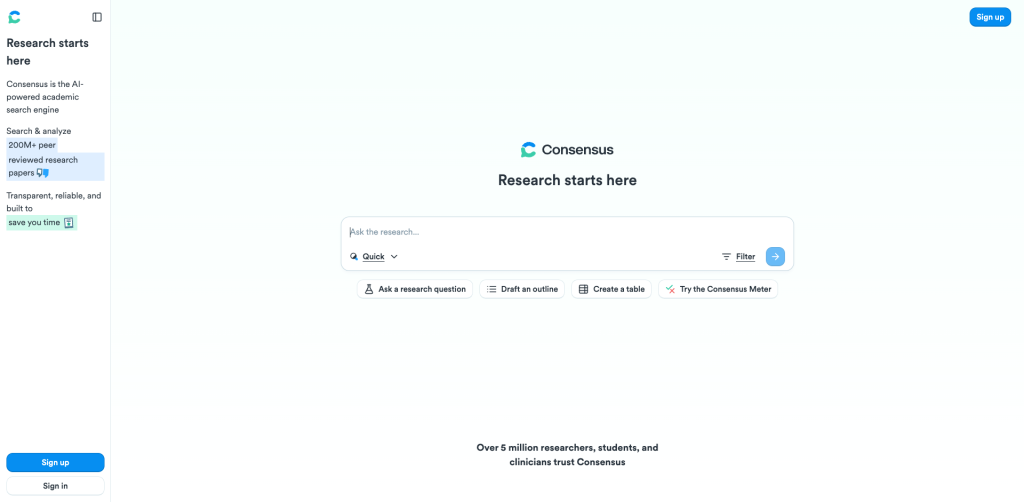
Consensus is an AI-powered academic search engine that helps you find, analyze, and synthesize findings from peer-reviewed research papers. Rather than returning a list of links like Google Scholar or dumping raw abstracts on your screen, Consensus uses large language models (including GPT-4) to read through its database of over 200 million scientific papers and give you clear, evidence-based answers with direct citations.
Think of it this way: if Google Scholar is a library catalog, Consensus is a research assistant who’s already read the papers and can tell you what they found.
Founded in 2021, Consensus has grown rapidly and now partners with over 170 university libraries worldwide. More than 10 million researchers, students, and clinicians use the platform daily. The company has also secured licensed full-text access from leading academic publishers, meaning it can analyze complete papers—not just abstracts—for deeper, more accurate answers.
How Consensus Works
- Ask a research question in plain English (e.g., “Does intermittent fasting improve insulin resistance?”)
- Consensus searches its database of 200M+ peer-reviewed papers using a hybrid of semantic search and keyword matching (BM25)
- AI analyzes the results, extracting key findings, methodology, and conclusions
- You get a synthesized answer with direct citations, study snapshots, and a visual breakdown of the evidence
- Dig deeper by chatting with individual papers, filtering by study design, or launching a comprehensive Deep Search
What makes this different from asking ChatGPT the same question? Every claim Consensus makes is traceable to a specific published paper. There’s no hallucination risk because the AI is constrained to its academic database—it can’t make things up from training data. AI hallucination
Key Features {#key-features}
Consensus Meter (Yes/No Evidence Visualization)
This is probably Consensus’s most iconic feature and one you won’t find anywhere else. When you ask a clear yes-or-no research question—like “Does exercise reduce anxiety?”—the Consensus Meter instantly shows you the breakdown of how the evidence stacks up.
You’ll see a visual bar showing what percentage of studies found Yes, No, or Possibly, giving you an at-a-glance read on where the scientific consensus actually stands. It’s like a poll, except the voters are peer-reviewed studies instead of random people on the internet.
Why it matters: In fields like medicine, nutrition, or psychology, debates rage endlessly online. The Consensus Meter cuts through the noise by showing you what the research actually says—not what influencers or bloggers claim.
Pro Analysis
Pro Analysis is Consensus’s AI-powered closer look at search results. When you run a query, Pro Analysis doesn’t just list papers—it reads across multiple studies and generates a comprehensive synthesis that includes:
- Key findings distilled from the most relevant papers
- Areas of agreement where studies converge
- Conflicting evidence where studies disagree
- Methodological notes on study quality and design
- Direct citations for every claim made
Think of it as getting a mini literature review written for you in under a minute. For graduate students writing thesis chapters or clinicians checking evidence for treatment decisions, this alone can save hours of manual paper-reading.
Deep Search
Introduced in mid-2025, Deep Search is Consensus’s most powerful research feature and represents a major leap beyond basic AI search. When you trigger a Deep Search, Consensus:
- Builds a comprehensive search strategy — expanding key terms, identifying synonyms, and considering related concepts
- Runs multiple parallel searches — casting a wider net across its 200M+ paper database
- Explores the citation graph — following references and citations to find papers you’d otherwise miss
- Identifies conflicting arguments — actively looking for studies that disagree with each other
- Synthesizes everything into a structured research report with sections, key themes, and full citations
Deep Search takes longer than a standard query (typically a few minutes), and you’ll receive an email notification when it’s complete. The results are significantly more comprehensive than a regular search—closer to what a human research assistant would produce after spending several hours on a literature review.
This feature is available on all plans in limited quantities (3/month on Free, 15/month on Pro, 200/month on Deep).
Study Snapshots
Study Snapshots give you a structured summary of any individual paper, breaking down the key components you’d normally have to dig through the full text to find:
- Population studied — Who were the participants?
- Study design — Was it a randomized controlled trial, meta-analysis, cohort study?
- Outcomes measured — What were they looking at?
- Key results — What did they actually find?
- Sample size — How many participants?
This is incredibly useful when you’re scanning through dozens of papers and need to quickly assess which ones are worth reading in full. Instead of opening each PDF and scrolling to the methods section, you get the critical details in one click.
Ask Paper (Chat with PDFs)
Ask Paper lets you interact directly with individual research papers through a conversational interface. You can:
- Ask specific questions about a paper’s methodology
- Request explanations of complex statistical analyses
- Get plain-language summaries of dense results sections
- Extract specific data points or figures
- Compare findings to what other papers have reported
This feature works best on papers where Consensus has full-text access (through its publisher licensing agreements). For papers where only the abstract is available, responses will naturally be more limited.
Smart Filters and Research Quality Indicators
Consensus doesn’t just find papers—it helps you evaluate their quality. Built-in research quality indicators show you:
- Study design type (RCT, meta-analysis, observational, etc.)
- Journal quality metrics
- Citation count and impact
- Recency of publication
- Sample size indicators
You can also apply smart filters directly in your search prompt. Specify timeframes (“studies from the last 5 years”), populations (“in elderly patients”), study designs (“randomized controlled trials only”), and more—Consensus automatically applies the right filters.
Clinical Evidence Mode
For medical professionals and health researchers, Consensus offers a dedicated clinical evidence mode that narrows results to approximately 50,000 clinical guidelines and 8 million articles from the top 1,000 medical journals. This gives clinicians quick, trusted answers from the highest-quality medical sources without having to wade through basic science or tangentially related papers.
MeSH Synonym Support
A more technical but important feature: Consensus now supports MeSH (Medical Subject Headings) synonyms in searches. This means when you search for a medical term, the system automatically expands your query to include standardized medical terminology variants, making your medical research queries significantly sharper and more comprehensive.
Library Integration
If you’re affiliated with a university or research institution, Consensus allows you to connect your library account directly. This means you can access full-text papers through your institution’s subscriptions right within the Consensus interface—no more bouncing between Consensus and your university library portal.
Over 170 university libraries have partnered with Consensus, and connecting is straightforward through your profile settings.
Reference Manager Export
Consensus integrates with the reference management tools researchers already use. You can export paper details directly into formats compatible with:
- Zotero
- Mendeley
- EndNote
- BibTeX
This small but critical feature means Consensus fits into existing academic workflows rather than forcing you to adopt an entirely new system.
Dark Mode
Added in September 2025 (yes, researchers asked for it), dark mode is available through profile settings. A small quality-of-life addition, but anyone doing late-night literature reviews will appreciate it.
Pricing & Plans {#pricing}
Consensus recently restructured its pricing (September 2025) to reflect the addition of Deep Search. Here’s the current breakdown:
Free Plan — $0/month
- Unlimited basic searches across 220M+ papers
- Unlimited research quality indicators
- Unlimited AI-powered filters
- 3 Deep Searches per month
- 15 Pro Analyses per month
- 10 Study Snapshots per month
- 10 Ask Paper messages per month
- Bookmarks and 1 custom list
The free plan is genuinely useful—not a crippled demo. You get unlimited basic searching plus a taste of every premium feature. For students doing occasional research or anyone who wants to test the platform before committing, it’s generous enough to be practical.
Pro Plan — $15/month ($10/month billed annually at $120/year)
- Everything in Free, plus:
- 15 Deep Searches per month
- Unlimited Pro Analyses
- Unlimited Study Snapshots
- Unlimited Ask Paper messages
- Unlimited bookmarks and custom lists
The Pro plan is Consensus’s most popular tier and where the real value kicks in. Unlimited Pro Analyses and Study Snapshots mean you can research without constantly watching a usage counter. The 15 Deep Searches per month is enough for most researchers unless you’re in the middle of a systematic review.
Student discount: Students with a verified educational email (.edu) can get up to 40% off, bringing the annual plan down significantly.
Deep Plan — $65/month ($45/month billed annually at $540/year)
- Everything in Pro, plus:
- 200 Deep Searches per month
- Priority access to new features
The Deep plan is built for power users—think PhD students mid-dissertation, research teams conducting systematic reviews, or clinicians who need comprehensive evidence summaries daily. At $65/month it’s a serious investment, but 200 Deep Searches per month is a massive amount of AI-powered research capacity.
Teams Plan — Custom Pricing
- All Pro features with 50 Deep Searches per user/month
- Discounts for up to 200 seats
- Centralized billing and account management
- Organization-level controls
- Coming soon: Consensus Search API
Enterprise Plan — Custom Pricing
- All Teams features, plus:
- Greater volume discounts
- Manage thousands of users
- Early access to features in development
- Library integrations
- Product training and search optimization sessions
- Development partner program (for organizations with 500+ users)
- Dedicated support
The Enterprise plan is designed for universities and large research organizations. If your institution is considering a campus-wide license, this is worth exploring—especially given the 170+ university partnerships already in place.
Is Consensus Worth Paying For?
For casual research or occasional use, the free tier is solid. But if you’re doing regular academic research—writing papers, conducting reviews, making evidence-based decisions—the Pro plan at $10/month (annual billing) is one of the best values in AI research tools. It’s cheaper than a single textbook and can save you dozens of hours per semester.
The Deep plan makes sense if Deep Search becomes a core part of your workflow. For most users, though, Pro is the sweet spot.
Pros and Cons {#pros-and-cons}
✅ Pros
1. Every Answer is Citation-Backed
This is Consensus’s biggest advantage over general AI tools like ChatGPT. There are zero hallucinations because every claim is grounded in a specific peer-reviewed paper. You can click through to the source and verify anything the AI tells you. In academic work, this is non-negotiable.
2. The Consensus Meter is Genuinely Unique
No other tool visualizes the weight of evidence quite like this. Being able to instantly see that 78% of studies say “yes” to a research question is incredibly powerful for forming evidence-based positions quickly.
3. Deep Search Produces Near-Human Literature Reviews
The Deep Search feature outputs comprehensive research summaries that rival what a human research assistant would produce. For the time savings alone, the Pro plan pays for itself after a single use.
4. Massive Database (200M+ Papers)
Consensus pulls from Semantic Scholar’s database of over 200 million research papers, covering virtually every academic discipline. This isn’t a niche tool—it works for medicine, psychology, economics, environmental science, computer science, and beyond.
5. Clean, Intuitive Interface
Unlike some academic tools that feel like they were designed in 2005, Consensus has a modern, clean interface that’s genuinely pleasant to use. The learning curve is minimal—if you can type a question, you can use Consensus.
6. Strong Free Tier
The free plan isn’t a bait-and-switch. You get real functionality, including limited access to every premium feature. Many students can accomplish a lot without ever upgrading.
7. University Library Integration
Being able to access full-text papers through your institutional subscription directly within Consensus eliminates one of the biggest friction points in academic research.
8. Clinical Evidence Mode
For medical professionals specifically, having a dedicated mode that filters to clinical guidelines and top medical journals is a significant workflow improvement.
❌ Cons
1. Limited to Academic/Scholarly Sources
Consensus only searches peer-reviewed academic papers. If you need information from news sources, industry reports, government databases, patents, or the general web, you’ll need a different tool. This is by design, but it means Consensus can’t be your only research tool.
2. Deep Search Can Be Slow
Deep Search takes several minutes to complete (sometimes longer for complex queries), and you can’t watch it work in real-time. You get an email when it’s done. For researchers who need immediate answers, this waiting period can be frustrating.
3. Coverage Gaps in Non-English Research
While the database is massive, it skews heavily toward English-language publications. If your research requires comprehensive coverage of non-English journals (common in regional studies, some social sciences, or traditional medicine), you may miss important papers.
4. Ask Paper Depends on Full-Text Access
The “chat with paper” feature is only as good as the text it can access. For papers where Consensus only has the abstract (no full-text licensing), the responses are noticeably thinner. This can be hit-or-miss depending on the journal.
5. No Collaborative Annotation or Note-Taking
Unlike tools like Zotero or Mendeley, Consensus doesn’t offer collaborative annotation features. You can bookmark and organize papers into lists, but there’s no way to highlight passages, leave notes, or collaborate with co-authors directly on the platform.
6. Deep Plan Pricing Is Steep
At $65/month ($540/year), the Deep plan is expensive for individual researchers—especially students. If you only need occasional Deep Searches, the Pro plan’s 15/month may feel limiting but the jump to Deep is a big one.
7. No API Access Yet
For teams wanting to integrate Consensus into custom research workflows or build automated pipelines, the lack of a public API is a limitation. It’s listed as “coming soon” on the Teams plan, but it hasn’t materialized yet.
8. Can Miss Niche or Very Recent Papers
Like all tools that depend on indexed databases, there can be a lag between when a paper is published and when it appears in Consensus. Preprints can also be hit-or-miss. For advanced fields where the latest papers matter most, this delay can be significant.
Who Is Consensus For? {#who-is-it-for}
🎓 Graduate Students and PhD Researchers
This is Consensus’s sweet spot. If you’re writing a thesis, conducting a literature review, or trying to situate your research within existing work, Consensus can compress days of manual searching into minutes. The Pro plan is a no-brainer for anyone in a research-intensive graduate program.
Best features for you: Deep Search, Pro Analysis, Study Snapshots, Reference Manager Export
🏥 Medical Professionals and Clinicians
Doctors, nurses, pharmacists, and other clinicians who need quick, evidence-based answers to clinical questions will find Consensus’s clinical evidence mode invaluable. Instead of navigating PubMed or UpToDate, you can ask a natural language question and get a synthesized answer from top medical journals.
Best features for you: Clinical Evidence Mode, Consensus Meter, MeSH Synonym Support
🔬 Academic Researchers and Faculty
For researchers writing grant proposals, peer reviews, or papers, Consensus helps you quickly map the landscape of existing research on a topic. It’s particularly useful for interdisciplinary work where you may not be familiar with all the relevant literature outside your specific sub-field.
Best features for you: Deep Search, Library Integration, Pro Analysis
📊 Policy Analysts and Think Tank Researchers
If your work involves synthesizing research evidence to inform policy decisions, the Consensus Meter and Pro Analysis features provide exactly the kind of “what does the research say?” overview that policy work demands.
Best features for you: Consensus Meter, Pro Analysis, Smart Filters
📝 Science Journalists and Content Writers
Writers who cover science, health, or technology topics can use Consensus to quickly verify claims, find supporting studies, and ensure their reporting is evidence-based. It’s faster and more reliable than Googling for studies.
Best features for you: Consensus Meter, Study Snapshots, Pro Analysis
❌ Who Should Look Elsewhere
- General knowledge seekers — If you just want quick answers to everyday questions, Perplexity AI or ChatGPT will serve you better
- Creative writers — Consensus has no creative writing capabilities
- Business researchers — If you need market reports, financial data, or industry analysis, tools like Perplexity or specialized business intelligence platforms are more appropriate
- Programmers — No code-related features; look at GitHub Copilot or similar tools
Consensus vs Alternatives {#alternatives}
Consensus vs Elicit
| Feature | Consensus | Elicit |
|---|---|---|
| Database | 200M+ papers (Semantic Scholar) | 200M+ papers (Semantic Scholar) |
| Core Strength | Evidence synthesis & Consensus Meter | Research tables & structured extraction |
| Unique Feature | Consensus Meter (yes/no evidence viz) | Research tables for comparing studies |
| Deep Research | Deep Search (multi-step, citation graph) | Systematic review automation |
| Pricing | Free / $15/mo (Pro) / $65/mo (Deep) | Free / $10/mo (Plus) / $24/mo (Pro) |
| Best For | Quick evidence-based answers | Structured data extraction from papers |
Bottom line: Elicit is better for structured, systematic extraction of data from papers (think: building comparison tables). Consensus is better for quickly understanding what the overall evidence says about a question. Many serious researchers use both.
Consensus vs Perplexity AI
| Feature | Consensus | Perplexity AI |
|---|---|---|
| Sources | Peer-reviewed papers only | Entire web + academic |
| Database Size | 200M+ academic papers | Entire internet |
| Hallucination Risk | Very low (citation-grounded) | Low but present (web sources vary) |
| Unique Feature | Consensus Meter | Focus Modes (Academic, Reddit, etc.) |
| Pricing | Free / $15/mo / $65/mo | Free / $20/mo (Pro) |
| Best For | Academic research specifically | General research + quick answers |
Bottom line: These tools serve different purposes. Perplexity is a general-purpose AI search engine that happens to have an Academic mode. Consensus is purpose-built for academic research. If you need peer-reviewed evidence, Consensus is more rigorous. If you need to research anything beyond academia, Perplexity is more versatile.
Consensus vs Google Scholar
| Feature | Consensus | Google Scholar |
|---|---|---|
| AI Synthesis | Yes (Pro Analysis, Deep Search) | No (just search results) |
| Evidence Visualization | Consensus Meter | None |
| Database Size | 200M+ papers | 300M+ papers (estimated) |
| Paper Summaries | Study Snapshots, Ask Paper | Basic snippets only |
| Price | Free tier / Paid plans | Completely free |
| Best For | Understanding what research says | Finding specific papers |
Bottom line: Google Scholar has a larger index and is completely free, but it’s fundamentally a search engine—it finds papers, it doesn’t read them for you. Consensus adds the AI intelligence layer that Google Scholar lacks. Most researchers will use Google Scholar alongside Consensus, not as a replacement.
Consensus vs Semantic Scholar
| Feature | Consensus | Semantic Scholar |
|---|---|---|
| AI Features | Extensive (Pro Analysis, Deep Search, Ask Paper) | TLDR summaries, citation context |
| Evidence Synthesis | Yes (Consensus Meter, Pro Analysis) | Limited |
| Interface | Modern, conversational | Traditional academic search |
| Database | Built on Semantic Scholar’s data | The source database itself |
| Price | Free / Paid plans | Free |
| Best For | AI-powered research synthesis | Citation graph exploration |
Bottom line: Consensus is essentially built on top of Semantic Scholar’s data but adds significant AI-powered analysis on top. If you want raw access to the database with citation graph tools, Semantic Scholar is great (and free). If you want AI to actually analyze and synthesize the research for you, that’s what Consensus adds.
Frequently Asked Questions {#faqs}
Is Consensus AI free to use?
Yes, Consensus offers a genuinely useful free plan. You get unlimited basic searches across 200M+ papers, plus limited access to premium features: 3 Deep Searches, 15 Pro Analyses, 10 Study Snapshots, and 10 Ask Paper messages per month. For light or occasional research, the free plan is practical enough to use without upgrading.
Can Consensus AI hallucinate or give wrong answers?
Consensus is designed to minimize hallucination by grounding every answer in specific peer-reviewed papers. Unlike general AI chatbots that generate responses from training data, Consensus only synthesizes information from its database of indexed studies. That said, the AI’s interpretation and synthesis can occasionally oversimplify nuanced findings, and the quality of answers depends on the quality of the underlying studies. Always click through to the cited papers for critical decisions.
Does Consensus AI have a student discount?
Yes. Students with a verified educational email address (.edu or equivalent) can receive up to 40% off paid subscription plans. This makes the Pro plan significantly more affordable for graduate students and academics on tight budgets.
Can I use Consensus for medical decisions?
Consensus is designed as a research tool, not a clinical decision-support system. While its clinical evidence mode provides access to top medical journals and clinical guidelines, it should be used to inform clinical reasoning—not replace it. Always apply clinical judgment and consult established clinical guidelines and protocols. The platform itself includes disclaimers that it’s not a substitute for professional medical advice.
How does Consensus compare to just using ChatGPT for research?
The critical difference is source reliability. ChatGPT generates responses from its training data and can (and does) hallucinate citations—inventing paper titles, authors, and findings that don’t exist. Consensus only returns information from actual, indexed, peer-reviewed papers with verifiable citations. For any research where accuracy and verifiability matter, Consensus is categorically more trustworthy than ChatGPT.
Does Consensus support non-English papers?
Consensus primarily indexes English-language publications, as its database draws from Semantic Scholar. While some non-English papers with English abstracts may appear in results, comprehensive coverage of non-English literature is limited. Researchers working in fields with significant non-English publication traditions should supplement Consensus with region-specific databases.
Can I export citations from Consensus?
Yes. Consensus supports exporting citations in formats compatible with major reference managers including Zotero, Mendeley, EndNote, and BibTeX. You can export individual paper citations or batch-export from your bookmarks and custom lists.
Is Consensus suitable for systematic reviews?
Consensus can significantly accelerate the early stages of systematic reviews—particularly the scoping and initial literature search phases. Deep Search is especially useful for building comprehensive search strategies. However, systematic reviews require methodological rigor (PRISMA guidelines, reproducible search strategies, explicit inclusion/exclusion criteria) that Consensus alone doesn’t formalize. Use it as a powerful starting tool, but pair it with traditional database searches (PubMed, Scopus, etc.) and dedicated systematic review software for publication-quality reviews.
Final Verdict {#final-verdict}
🏆 Our Verdict
Consensus AI has carved out a distinct and valuable niche in the AI research tool landscape. It’s not trying to be everything to everyone—it’s specifically built for people who need evidence-based answers from peer-reviewed science, and it does that job exceptionally well.
The Consensus Meter alone makes it worth trying. No other tool gives you an instant visual breakdown of where the scientific evidence stands on a yes-or-no question. Pair that with Deep Search’s comprehensive literature review capabilities, Study Snapshots for quick paper evaluation, and Ask Paper for drilling into specific studies, and you have a genuinely powerful research toolkit.
The pricing is fair. The free tier is legitimately useful (not just a teaser), and the Pro plan at $10/month (annual) is accessible for most students and researchers. The Deep plan is expensive but justified if you’re doing heavy, frequent literature reviews.
Where it falls short: If you need anything beyond academic research—news, market data, general web information—you’ll need another tool alongside it. The Deep Search wait times can be frustrating, and the lack of collaborative features means it won’t replace your reference manager.
Who should sign up today?
- Graduate students writing theses or dissertations — the Pro plan will pay for itself in the first week
- Clinicians who need quick evidence summaries — clinical evidence mode is tailor-made for you
- Academic researchers tired of manually sifting through papers — Deep Search changes the game
- Anyone who’s ever argued about “what the research says” — let the Consensus Meter settle it
Our Rating: 4.5/5
Consensus AI isn’t a replacement for Google Scholar, Perplexity, or your university’s library databases. It’s the intelligent layer on top that reads the papers for you and tells you what they found. In a world drowning in published research, that’s not just useful—it’s essential.
This review reflects our honest assessment after extensive testing. Pricing and features are accurate as of February 2026 but may change. We recommend checking the official Consensus pricing page for the latest information.
Frequently Asked Questions
What exactly is Consensus AI and how does it work?
Consensus AI is an AI-powered academic search engine designed to help users find and synthesize information from over 200 million peer-reviewed research papers. Instead of providing a list of links, it uses advanced language models to deliver clear, evidence-based answers with direct citations.
Who can benefit the most from using Consensus AI?
Consensus AI is particularly beneficial for graduate students, academic researchers, medical professionals, and anyone seeking citation-backed answers from peer-reviewed literature. Its focus on scientific accuracy makes it ideal for those needing reliable data for their work.
How does Consensus AI compare to other research tools like Elicit or Semantic Scholar?
While tools like Elicit and Semantic Scholar also serve academic purposes, Consensus AI stands out by providing synthesized answers rather than just lists of papers or abstracts. Its use of advanced AI to analyze complete papers allows for deeper insights and more accurate responses.
What are the pricing options for Consensus AI?
Consensus AI offers a free tier for users, along with paid plans that include a Pro version at $15 per month and a Deep plan at $65 per month. Custom pricing is available for teams and enterprise users, making it accessible for various needs.
Is Consensus AI suitable for casual users or just for academics?
Consensus AI is primarily designed for academic and professional use, making it best for those needing in-depth research and citation-backed answers. Casual users looking for general web searches or creative writing assistance might find it less suitable.
What are the main advantages of using Consensus AI?
One of the main advantages of Consensus AI is its ability to provide clear, evidence-based answers derived from a vast database of peer-reviewed literature. Additionally, it saves time by synthesizing complex information, allowing users to focus on their research without sifting through numerous papers.
Can I access full-text papers through Consensus AI?
Yes, Consensus AI has secured licensed full-text access from leading academic publishers, enabling it to analyze complete papers rather than just abstracts. This feature enhances the depth and accuracy of the answers provided.